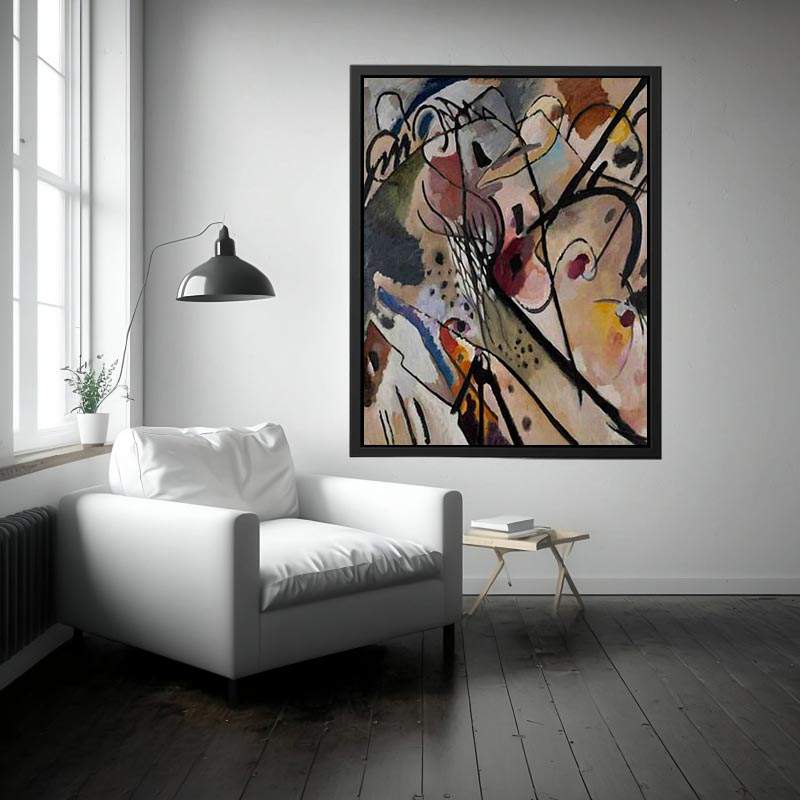
Improvisation 23 Painting by Wassily Kandinsky
Improvisation 23 stands as one of the most revealing and psychologically charged works of Wassily Kandinsky’s early abstract period, a painting in which inner sensation, spiritual urgency, and formal liberation converge with extraordinary intensity. Created in 1911, at a moment when Kandinsky was decisively severing ties with representational art, the work embodies his radical conviction that painting could function as a direct expression of inner life, unmediated by the depiction of the external world. Improvisation 23 is not a visual narrative nor a symbolic code; it is an event—an eruption of colour and form that registers emotion as movement and thought as rhythm.
At this stage in his career, Kandinsky was articulating ideas that would fundamentally alter the course of modern art. His theoretical writings from this period argue that true artistic expression arises from “inner necessity,” a spiritual impulse that precedes form and dictates its emergence. Improvisation 23 belongs to a series of works that Kandinsky explicitly distinguished from his more carefully planned “Compositions.” Whereas those works were constructed through extensive preparatory studies, the Improvisations were conceived as more immediate responses—visual equivalents of spontaneous musical expression. Yet spontaneity here does not mean disorder. The painting’s intensity is governed by a profound intuitive coherence.
The composition unfolds as a dense field of intersecting lines, sweeping curves, and chromatic surges that resist stable orientation. There is no horizon, no anchoring ground, no fixed centre. Instead, the surface is activated across its entirety, compelling the viewer’s eye to move continuously. Kandinsky deliberately destabilises spatial certainty, allowing forms to emerge and dissolve in rapid succession. The result is a sense of perpetual becoming, as though the painting were caught mid-transformation.
Colour operates as the primary vehicle of meaning. Kandinsky employs a highly charged palette of blues, reds, yellows, greens, and whites, layered and juxtaposed to generate vibration and tension. These colours do not describe objects or environments; they act directly upon perception. Blue introduces depth and spiritual gravity, red asserts urgency and vitality, yellow flashes with sharp, almost piercing energy, while white punctuates the composition with moments of release. The interaction of these colours produces an emotional resonance that feels both urgent and expansive.
Line functions as energy rather than contour. Kandinsky’s lines do not enclose forms in a conventional sense; they propel movement, redirect force, and fracture space. Diagonals cut aggressively across the surface, while curves sweep and recoil, creating rhythms that echo musical phrasing. This linear dynamism reinforces the painting’s improvisational character. The viewer does not observe a static arrangement; they experience a sequence of visual impulses unfolding over time.
The spatial organisation of Improvisation 23 is deliberately ambiguous. Kandinsky abandons traditional perspective, constructing depth through overlapping forms and chromatic recession. Certain elements appear to surge forward, while others recede into visual density, only to reassert themselves elsewhere. This instability is essential to the painting’s expressive power. Kandinsky understood that spiritual experience is rarely orderly or symmetrical. By denying spatial resolution, he places the viewer within a state of heightened awareness.
Brushwork is visibly energetic, contributing to the painting’s immediacy. Kandinsky allows strokes to remain present, reinforcing the sense that the image is the product of lived action rather than calculated design. Yet this physicality never collapses into chaos. The surface bears evidence of control within release, of intention guiding impulse. This balance between discipline and freedom is central to Kandinsky’s conception of abstraction.
Although Improvisation 23 is fully abstract, it is not devoid of associative suggestion. Kandinsky often acknowledged that traces of the visible world could surface unconsciously within his early abstractions—echoes of landscape, conflict, or spiritual ascent. In this painting, such associations remain fluid and unresolved. Forms may suggest motion, encounter, or transformation, but they refuse to stabilise into recognisable imagery. Meaning remains experiential rather than descriptive.
Emotionally, the painting is intense and demanding. It does not invite passive viewing or decorative appreciation. Instead, it confronts the viewer with a field of sensations that must be navigated rather than interpreted. There is urgency here, but not panic; movement, but not collapse. Kandinsky creates a condition of heightened alertness, mirroring his belief that art should awaken the inner life rather than soothe it.
Within Kandinsky’s artistic development, Improvisation 23 occupies a crucial position. It belongs to the period immediately preceding his most monumental early abstractions, including Composition VII. In this sense, it represents a moment of radical openness, when intuition led form and structure followed. The painting demonstrates Kandinsky’s growing confidence that abstraction could carry emotional and spiritual meaning without recourse to representation.
The cultural significance of Improvisation 23 lies in its role in establishing abstraction as a legitimate and powerful artistic language. At a time when many artists still relied on recognisable motifs, Kandinsky asserted that pure form and colour could speak directly to the human spirit. This assertion continues to resonate across the United States, the United Kingdom, Canada, Australia, and Europe, where contemporary audiences recognise the painting’s historical daring and enduring vitality.
In interior spaces, Improvisation 23 introduces dynamic energy and intellectual depth. In living rooms, it functions as a catalyst for engagement, drawing the eye and stimulating conversation. In studies and offices, it reinforces creativity, intuition, and openness to complex thought. In galleries and luxury residences, it signals a serious and informed relationship with the origins of abstract art.
The painting integrates powerfully into modern, minimalist, and eclectic décor, where its intensity can be balanced by architectural clarity. In traditional interiors, it serves as a striking counterpoint, introducing movement and contemporary relevance. Its richness of colour and form ensures that it commands presence without relying on narrative or imagery.
The enduring relevance of Improvisation 23 lies in its refusal to separate emotion from intellect. Kandinsky demonstrates that spontaneity can be rigorous, and that intuition, when trusted, can yield profound structure. The painting remains meaningful because it addresses a fundamental human experience: the attempt to give form to inner life in moments of transition and urgency.
To live with Improvisation 23 is to engage daily with one of Kandinsky’s most uncompromising and revelatory works. Through its explosive colour, dynamic line, and spiritual intensity, the painting continues to affirm abstraction as a language of depth rather than absence. It stands as a testament to Kandinsky’s belief that art, at its most powerful, does not depict the world—it transforms perception itself.
Buy museum qulaity 400- 450 canvas prints, framed prints, and 100% oil paintings of Improvisation 23 by Wassily Kandinsky at Alpha Art Gallery, where world-famous masterpieces are recreated with museum-quality detail, refined craftsmanship, and premium materials.
FAQS
What defines Improvisation 23 within Kandinsky’s work?
It exemplifies Kandinsky’s belief in spontaneous, intuition-led abstraction guided by inner necessity rather than representation.
Is Improvisation 23 completely abstract?
Yes. While it may evoke associations, it does not depict recognisable objects or scenes.
Why did Kandinsky refer to works like this as “Improvisations”?
He compared them to musical improvisation, emphasising immediacy, intuition, and emotional response.
How does colour function in Improvisation 23?
Colour operates directly on perception, creating emotional and spatial tension without symbolic narration.
Is Improvisation 23 suitable for contemporary interiors?
Yes. Its dynamic energy and expressive force integrate especially well into modern and design-led spaces.
What emotional response does the painting evoke?
It often evokes intensity, movement, and heightened awareness rather than calm or decorative pleasure.
Does this artwork have lasting cultural significance?
As an early milestone in abstract art, it holds enduring historical and philosophical importance.
Where is the best place to display Improvisation 23?
It is most effective in living rooms, studies, offices, and gallery settings where visual energy and engagement are valued.