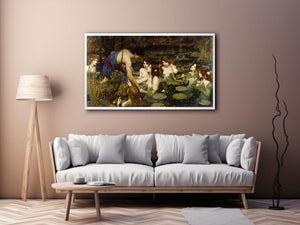
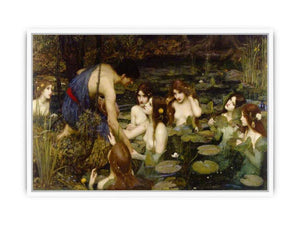
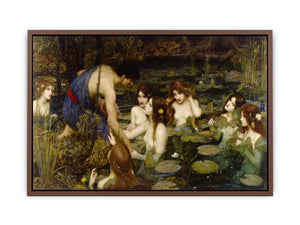
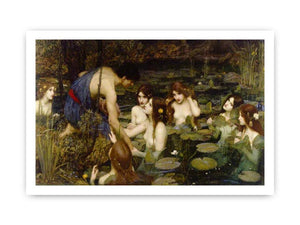
Hylas and the Nymphs 1896 Painting by John William Waterhouse
Hylas and the Nymphs 1896 Painting by John William Waterhouse is one of the most seductive and psychologically complex images of late nineteenth-century British painting, a work in which classical myth becomes a vehicle for exploring desire, danger, and the fatal allure of beauty. Painted in 1896, the canvas captures the precise instant before disappearance—when fascination tips into surrender and the boundary between the human and the supernatural dissolves. Waterhouse transforms an ancient myth into a timeless meditation on vulnerability, temptation, and the irreversible consequences of yielding to enchantment.
By the mid-1890s, John William Waterhouse had reached full artistic maturity. Though often associated with the Pre-Raphaelite tradition, Waterhouse had by this point forged a distinctly personal language, one that fused classical subject matter with Symbolist psychology and a modern sensitivity to mood. His mythological paintings from this period are less concerned with narrative completeness than with emotional concentration. Hylas and the Nymphs exemplifies this approach, distilling a dramatic legend into a moment of charged stillness.
The subject derives from Greek mythology. Hylas was a beautiful youth and companion of Heracles, sent to fetch water during the Argonauts’ journey. Drawn by voices from a woodland pool, he encountered water nymphs—naiads—who, captivated by his beauty, pulled him beneath the surface, never to return. Waterhouse chooses not to depict the struggle or aftermath. Instead, he fixes upon the threshold moment, when invitation and peril are indistinguishable, and the outcome is already sealed.
Compositionally, the painting is intimate and deliberately compressed. Hylas kneels at the water’s edge, his body angled forward, caught between stability and immersion. The nymphs cluster within the pool, their pale forms emerging from dark water and dense foliage. Their circular arrangement creates a visual trap, enclosing Hylas within a ring of gazes and gestures. The composition draws the viewer inward, mirroring Hylas’s own movement toward the water, and creating a sense of inevitable enclosure.
Perspective intensifies this effect. The viewer is positioned close to the scene, almost at eye level with the nymphs. There is no distant overview, no contextual escape. The forest presses in, the water fills the lower plane, and space feels shallow and intimate. This proximity heightens the psychological tension. The viewer, like Hylas, is drawn into the nymphs’ domain, compelled to linger despite the clear sense of danger.
Light plays a crucial role in shaping the painting’s atmosphere. Waterhouse employs a soft, filtered illumination that seems to emanate from the nymphs themselves. Their pale skin catches the light against the darker greens and browns of the forest, making them appear luminous, almost otherworldly. Light here is not naturalistic alone; it is seductive. It guides the eye, isolates the figures, and reinforces the supernatural pull exerted upon Hylas.
The color palette is restrained yet highly expressive. Cool greens and deep shadows dominate the surrounding landscape, evoking damp earth and shaded woodland. Against this, the nymphs’ flesh tones appear strikingly bright, creating a stark contrast between human warmth and the cold depths of the water. Hylas’s darker clothing anchors him briefly to the human world, even as his exposed skin echoes the nymphs’ pallor, visually foreshadowing his fate. Color thus becomes narrative, marking transition and vulnerability.
Waterhouse’s technique is refined and fluid. Brushwork is smooth, particularly in the rendering of skin and water, allowing surfaces to appear soft and inviting. The water’s surface is painted with subtle reflections and gentle ripples, suggesting depth without turbulence. Vegetation is rendered with controlled detail, framing the figures without distracting from them. This technical restraint ensures that sensuality never becomes excess; it remains poised, deliberate, and psychologically charged.
The nymphs themselves are depicted with an unsettling calm. Their expressions are serene, their gestures gentle rather than violent. They do not seize Hylas; they invite him. This restraint is central to the painting’s meaning. Waterhouse portrays danger not as overt threat, but as irresistible attraction. The absence of struggle heightens the sense of inevitability. The tragedy lies in consent rather than force.
Symbolically, Hylas and the Nymphs operates on multiple levels. On the mythological plane, it recounts a cautionary tale of mortal vulnerability to divine allure. Psychologically, it explores the moment when desire overrides self-preservation. Culturally, it reflects late Victorian anxieties about sensuality, femininity, and the loss of control. The nymphs can be read as embodiments of nature’s seductive power, or as projections of unconscious longing. Waterhouse does not resolve these readings; he allows them to coexist.
Within Waterhouse’s broader oeuvre, this painting stands among his most iconic works. It crystallizes his fascination with mythic women who embody both beauty and danger, and with male figures caught at moments of irreversible choice. Unlike some earlier narrative-driven works, Hylas and the Nymphs achieves its impact through concentration rather than complexity. It is a painting about the instant when story collapses into fate.
The cultural significance of the painting extends beyond its mythological source. It has become emblematic of Symbolist exploration of desire and loss, influencing later interpretations of myth as psychological allegory rather than heroic tale. Its enduring power lies in its ambiguity: the nymphs are neither wholly benevolent nor overtly malicious, and Hylas is neither innocent child nor reckless fool. The painting resists moral simplification.
In contemporary interiors across the United States, the United Kingdom, Canada, Australia, and Europe, Hylas and the Nymphs carries a distinctive and sophisticated presence. In living rooms, it introduces sensual depth and narrative intrigue. In studies and offices, it invites reflection on choice, temptation, and consequence. In galleries and luxury residences, it anchors interiors with mythic intensity, integrating seamlessly with traditional, modern, minimalist, and eclectic décor through its balanced composition and rich tonality.
The painting remains meaningful today because it addresses a universal human experience: the pull of what is beautiful, dangerous, and unknown. In a world still shaped by invisible attractions and irreversible decisions, Waterhouse’s vision feels uncannily contemporary. Hylas and the Nymphs does not warn loudly. It entices—and in doing so, it reveals the quiet power of surrender.
Hylas and the Nymphs 1896 Painting by John William Waterhouse endures as one of the most psychologically compelling mythological images of its era. Through restrained composition, luminous color, and profound emotional intelligence, Waterhouse transformed an ancient legend into a timeless meditation on desire and loss. The painting does not depict violence. It captures the moment before it—and that is where its enduring power lies.
Buy museum qulaity 400- 450 canvas prints, framed prints, and 100% oil paintings of Hylas and the Nymphs by John William Waterhouse at Alpha Art Gallery, where world-famous masterpieces are recreated with museum-quality detail, refined craftsmanship, and premium materials.
FAQs
What myth does Hylas and the Nymphs depict?
It depicts the Greek myth of Hylas, a youth lured into a pool by water nymphs and lost forever.
Why is the moment before disappearance shown instead of the struggle?
Waterhouse focused on psychological inevitability rather than physical conflict, heightening emotional tension.
What do the nymphs symbolize in the painting?
They symbolize seductive natural forces, desire, and the unconscious pull of beauty and danger.
Why is Hylas shown kneeling at the water’s edge?
His posture conveys vulnerability and transition, caught between safety and surrender.
How does light contribute to the painting’s meaning?
Light isolates the nymphs as alluring and otherworldly, intensifying their seductive power.
Is this painting connected to Symbolism?
Yes, it reflects Symbolist themes of desire, ambiguity, and inner psychological states.
Why does the painting remain relevant today?
Its exploration of temptation and irreversible choice resonates across cultures and eras.
Where does this artwork work best in interiors?
It is well suited to living rooms, studies, offices, galleries, and refined private collections.