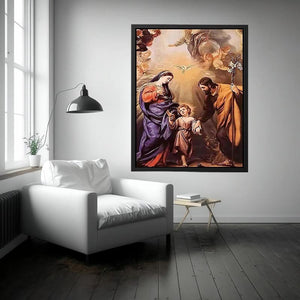
Holy Family Painting by Claudio Coello
Holy Family Painting by Claudio Coello is a work of profound devotional intelligence and compositional dignity, reflecting the maturity of Spanish Baroque painting at its most refined and contemplative. Created by an artist who stood at the culmination of Spain’s Golden Age tradition, the painting presents the sacred not through excess or spectacle, but through balance, intimacy, and theological clarity. Coello approaches the Holy Family as a living spiritual unit—human in presence, divine in implication—inviting the viewer into a space where faith is experienced through quiet attention rather than dramatic revelation.
Claudio Coello was among the last great masters of the Spanish Baroque, working in a lineage shaped by Velázquez, Zurbarán, and Murillo. As court painter to Charles II, Coello combined academic rigor with deep devotional sensitivity. His religious works are distinguished by psychological restraint, luminous color, and compositional order, qualities that find a particularly eloquent expression in Holy Family Painting. Here, Coello synthesizes Baroque naturalism with Counter-Reformation clarity, producing an image intended not to overwhelm, but to instruct and sustain contemplation.
The subject of the Holy Family—Mary, Joseph, and the Christ Child—occupied a central place in post-Tridentine spirituality. It functioned as both theological model and moral exemplar, emphasizing obedience, humility, and domestic sanctity. Coello’s interpretation aligns with this devotional purpose. Rather than presenting the family as distant icons, he renders them with tangible presence, grounding sacred meaning in human relationship. The result is a painting that feels lived rather than staged, intimate rather than ceremonial.
Compositionally, the work is organized with calm authority. The figures are arranged in a stable, pyramidal structure that reinforces unity and balance. The Christ Child occupies a natural focal point, not through scale or gesture, but through relational gravity. Mary’s posture communicates protection and attentiveness, while Joseph’s presence conveys guardianship and quiet resolve. Coello avoids theatrical diagonals or dramatic foreshortening, choosing instead a compositional clarity that mirrors the spiritual order being represented.
Perspective is carefully controlled, placing the viewer at a respectful proximity. The scene does not intrude, nor does it withdraw. This measured distance reinforces the painting’s contemplative function, allowing the viewer to observe without disruption. Spatial relationships are coherent and legible, ensuring that attention remains focused on the figures rather than absorbed by architectural or environmental complexity.
Light plays a crucial role in shaping the painting’s devotional tone. Illumination is soft and directional, revealing faces and hands with tenderness rather than intensity. There is no overt divine radiance separating the holy from the human. Instead, light unifies the figures, suggesting sanctity through harmony and presence. This approach reflects Coello’s theological restraint, presenting divinity as immanent within the ordinary bonds of family.
Colour is employed with disciplined richness. Coello’s palette favors warm earth tones, gentle reds, and subdued blues, creating a chromatic environment that feels both dignified and accessible. Mary’s garments are rendered with luminous calm, signaling purity without ostentation. Joseph’s tones are quieter, reinforcing his role as support rather than center. Flesh tones are natural and unidealized, grounding the scene in physical reality while maintaining reverence.
Coello’s handling of texture demonstrates technical mastery tempered by humility. Fabrics are described with sensitivity to weight and drape, yet never distract from the figures’ expressions and relationships. Skin is rendered with softness and precision, conveying life without idealization. The surface of the painting retains a sense of cohesion, ensuring that technique serves meaning rather than display.
Emotionally, Holy Family Painting is defined by composure and mutual attentiveness. There is no overt drama, no gesture of prophecy or forewarning. Instead, the painting dwells in a moment of quiet presence. Mary’s gaze suggests care and contemplation; Joseph’s expression conveys responsibility borne without complaint; the Christ Child embodies vulnerability rather than authority. This emotional equilibrium reinforces the painting’s moral message: sanctity is found in care, patience, and shared life.
Symbolically, the painting communicates Counter-Reformation ideals with clarity. The Holy Family is presented as a model for Christian life, emphasizing obedience, humility, and unity. Coello avoids overt allegorical attributes, allowing symbolism to emerge through posture, proximity, and relational focus. Meaning is embedded within human interaction rather than imposed through iconographic excess.
Within Claudio Coello’s artistic career, Holy Family Painting represents the culmination of his devotional approach. While he was capable of grand ecclesiastical compositions, this work demonstrates his ability to achieve depth through restraint. It reflects a mature confidence in painting’s capacity to communicate theology through harmony rather than intensity.
Culturally, the painting belongs to a moment when Spanish religious art sought to reaffirm faith through intelligibility and emotional accessibility. Coello’s work responds to this aim with seriousness and refinement, offering an image that could function equally within a church, a private oratory, or a cultivated domestic interior. Its enduring appeal lies in this adaptability, rooted in clarity rather than ornament.
In contemporary interiors across the United States, the United Kingdom, Canada, Australia, and Europe, Holy Family Painting integrates with profound elegance. In living rooms, it introduces calm authority and moral depth. In studies and libraries, it supports reflection and continuity. In galleries and luxury residences, it communicates appreciation for Spanish Baroque art at its most intellectually and spiritually resolved.
The painting aligns naturally with traditional interiors, where its classical composition and sacred subject resonate with established aesthetics. At the same time, it functions powerfully in modern and minimalist spaces, where its restraint and compositional clarity provide spiritual counterbalance to visual austerity. In eclectic settings, it acts as a stabilizing presence, grounding diverse elements through shared stillness.
The long-term artistic importance of Holy Family Painting lies in its affirmation of quiet devotion. Coello demonstrates that sacred art need not rely on spectacle to endure. Through balance, light, and relational intimacy, he offers an image of faith rooted in lived experience and moral continuity.
Today, Holy Family Painting remains deeply meaningful because it speaks to universal values—care, responsibility, and unity—without rhetorical excess. Through disciplined composition, emotional restraint, and theological intelligence, Claudio Coello created a work that continues to sustain contemplation across cultures and centuries, securing its place among the most refined devotional paintings of the Spanish Baroque.
Buy museum qulaity 400- 450 canvas prints, framed prints, and 100% oil paintings of Holy Family by Claudio Coello at Alpha Art Gallery, where world-famous masterpieces are recreated with museum-quality detail, refined craftsmanship, and premium materials.
FAQS
What is the central theme of Holy Family by Claudio Coello?
The painting emphasizes unity, care, and quiet devotion within the sacred family as a model for Christian life.
How does Coello’s Baroque style differ from more dramatic interpretations?
He favors restraint, balance, and clarity over theatrical movement or intense emotional display.
Is the painting aligned with Counter-Reformation ideals?
Yes, it reflects Counter-Reformation values of intelligibility, moral instruction, and devotional focus.
What role does light play in the painting?
Light is soft and unifying, revealing sanctity through harmony rather than supernatural spectacle.
Where does this artwork work best in interior spaces?
It is well suited to living rooms, studies, libraries, galleries, and refined residential interiors.
Is Holy Family compatible with modern décor?
Yes, its compositional clarity and calm palette integrate seamlessly into modern, traditional, and minimalist settings.
Does the painting have lasting spiritual and artistic value?
Its theological clarity, emotional restraint, and Baroque mastery ensure enduring relevance.