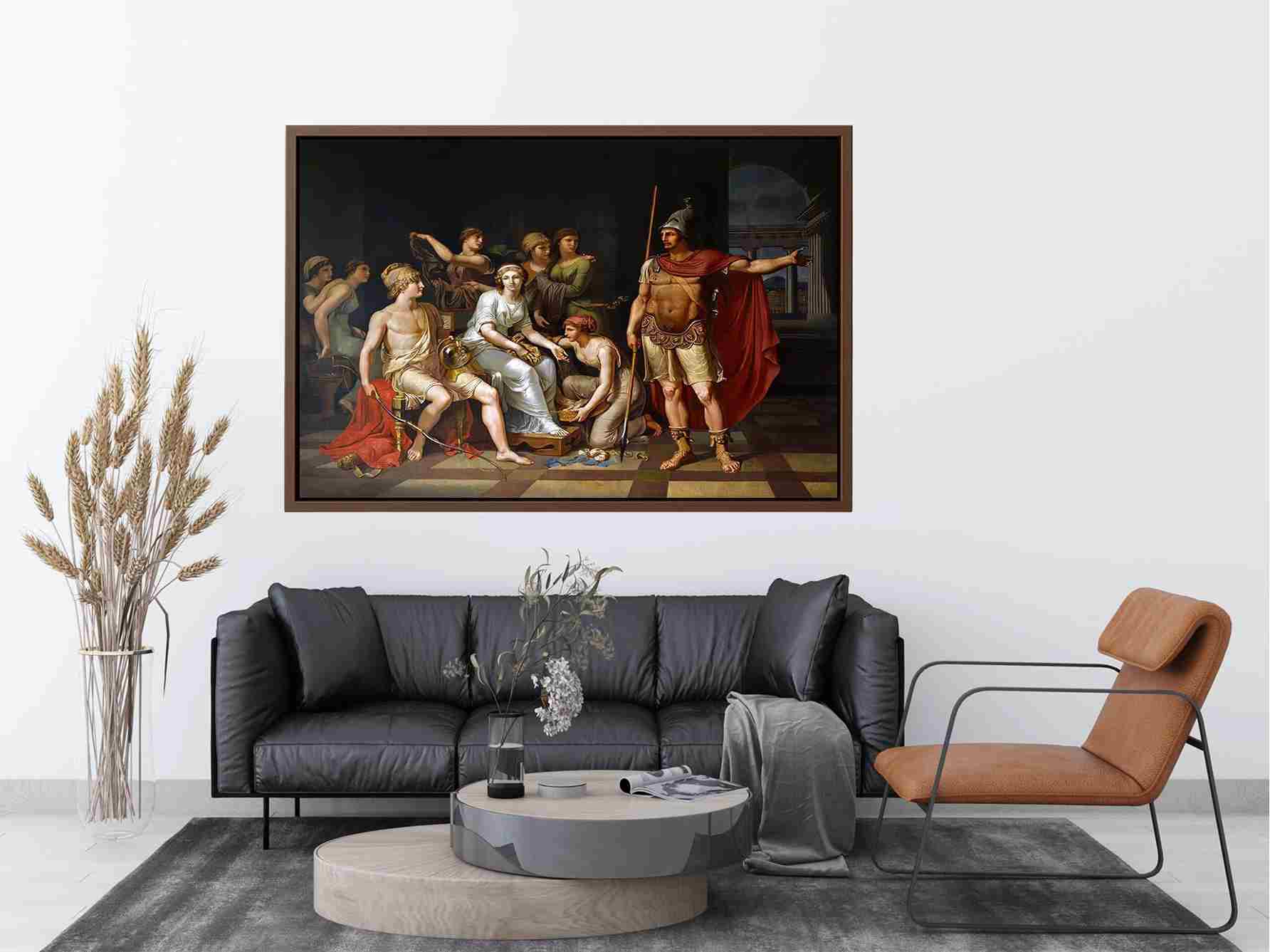
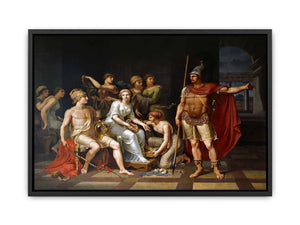
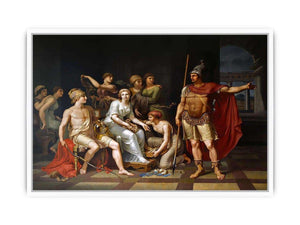
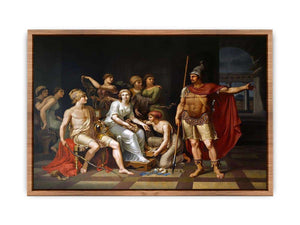
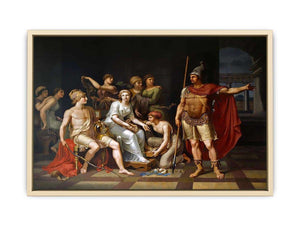
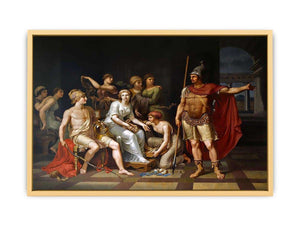
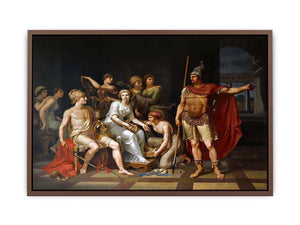
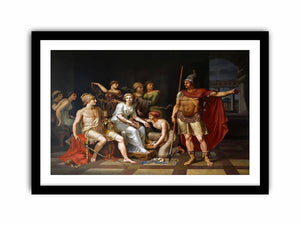
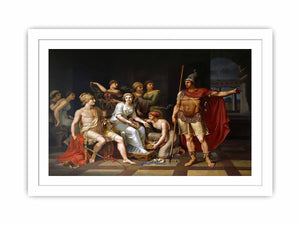
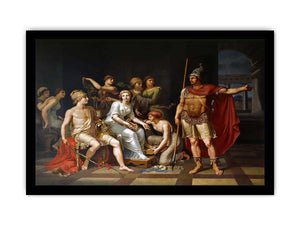
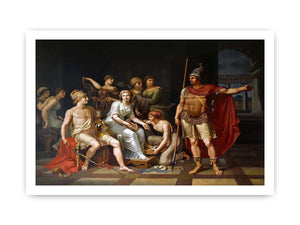
Hector Admonishes Paris and Exhorts Him to Go to War Painting by Tischbein
Painted within the intellectual climate of eighteenth-century Neoclassicism, Hector Admonishes Paris and Exhorts Him to Go to War by Tischbein stands as a morally charged interpretation of Homeric epic, transformed into a disciplined meditation on duty, honour, and moral responsibility. Drawing from a pivotal episode in The Iliad, the painting captures not the chaos of battle, but the ethical confrontation that precedes it—an encounter in which private desire is measured against public obligation. In this moment of counsel and reproach, Tischbein locates the true drama of heroism not in physical combat, but in the demand for moral choice.
The historical and literary background of the painting is rooted in Homer’s portrayal of Troy at its most vulnerable. Paris, whose actions precipitated the Trojan War, embodies indulgence, beauty, and personal desire, while Hector represents civic virtue, restraint, and sacrifice. Tischbein’s decision to focus on this exchange reflects the Enlightenment-era conviction that classical history offered moral instruction for contemporary society. Rather than glorifying violence, the painting interrogates responsibility—who must fight, who must lead, and who must bear the consequences of personal failings.
Within Tischbein’s artistic career, the work exemplifies his commitment to classical clarity and ethical seriousness. Trained in the academic tradition and deeply influenced by antiquity, Tischbein approached mythological subjects as vehicles for moral reasoning. His figures are not theatrical caricatures but psychologically legible individuals, each embodying distinct ethical positions. The painting thus becomes a visual argument, aligning artistic composition with philosophical intent.
The work belongs firmly within the Neoclassical movement, characterised by restraint, order, and intellectual purpose. Unlike Baroque interpretations of classical myth that favoured dramatic excess, Tischbein employs compositional discipline to reinforce moral clarity. Gesture, posture, and spatial arrangement are calibrated to express hierarchy and ethical contrast. Hector’s authoritative stance and controlled intensity contrast sharply with Paris’s hesitance, reinforcing the moral imbalance at the heart of the scene.
Compositionally, the painting is structured to guide the viewer’s judgment without overt instruction. Hector occupies a commanding position, his body language firm yet measured, embodying responsibility rather than aggression. Paris, by contrast, is depicted in a posture of reluctance or distraction, visually reinforcing his detachment from the collective crisis. The spatial relationship between the two figures creates tension, placing moral authority and moral failure in direct dialogue. The surrounding elements are subdued, ensuring that nothing detracts from the ethical exchange at the painting’s core.
Perspective and spatial design contribute to the painting’s philosophical gravity. The figures are presented with clarity and balance, avoiding dramatic foreshortening or emotional distortion. This measured perspective aligns with Enlightenment ideals of reason and proportion, encouraging contemplation rather than visceral reaction. The viewer is positioned as a witness to moral instruction, invited to assess the arguments embodied by each figure.
Colour and light are employed with refined moderation. Tischbein favours a controlled palette that reinforces dignity and seriousness rather than spectacle. Light is distributed to articulate form and gesture, clarifying the figures’ physical and moral presence. There is no divine illumination or dramatic chiaroscuro; instead, illumination serves reason, revealing rather than persuading. Texture is rendered with academic precision, reinforcing the solidity and permanence of the ethical values under discussion.
Symbolically, Hector Admonishes Paris and Exhorts Him to Go to War operates as an allegory of civic duty. Hector represents the ideal citizen-warrior, willing to subordinate personal happiness to the survival of his community. Paris embodies the consequences of moral evasion, his beauty and refinement rendered hollow in the face of responsibility. The painting thus extends beyond Homeric narrative to address universal questions of leadership, accountability, and the cost of indulgence.
Emotionally, the work is restrained yet forceful. There is no overt anger or sentimentality. Hector’s admonition is firm but controlled, suggesting moral authority grounded in reason rather than passion. Paris’s response is marked by hesitation rather than defiance, reinforcing the painting’s emphasis on ethical failure as weakness rather than villainy. This emotional restraint enhances the painting’s intellectual impact, allowing viewers to engage thoughtfully with its themes.
Culturally, the painting reflects the Enlightenment belief that art should instruct as well as please. By revisiting classical myth through a moral lens, Tischbein affirms the enduring relevance of antiquity as a guide for ethical reflection. The work stands as an example of how historical painting can function as moral philosophy rendered visible, bridging ancient narrative and modern conscience.
The relevance of this painting today remains striking. In a contemporary world still negotiating the balance between private desire and public responsibility, Hector Admonishes Paris and Exhorts Him to Go to War speaks with clarity and urgency. It reminds viewers that leadership demands sacrifice, and that the consequences of inaction often fall upon others. The painting’s refusal to dramatise violence allows its ethical message to remain timeless and applicable across contexts.
Within modern interiors across the United States, United Kingdom, Canada, Australia, and Europe, the artwork integrates with intellectual authority. In living rooms, it establishes a focal point of cultural seriousness and classical refinement. In studies and offices, it reinforces values of responsibility, leadership, and ethical reflection. Galleries and luxury residences benefit from its historical gravitas and philosophical depth, as the painting rewards sustained contemplation.
Across decorative styles, the work adapts with distinction. Traditional interiors are enriched by its classical lineage and formal balance. Modern and minimalist spaces benefit from its compositional clarity and disciplined palette, which provide visual strength without excess. Eclectic interiors find coherence in its timeless narrative and moral focus. The painting does not merely occupy space; it shapes intellectual atmosphere.
Ultimately, Hector Admonishes Paris and Exhorts Him to Go to War by Tischbein stands as a profound exploration of moral responsibility within classical myth. Through compositional discipline, psychological insight, and ethical seriousness, Tischbein transforms a Homeric episode into a universal meditation on duty and choice. The painting endures because it confronts viewers with a question that transcends time: when called upon, will one act for oneself, or for the greater good?
Buy museum qulaity 400- 450 canvas prints, framed prints, and 100% oil paintings of Hector Admonishes Paris and Exhorts Him to Go to War by Tischbein at Alpha Art Gallery, where world-famous masterpieces are recreated with museum-quality detail, refined craftsmanship, and premium materials.
FAQS
What moment from The Iliad does this painting depict?
It depicts Hector confronting Paris, urging him to abandon indulgence and fulfil his duty to Troy.
What is the central theme of the painting?
The work explores moral responsibility, civic duty, and the ethical tension between personal desire and collective obligation.
Why is Hector portrayed as calm rather than aggressive?
His restraint reinforces moral authority grounded in reason and leadership rather than anger.
How does this painting reflect Neoclassical ideals?
It emphasises clarity, balance, moral instruction, and intellectual seriousness over emotional excess.
Is this artwork relevant to modern audiences?
Yes. Its themes of leadership, accountability, and ethical choice remain universally applicable.
Does the painting suit contemporary interiors?
Its disciplined composition and classical subject integrate well into both traditional and modern spaces.
Why is Paris shown as hesitant rather than villainous?
The painting frames moral failure as weakness and avoidance, not inherent evil.
Where is the best place to display this artwork?
It is especially effective in studies, offices, living rooms, galleries, and luxury residences that value cultural depth and reflection.