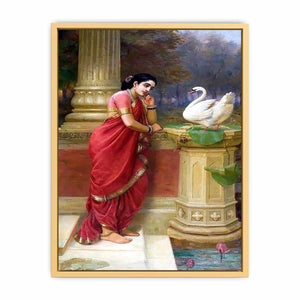
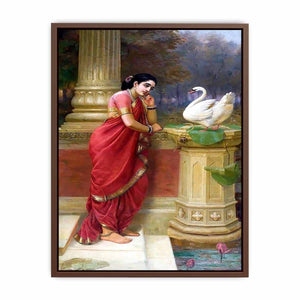
Hamsa Damayanthi Painting by Raja Ravi Varma
Hamsa Damayanthi Painting by Raja Ravi Varma stands as one of the most refined and emotionally resonant works in the canon of Indian art, embodying a rare synthesis of classical Indian literature, European academic realism, and psychological subtlety. Painted in the late nineteenth century, this masterpiece reflects a transformative moment in South Asian visual culture, when traditional narratives were reinterpreted through modern painterly techniques without losing their philosophical and poetic depth. The painting does not merely illustrate a mythological episode; it gives visual form to longing, anticipation, and restrained emotion, rendered with extraordinary grace.
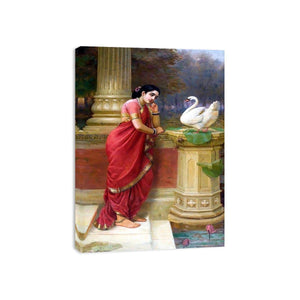
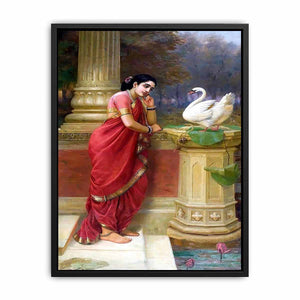
Raja Ravi Varma emerged during a period of profound cultural transition in India. Colonial presence, Western education, and new artistic technologies were reshaping how Indian identity could be expressed. Trained in European oil painting techniques yet deeply rooted in Indian epics and aesthetics, Varma forged a visual language that bridged two worlds. Hamsa Damayanthi exemplifies this synthesis. Drawing from the Mahabharata, the painting depicts Princess Damayanthi at the moment she receives news of King Nala’s love through a divine swan, or hamsa, a messenger associated with purity, wisdom, and spiritual insight.
The narrative moment Varma selects is one of quiet emotional intensity rather than dramatic action. Damayanthi is shown alone, absorbed in thought, her posture poised yet inwardly charged. The swan at her feet, delicately rendered, becomes both a narrative device and a symbolic presence. By choosing this intimate moment, Varma shifts the focus away from heroic spectacle and toward interior experience. The painting thus becomes a study of psychological awakening, capturing the instant when love moves from abstraction into consciousness.
Compositionally, the painting is balanced and harmonious, reflecting Varma’s deep understanding of classical proportion. Damayanthi’s figure is centrally placed yet integrated seamlessly into her surroundings. The gentle curve of her body, the incline of her head, and the placement of her hands create a visual rhythm that guides the viewer’s eye across the canvas. The swan anchors the lower portion of the composition, establishing a subtle dialogue between human and divine, earthly emotion and celestial intention.
Varma’s treatment of space is restrained and elegant. The background is neither densely detailed nor entirely abstract. Instead, it provides a serene setting that enhances the figure without competing for attention. Architectural and natural elements are suggested with enough clarity to situate the scene, yet softened to maintain focus on Damayanthi’s emotional state. This measured approach to spatial depth reflects Varma’s academic training while preserving the lyrical quality of the narrative.
Colour plays a vital role in articulating mood and symbolism. Varma employs a refined palette of warm earth tones, soft whites, and muted golds, punctuated by the subtle luminosity of Damayanthi’s attire. Her garments, rendered with meticulous attention to texture and drape, signal royal elegance without ostentation. The colours do not overwhelm; they whisper. This restraint allows emotional nuance to emerge gradually, reinforcing the painting’s contemplative character.
Light in Hamsa Damayanthi is gentle and diffused, bathing the figure in a glow that suggests inner illumination rather than theatrical spotlighting. Varma avoids harsh contrast, opting instead for smooth tonal transitions that lend the painting a timeless quality. Light becomes a vehicle for psychological clarity, illuminating Damayanthi’s face and form while leaving peripheral elements in soft recession. The effect is one of intimacy and stillness, as though the moment exists outside the flow of time.
The psychological sophistication of the painting is among its most enduring qualities. Damayanthi is neither idealized into an unreachable archetype nor reduced to decorative beauty. Varma presents her as a thinking, feeling individual, caught in a moment of introspection. Her expression conveys curiosity, restraint, and dawning awareness, allowing viewers to project their own emotional experiences onto the scene. This humanization of mythological figures was one of Varma’s greatest contributions to Indian art, making ancient narratives accessible to modern sensibilities.
Symbolism operates quietly yet effectively throughout the composition. The swan, long associated in Indian philosophy with discernment and purity, represents the transmission of truth and the awakening of love guided by destiny. Damayanthi’s composed posture suggests moral and emotional integrity, reinforcing her role as an ideal yet relatable figure. Unlike overt allegory, Varma’s symbolism remains integrated into the narrative, enriching rather than dominating the visual experience.
Within Raja Ravi Varma’s artistic evolution, Hamsa Damayanthi occupies a central position. It demonstrates his mastery of oil painting, anatomical accuracy, and European realism, while simultaneously affirming his commitment to Indian themes and values. The painting reflects Varma’s belief that Indian stories deserved the same visual dignity and technical excellence accorded to classical Western subjects. In doing so, he reshaped the visual imagination of an entire generation.
Culturally, the painting holds lasting significance as a marker of India’s artistic modernity. It represents a moment when indigenous narratives were reclaimed and re-presented through a global visual language. Hamsa Damayanthi helped establish a shared visual vocabulary for mythological subjects, influencing popular art, print culture, and later generations of painters. Its impact extended far beyond elite art circles, embedding itself in the collective consciousness.
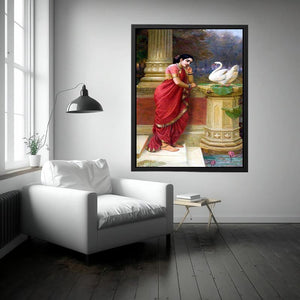
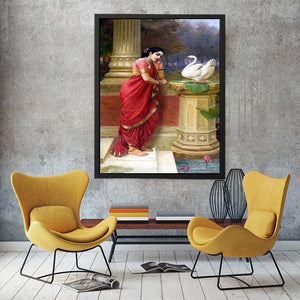
In contemporary interiors across the United States, the United Kingdom, Canada, Australia, and Europe, this painting resonates as both a cultural statement and a work of refined aesthetic presence. In living rooms, it introduces warmth, narrative depth, and quiet elegance. In studies or libraries, it complements spaces devoted to reflection, literature, and history. In offices and galleries, it communicates intellectual curiosity and cross-cultural appreciation.
The painting integrates effortlessly into traditional interiors, where its classical subject and harmonious palette echo established design sensibilities. Equally, it finds a natural place in modern and minimalist spaces, where its compositional clarity and emotional restraint provide contrast without discord. In eclectic settings, it serves as a bridge between cultures and eras, enriching the visual dialogue of the space.
The long-term artistic importance of Hamsa Damayanthi lies in its balance of beauty and intellect. It affirms that art can be both emotionally accessible and culturally profound. Varma’s achievement was not merely technical but philosophical: he demonstrated that modernity need not erase tradition, and that storytelling could coexist with realism without loss of meaning.
Today, the painting remains deeply relevant. In a world increasingly drawn to immediacy and spectacle, its quiet introspection offers a counterpoint. Hamsa Damayanthi invites viewers to pause, reflect, and engage with emotion in its most refined form. It endures as a testament to Raja Ravi Varma’s vision and to the timeless power of art rooted in narrative, dignity, and human experience.
Buy museum qulaity 400- 450 canvas prints, framed prints, and 100% oil paintings of Hamsa Damayanthi by Raja Ravi Varma at Alpha Art Gallery, where world-famous masterpieces are recreated with museum-quality detail, refined craftsmanship, and premium materials.
FAQS
What story does Hamsa Damayanthi by Raja Ravi Varma depict?
The painting illustrates a moment from the Mahabharata when Princess Damayanthi receives a message of love from King Nala through a divine swan.
Why is this painting considered important in Indian art history?
It represents a key moment in the fusion of Indian mythological themes with European academic realism, shaping modern Indian visual culture.
What emotions does the painting primarily convey?
The work expresses quiet anticipation, introspection, and emotional awakening rather than dramatic passion.
How does Raja Ravi Varma humanize mythological figures in this painting?
He portrays Damayanthi with psychological depth and realistic expression, making her emotionally relatable rather than purely idealized.
Is this artwork suitable for contemporary interiors outside India?
Yes, its universal themes, refined composition, and balanced palette make it highly adaptable to interiors across Western and global contexts.
Where is the best place to display this painting?
It is well suited to living rooms, studies, libraries, offices, and gallery-style spaces that encourage contemplation.
Does Hamsa Damayanthi have long-term artistic and cultural value?
Its historical significance, technical excellence, and enduring narrative relevance ensure lasting appreciation across generations.