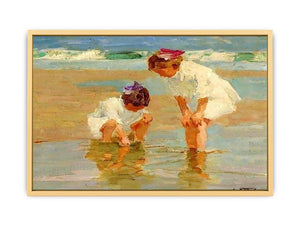
Girls Playing in Surf Painting by Edward Henry Potthast
Girls Playing in Surf stands as one of Edward Henry Potthast’s most expressive celebrations of light, movement, and unselfconscious joy, a painting in which the immediacy of lived experience is transformed into enduring visual harmony. Created during Potthast’s mature period, when his command of Impressionist technique and his fascination with coastal leisure had fully coalesced, the work reflects an artist intent on capturing not an event, but a state of being. The surf, the figures, and the sunlight are bound together in a moment of rhythmic vitality that affirms the beach as a space of freedom, renewal, and shared human presence.
Edward Henry Potthast occupies a distinctive place within American Impressionism. Deeply influenced by French Impressionist methods yet firmly rooted in American subject matter, Potthast turned repeatedly to seaside scenes as a means of exploring light in motion and the relaxed sociability of modern life. Girls Playing in Surf exemplifies this commitment. Rather than depicting the coast as a dramatic or sublime frontier, Potthast presents it as an accessible, democratic environment where bodily movement and natural forces meet in balance.
The composition is open and fluid, organised to suggest motion without imposing rigid structure. The figures are placed within the shallow surf, their arrangement informal and responsive, as though shaped by the water’s movement rather than by compositional design. Potthast resists symmetry and central focus, allowing the eye to move freely across the canvas. This openness mirrors the physical sensation of standing at the water’s edge, where boundaries between body, light, and motion dissolve.
Perspective is handled with characteristic Impressionist sensitivity. The shoreline creates a gentle spatial progression, guiding the viewer into the scene without asserting depth through strict linear recession. The horizon remains understated, ensuring that the primary emphasis remains on the interaction between figures and water. The viewer’s vantage point feels participatory rather than detached, reinforcing the painting’s sense of immediacy and shared experience.
Light is the dominant expressive element in Girls Playing in Surf. Potthast employs bright, natural sunlight that fragments across water and skin, dissolving contours and animating the entire surface of the painting. Rather than modelling form through shadow, he allows light itself to define space and movement. Reflections shimmer across the surf, creating a visual rhythm that echoes the physical play of the figures. Light here is not merely descriptive; it is experiential, conveying warmth, energy, and sensory presence.
Colour is applied with confidence and responsiveness. Potthast favours a palette of luminous blues, soft whites, warm creams, and sunlit flesh tones, punctuated by subtle accents that enliven the scene without disrupting its harmony. Colours are placed in loose, responsive strokes rather than blended into smooth gradients. This approach allows colour relationships to vibrate, reinforcing the sense of movement and spontaneity that defines the painting.
Potthast’s brushwork is loose, visible, and purposeful. The surf is rendered with energetic strokes that suggest constant motion, while figures are defined through colour and gesture rather than precise line. This painterly freedom does not result in ambiguity; instead, it enhances realism by acknowledging the instability of the scene itself. The beach is not static, and Potthast’s technique embraces that truth fully.
The figures themselves are central to the painting’s emotional resonance. Potthast depicts the girls not as posed subjects, but as participants absorbed in play. Their postures are relaxed and responsive, shaped by water and movement rather than self-awareness. There is no sense of performance or observation. The figures exist entirely within the moment, embodying a state of ease and physical freedom that is both specific and universal.
Emotionally, Girls Playing in Surf conveys uncomplicated joy tempered by balance. There is excitement, but not frenzy; freedom, but not abandon. Potthast captures a state of happiness grounded in physical sensation and shared presence rather than narrative climax. This emotional clarity is central to the painting’s enduring appeal. It invites the viewer to remember not a story, but a feeling—the sensation of cool water, warm sun, and unguarded play.
Within Potthast’s broader body of work, this painting represents a refined articulation of his beach scenes. While he painted numerous coastal compositions, Girls Playing in Surf stands out for its synthesis of movement, light, and human interaction. It demonstrates his ability to maintain compositional coherence while embracing spontaneity, confirming his role as one of the most assured American interpreters of Impressionist coastal life.
The painting’s relevance today remains strong across the United States, the United Kingdom, Canada, Australia, and Europe. Contemporary viewers continue to respond to its affirmation of simple pleasure and shared space. In a modern context often dominated by abstraction and velocity, Girls Playing in Surf offers a vision of presence grounded in physical reality and collective ease.
In interior settings, the painting introduces brightness, movement, and emotional lift. In living rooms, it creates an atmosphere of warmth and openness. In studies and offices, it offers visual relief and rhythmic energy, counterbalancing intellectual intensity with sensory calm. In galleries and luxury residences, it signals appreciation for American Impressionism rooted in lived experience rather than formal theory.
The painting integrates seamlessly into traditional, modern, minimalist, and eclectic décor. Traditional interiors benefit from its painterly warmth and figurative clarity. Modern spaces resonate with its looseness and light-driven composition. Minimalist environments are animated by its colour and movement, while eclectic interiors draw cohesion from its harmonious palette and joyful restraint.
The enduring importance of Girls Playing in Surf lies in its recognition of the ordinary as worthy of sustained attention. Potthast affirms that joy need not be monumental to be meaningful. The painting endures because it preserves a moment of freedom without sentimentality, allowing light, movement, and human presence to speak for themselves.
To live with Girls Playing in Surf is to engage daily with a work that radiates vitality and ease. Through its confident colour, fluid brushwork, and emotional generosity, the painting continues to affirm Edward Henry Potthast’s place among the most sensitive and accomplished painters of modern leisure. It stands as a testament to his belief that art, when attentive to the rhythms of lived experience, can hold joy with lasting sincerity.
Buy museum qulaity 400- 450 canvas prints, framed prints, and 100% oil paintings of Girls Playing in Surf by Edward Henry Potthast at Alpha Art Gallery, where world-famous masterpieces are recreated with museum-quality detail, refined craftsmanship, and premium materials.
FAQS
What is the central theme of Girls Playing in Surf?
It explores joy, movement, and light through unselfconscious play at the seaside.
Why did Edward Henry Potthast frequently paint beach scenes?
The beach allowed him to explore sunlight, colour, and relaxed human interaction with exceptional freedom.
How does Impressionism shape this painting?
Loose brushwork, visible strokes, and vibrant colour capture fleeting sensory experience rather than fixed detail.
Are the figures meant to represent specific individuals?
No. They function as participants in a shared experience rather than identifiable portraits.
Is Girls Playing in Surf suitable for contemporary interiors?
Yes. Its brightness and energy integrate beautifully into modern, traditional, and minimalist spaces.
What emotional tone does the painting convey?
It conveys ease, vitality, and uncomplicated happiness without sentimentality.
Does this artwork have lasting artistic value?
As a strong example of American Impressionist beach painting, it holds enduring cultural and aesthetic importance.
Where is the best place to display Girls Playing in Surf?
It is especially well suited to living rooms, studies, offices, and gallery spaces that benefit from light, movement, and warmth.