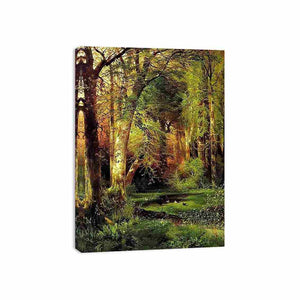
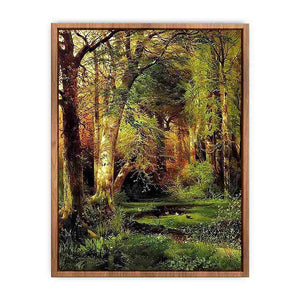
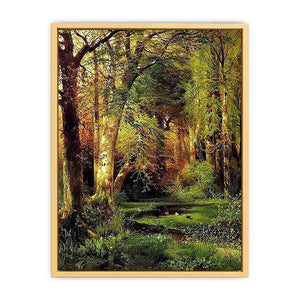
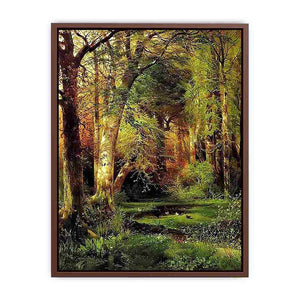
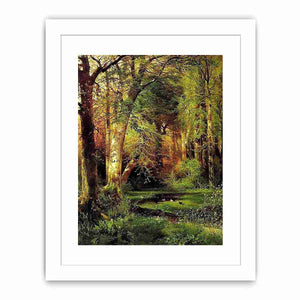
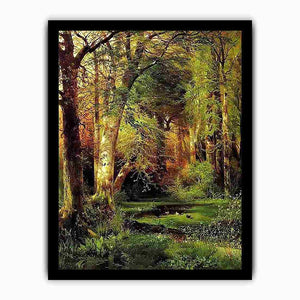
Forest Scene Painting by Thomas Moran
Forest Scene stands as a contemplative and quietly monumental work within Thomas Moran’s artistic vision, a painting in which nature is approached not as spectacle alone, but as a living presence shaped by light, atmosphere, and time. While Moran is most widely celebrated for his vast Western landscapes and their role in shaping America’s visual understanding of wilderness, Forest Scene reveals another dimension of his practice: an inward, reflective engagement with nature’s intimate spaces. Here, grandeur is not measured by scale, but by depth of feeling and perceptual richness.
Thomas Moran emerged in the nineteenth century as one of the most influential interpreters of the natural world, helping define how landscapes could communicate cultural values, spiritual reflection, and national identity. Deeply influenced by Romanticism and the luminist tradition, Moran believed that nature carried moral and emotional significance beyond its physical form. In Forest Scene, this belief finds expression through restraint rather than excess. The forest is not dramatic in the conventional sense; it is immersive, layered, and quietly commanding.
The subject matter is deceptively simple: a wooded interior rendered with sensitivity to foliage, earth, and filtered light. Moran does not impose narrative or human drama upon the scene. Instead, he allows the forest itself to become the protagonist. Trees rise with organic irregularity, their trunks and branches forming a natural architecture that encloses space without confinement. The forest floor, textured with undergrowth and shadow, suggests continuity rather than interruption. The viewer is invited not to conquer the landscape, but to enter it mentally and emotionally.
Compositionally, the painting is structured to guide the eye inward. Moran often uses subtle diagonals and layered planes to create depth, and Forest Scene exemplifies this approach. Foreground elements anchor the viewer, while mid-ground vegetation and distant light draw the gaze deeper into the scene. This gradual recession fosters a sense of movement through space, as though the forest extends beyond the limits of the canvas. The composition encourages lingering observation rather than immediate comprehension.
Perspective is intimate and grounded. The viewer stands at human height, positioned as a quiet observer within the forest rather than an external spectator. Moran avoids elevated viewpoints or sweeping panoramas. This choice reinforces the painting’s contemplative tone. The forest is encountered as a place of presence and stillness, where attention sharpens and time seems to slow.
Light plays a central role in shaping the painting’s emotional character. Moran was a master of atmospheric illumination, and in Forest Scene he employs light with subtle precision. Sunlight filters through foliage in broken patterns, illuminating patches of ground and leaves while leaving other areas in cool shadow. This interplay creates visual rhythm and reinforces the forest’s depth. Light is not symbolic in an overt sense; it functions experientially, guiding perception and mood.
Colour is restrained and harmonised. Moran favours a palette of deep greens, warm browns, muted golds, and softened earth tones. These colours are carefully modulated to reflect natural variation without overwhelming the composition. No single hue dominates. Instead, colour works cumulatively, binding tree, ground, and air into a cohesive whole. The result is a tonal unity that supports calm contemplation.
Moran’s handling of paint reveals disciplined craftsmanship. Brushwork is confident yet controlled, allowing textures to emerge naturally. Leaves and bark are suggested rather than meticulously detailed, preserving the painting’s atmospheric integrity. The forest feels dense without becoming cluttered, alive without appearing chaotic. Technique serves perception rather than display, aligning with Moran’s belief that painting should evoke experience rather than replicate detail.
Emotionally, Forest Scene conveys quiet introspection and reverence. There is no sense of threat or drama, but neither is the scene sentimental. The forest feels ancient, enduring, and indifferent to human presence. This emotional neutrality is powerful. It allows the viewer to project thought and feeling into the space, making the painting a site of reflection rather than instruction.
Symbolically, the forest has long represented retreat, renewal, and contemplation. Moran does not explicitly invoke these associations, but he allows them to resonate implicitly. The absence of human figures reinforces the painting’s meditative quality, suggesting nature as a space of inward encounter rather than external action. The forest becomes a place where perception deepens and awareness expands.
Within Moran’s broader oeuvre, Forest Scene occupies an important complementary position. While his large-scale landscapes celebrate the sublime vastness of nature, this painting affirms the significance of intimate environments. It demonstrates that Moran’s vision of nature was not limited to spectacle, but encompassed quiet spaces where meaning arises through attentiveness.
The painting’s relevance today remains strong across the United States, the United Kingdom, Canada, Australia, and Europe. Contemporary viewers, increasingly attuned to questions of environmental presence and psychological restoration, find resonance in Moran’s forest interior. In a modern world often defined by speed and noise, Forest Scene offers visual stillness and depth.
In interior settings, Forest Scene introduces calm, grounding, and natural continuity. In living rooms, it creates a serene focal point that softens architectural space. In studies and offices, it supports reflection and sustained attention. In galleries and luxury residences, it signals refined engagement with nineteenth-century landscape painting that values atmosphere and perception over spectacle.
The painting integrates seamlessly into traditional, modern, minimalist, and eclectic décor. Traditional interiors resonate with its Romantic lineage and painterly restraint. Modern spaces benefit from its tonal harmony and psychological depth. Minimalist environments amplify its quiet presence, while eclectic interiors draw cohesion from its natural palette and contemplative mood.
The enduring importance of Forest Scene lies in its affirmation of nature as an interior experience as much as an external one. Moran reminds us that landscapes do not need to overwhelm to be profound. They can speak softly, inviting reflection rather than awe. The painting endures because it recognises that meaning often emerges not from grandeur, but from attentive stillness.
To live with Forest Scene is to engage daily with a work that rewards patience. Through its layered composition, subtle light, and emotional restraint, the painting continues to affirm Thomas Moran’s position as one of the most thoughtful interpreters of the natural world. It stands as a testament to his belief that art, when guided by perception and reverence, can transform nature into a space of enduring contemplation.
Buy museum qulaity 400- 450 canvas prints, framed prints, and 100% oil paintings of Forest Scene by Thomas Moran at Alpha Art Gallery, where world-famous masterpieces are recreated with museum-quality detail, refined craftsmanship, and premium materials.
FAQS
What does Forest Scene by Thomas Moran depict?
It depicts a wooded interior rendered with atmospheric light, focusing on depth, stillness, and natural continuity.
How does this painting differ from Moran’s grand Western landscapes?
It emphasises intimacy and contemplation rather than vast scale and dramatic spectacle.
What emotional tone does Forest Scene convey?
It conveys calm, introspection, and reverence without sentimentality or drama.
How does Moran use light in this work?
Light filters gently through foliage, creating rhythm, depth, and mood without theatrical contrast.
Is Forest Scene symbolic?
While primarily observational, it carries implicit associations of reflection, renewal, and natural continuity.
Is this painting suitable for contemporary interiors?
Yes. Its restrained palette and calming presence integrate seamlessly into modern and traditional spaces.
Does Forest Scene have lasting artistic significance?
As a refined example of Moran’s atmospheric landscape painting, it holds enduring cultural and artistic value.
Where is the best place to display Forest Scene?
It is especially well suited to living rooms, studies, galleries, and spaces intended for calm reflection.