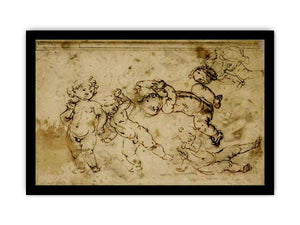
Five Naked Children Painting by Andrea del Verrocchio
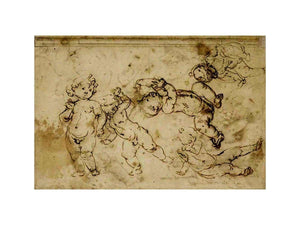
Five Naked Children by Andrea del Verrocchio is a rare and intellectually charged meditation on the human form at the dawn of the Italian Renaissance, revealing an artist deeply engaged with anatomy, movement, and the philosophical foundations of natural beauty. Far from being a simple study of youthful bodies, the painting reflects a moment when art, science, and humanist thought converged, reshaping how the human figure was understood, observed, and represented. In this work, Verrocchio approaches childhood not as sentiment, but as structure—an opportunity to investigate proportion, vitality, and the universal laws governing form.
The historical background of Five Naked Children is rooted in fifteenth-century Florence, a city that served as the intellectual engine of the Renaissance. During this period, artists turned decisively toward direct observation of nature, guided by humanist ideals that placed humanity at the centre of intellectual inquiry. Verrocchio, both sculptor and painter, stood at the forefront of this transformation. His workshop was renowned not only for artistic production but for rigorous study, attracting figures who would later define the Renaissance itself. Within this context, a painting devoted entirely to the nude child figure becomes an assertion of artistic seriousness rather than decorative intent.
Within Verrocchio’s artistic life, Five Naked Children aligns closely with his broader commitment to anatomical truth and physical coherence. Unlike artists who idealised the body through inherited formulas, Verrocchio treated the figure as a living structure governed by balance, tension, and movement. Children, with their distinct proportions and fluid gestures, offered a particularly demanding subject. In rendering them unclothed, Verrocchio removes all distraction, allowing form, posture, and interaction to carry meaning. The painting thus functions as both an artistic exploration and a philosophical statement about the integrity of the human body.
The work belongs firmly within the early Renaissance movement, yet it anticipates developments that would later define High Renaissance naturalism. There is no reliance on medieval symbolism or narrative framing. Instead, the painting asserts the autonomy of form itself. The children are not allegorical figures nor components of a larger myth; they exist in their own right, unified by shared space and subtle interaction. This focus reflects the Renaissance conviction that understanding the physical world was essential to understanding humanity’s place within it.
Compositionally, Five Naked Children is remarkable for its equilibrium. The figures are arranged in a manner that distributes visual weight evenly across the surface, creating a rhythmic interplay of limbs and torsos. Each child occupies a distinct posture, yet none dominates the composition. The viewer’s eye moves fluidly from one figure to the next, guided by gentle arcs of movement and carefully calibrated spacing. This compositional harmony reflects Verrocchio’s sculptural sensibility, where balance and spatial coherence were paramount.
Perspective is handled with quiet sophistication. Rather than dramatic foreshortening or theatrical depth, Verrocchio employs a shallow, controlled space that keeps the figures intimately present. This choice enhances the painting’s analytical clarity, allowing the viewer to study form without illusionistic distraction. The figures inhabit space naturally, reinforcing the sense that they are governed by physical laws rather than compositional contrivance.
The treatment of colour and light is restrained, serving structure rather than spectacle. Flesh tones are rendered with subtle variation, suggesting warmth and vitality without idealised gloss. Light falls evenly across the bodies, revealing musculature and curvature with scientific precision. There are no dramatic highlights or deep shadows; instead, illumination functions as a tool of understanding, clarifying form and reinforcing volume. Texture is controlled and disciplined, ensuring that surface detail supports anatomical truth rather than competing with it.
Symbolically, Five Naked Children resists overt allegory. Its meaning lies not in narrative reference but in philosophical implication. By presenting multiple youthful figures together, Verrocchio invites reflection on universality and variation—how a single human type can manifest infinite difference. The absence of clothing or contextual markers strips the scene of social specificity, elevating the figures into studies of humanity itself. Innocence here is not moralised; it is structural, defined by proportion and motion rather than sentiment.
Emotionally, the painting is calm and observational. There is no overt drama, no theatrical expression. The children appear absorbed in their own physical presence, embodying a quiet vitality that feels both natural and timeless. This emotional restraint aligns with the Renaissance pursuit of measured harmony, where beauty emerged from balance rather than excess. The viewer is encouraged to contemplate rather than react, engaging intellectually with what is seen.
Culturally, Five Naked Children holds enduring significance as an example of how Renaissance artists reconceptualised the human body. It reflects a pivotal shift away from symbolic representation toward empirical observation, laying groundwork for later masters who would further refine anatomical realism. The painting stands as evidence that even seemingly modest subjects could serve profound artistic and philosophical ends.
The relevance of this work today is unmistakable. In a contemporary world still negotiating the relationship between body, identity, and representation, Verrocchio’s disciplined approach offers a model of respect and clarity. The painting affirms that the human form, when treated with seriousness and insight, transcends time and cultural context. Its focus on structure over ornament resonates strongly with modern sensibilities that value authenticity and intellectual depth.
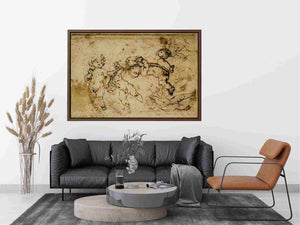
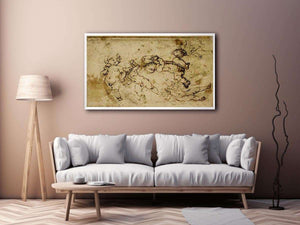
Within contemporary interiors across the United States, United Kingdom, Canada, Australia, and Europe, Five Naked Children integrates with refined subtlety. In living rooms, it introduces classical intelligence without visual dominance. In studies and offices, it reinforces an atmosphere of inquiry and cultivated taste. Galleries and luxury residences benefit from its historical gravity and quiet authority, as the work rewards close viewing rather than immediate spectacle.
Across interior styles, the painting remains adaptable. In minimalist spaces, its restrained palette and compositional clarity align seamlessly with simplicity. Traditional interiors gain depth through its Renaissance lineage, while eclectic environments find balance in its disciplined form. The artwork does not impose narrative; it offers presence, making it suitable for spaces that value contemplation and cultural continuity.
Ultimately, Five Naked Children by Andrea del Verrocchio stands as a testament to the Renaissance belief that understanding the human form was central to understanding humanity itself. Through compositional balance, anatomical precision, and emotional restraint, Verrocchio created a work that continues to speak across centuries. Its enduring power lies in its refusal to explain, choosing instead to reveal—quietly, rigorously, and with lasting intellectual grace.
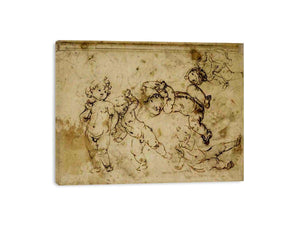
Buy museum qulaity 400- 450 canvas prints, framed prints, and 100% oil paintings of Five Naked Children by Andrea del Verrocchio at Alpha Art Gallery, where world-famous masterpieces are recreated with museum-quality detail, refined craftsmanship, and premium materials.
FAQS
What is the main focus of Five Naked Children by Andrea del Verrocchio?
The painting focuses on anatomical study, proportion, and the natural movement of the human body rather than narrative storytelling.
Why did Verrocchio choose to depict children nude?
The absence of clothing allows direct study of form, structure, and physical development without distraction.
Is this painting symbolic or purely observational?
While primarily observational, it carries philosophical meaning about universality, variation, and human nature.
What artistic movement does this painting belong to?
It belongs to the early Italian Renaissance, characterised by humanism, anatomical study, and naturalism.
Does this artwork suit modern interiors?
Yes. Its restrained palette and intellectual clarity make it suitable for modern, minimalist, traditional, and eclectic spaces.
Why is Verrocchio important in art history?
He was a pivotal Renaissance master and influential teacher whose emphasis on anatomy and structure shaped future generations.
Is Five Naked Children considered culturally significant?
Yes. It represents a critical moment in the Renaissance shift toward empirical observation of the human form.
Where is the best place to display this artwork?
It is especially effective in studies, living rooms, offices, galleries, and refined residential spaces where thoughtful viewing is encouraged.