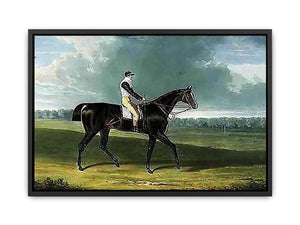
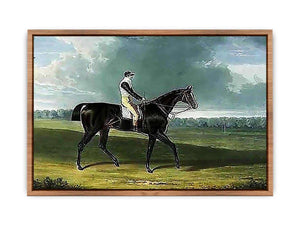
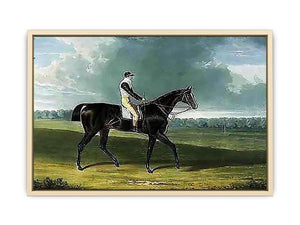
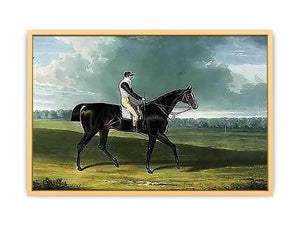
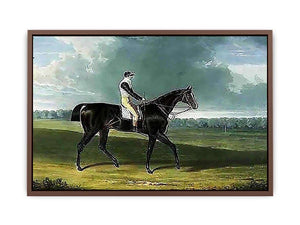
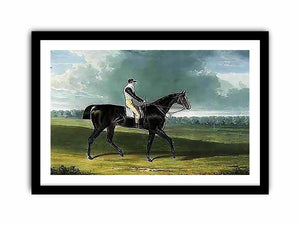
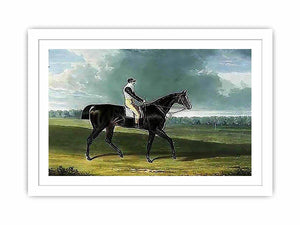
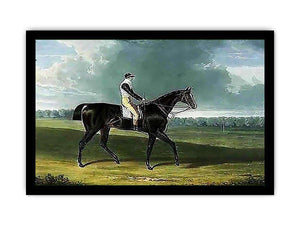
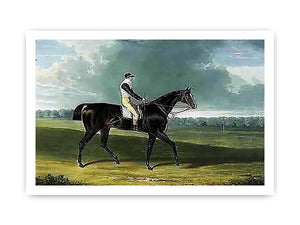
‘Filho da Puta’, the Winner of the Great St. Leger at Doncaster Painting by John Frederick Herring Snr
‘Filho da Puta’, the Winner of the Great St. Leger at Doncaster stands as one of John Frederick Herring Snr’s most authoritative and historically grounded equestrian portraits, a painting in which sporting achievement, anatomical mastery, and national pride are brought into composed visual alignment. Created by the foremost British sporting painter of the nineteenth century, the work commemorates not merely a victory, but a precise moment when breeding, training, and competitive excellence converged at the highest level of the English turf. Herring’s painting transforms the racehorse from fleeting spectacle into enduring presence, presenting triumph with discipline rather than exaggeration.
John Frederick Herring Snr occupied an unrivalled position in British sporting art. His reputation rested on an extraordinary capacity to render horses with anatomical precision, psychological presence, and narrative clarity. Unlike painters who approached the subject romantically or decoratively, Herring understood the horse as an athlete shaped by lineage, conditioning, and temperament. In ‘Filho da Puta’, the Winner of the Great St. Leger at Doncaster, this understanding reaches mature expression. The painting is not a dramatic racing scene, but a composed portrait of achievement, where victory is acknowledged through poise rather than motion.
The subject itself carries substantial historical weight. The St. Leger Stakes, one of Britain’s most prestigious Classic races, represented the ultimate test of stamina and quality. To win at Doncaster was to secure lasting recognition within the annals of British racing. Herring approaches this context with restraint. He does not depict the chaos of the course or the intensity of competition. Instead, he presents the horse after triumph, when effort has resolved into status. This choice allows the painting to function as a document of legacy rather than immediacy.
The composition is clear, balanced, and deliberate. ‘Filho da Puta’ is positioned prominently, his body angled to display strength, proportion, and condition. Herring arranges the horse so that conformation can be read with ease: the line of the back, the power of the hindquarters, the elegance of the neck, and the alertness of stance. There is no distortion for effect. The painting communicates excellence through accuracy and calm authority.
Perspective is chosen to reinforce dignity and legibility. The viewer encounters the horse at eye level, fostering respect rather than domination. This vantage point allows the animal’s presence to assert itself naturally. Surrounding elements are subordinated to the central figure, ensuring that attention remains focused on the horse’s physical and symbolic significance.
Light is applied with controlled naturalism. Herring uses even illumination to clarify form, coat, and musculature without theatrical contrast. Light falls across the horse’s body with consistency, revealing texture and volume while preserving unity. This measured lighting aligns with the painting’s documentary purpose. The horse is shown as he is, without embellishment or dramatic emphasis.
Colour is restrained and functional. Herring favours natural tones that reflect the horse’s coat and the surrounding environment with fidelity. The palette avoids unnecessary richness, allowing subtle variations in tone to articulate anatomy and surface. Colour serves structure and truth rather than ornament, reinforcing the painting’s credibility as both portrait and record.
Herring’s handling of detail is exacting yet disciplined. The horse’s coat is rendered with sensitivity to sheen and texture, suggesting health and conditioning without excessive polish. Limbs are articulated with anatomical accuracy, hooves grounded with weight and realism. Any accompanying figures or tack are treated with equal care but never allowed to distract from the central subject. Brushwork remains controlled and confident, reflecting Herring’s consummate professionalism.
Emotionally, the painting conveys quiet assurance rather than exuberance. Victory is not shouted; it is assumed. ‘Filho da Puta’ stands with the composure of an athlete who has fulfilled expectation and proven merit. This emotional restraint elevates the work beyond celebratory image into enduring testament. The horse’s presence communicates achievement without narrative insistence.
Symbolically, the painting represents the ideals of British sporting culture in the nineteenth century: discipline, breeding, endurance, and measured excellence. Herring presents success as the result of sustained effort and inherent quality rather than chance or spectacle. The horse becomes an emblem of continuity, where bloodline, training, and tradition converge.
Within Herring’s broader oeuvre, this work exemplifies his approach to equestrian portraiture at its most refined. While he painted dramatic hunts and racing scenes elsewhere, portraits such as this demonstrate his belief that true greatness is best conveyed through stillness and accuracy. ‘Filho da Puta’, the Winner of the Great St. Leger at Doncaster confirms Herring’s role not merely as an artist, but as a visual chronicler of British sporting history.
The painting’s relevance today remains strong across the United States, the United Kingdom, Canada, Australia, and Europe. Contemporary collectors and viewers continue to respond to its clarity, authority, and respect for the subject. In a modern context where speed and spectacle often dominate representation, Herring’s painting offers an alternative vision of athletic excellence grounded in patience and truth.
In interior settings, the painting introduces distinction, tradition, and compositional strength. In living rooms, it becomes a statement of refined taste and historical awareness. In studies and offices, it reinforces values of discipline, focus, and achievement. In galleries and luxury residences, it signals serious engagement with nineteenth-century British sporting art at the highest level.
The work integrates seamlessly into traditional, modern, minimalist, and eclectic décor. Traditional interiors resonate with its historical subject and classical execution. Modern spaces benefit from its compositional clarity and restrained palette. Minimalist environments amplify its authority through contrast, while eclectic interiors draw cohesion from its disciplined realism and cultural depth.
The enduring importance of ‘Filho da Puta’, the Winner of the Great St. Leger at Doncaster lies in its ability to preserve achievement without exaggeration. Herring recognises that legacy is secured not through spectacle, but through accuracy and respect. The painting endures because it treats victory as a state of being rather than a moment of noise.
To live with ‘Filho da Puta’, the Winner of the Great St. Leger at Doncaster is to engage daily with a work that honours excellence through truth. Through its anatomical precision, compositional restraint, and historical intelligence, the painting continues to affirm John Frederick Herring Snr’s position as the definitive painter of British equestrian achievement. It stands as a testament to his belief that art, when guided by observation and discipline, can secure sporting history in lasting visual form.
Buy museum qulaity 400- 450 canvas prints, framed prints, and 100% oil paintings of ‘Filho da Puta’, the Winner of the Great St. Leger at Doncaster by John Frederick Herring Snr at Alpha Art Gallery, where world-famous masterpieces are recreated with museum-quality detail, refined craftsmanship, and premium materials.
FAQS
What does ‘Filho da Puta’, the Winner of the Great St. Leger at Doncaster depict?
It depicts the celebrated racehorse after winning the St. Leger Stakes, focusing on conformation, presence, and achievement.
Why is the St. Leger considered significant in horse racing history?
It is one of Britain’s oldest and most prestigious Classic races, testing stamina and breeding at the highest level.
How does John Frederick Herring Snr approach equestrian portraiture in this work?
He emphasises anatomical accuracy, restraint, and dignity rather than dramatic racing action.
Is the painting a racing scene or a portrait?
It is a commemorative portrait, presenting victory through stillness and authority rather than motion.
What emotional tone does the painting convey?
It conveys assurance, composure, and earned success rather than excitement or spectacle.
Is this artwork suitable for contemporary interiors?
Yes. Its clarity, balance, and historical significance integrate beautifully into both modern and traditional spaces.
Does this painting have lasting historical value?
As a visual record of a major racing victory by Britain’s leading sporting painter, it holds enduring cultural and artistic importance.
Where is the best place to display this painting?
It is especially well suited to studies, offices, living rooms, galleries, and spaces that value sporting heritage and refinement.