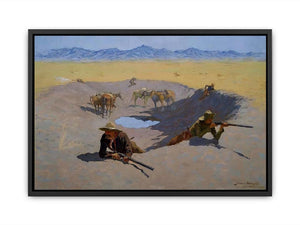
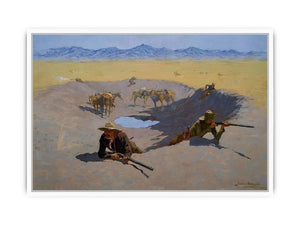
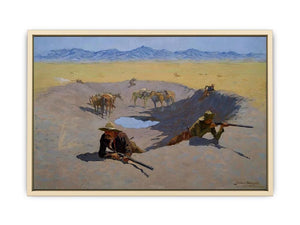
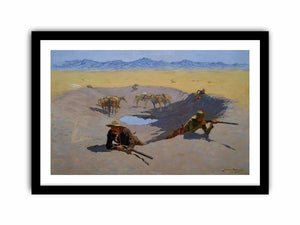
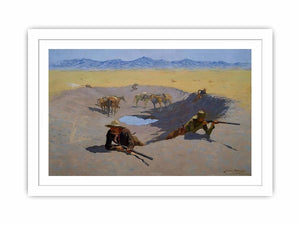
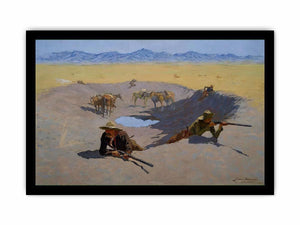
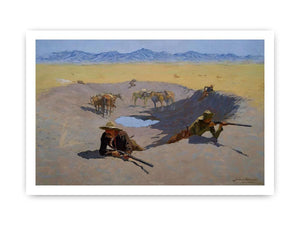
Fight for the Water Hole Painting by Frederic Remington
Fight for the Water Hole stands as one of Frederic Remington’s most visceral and morally complex depictions of frontier violence, a painting in which desperation, survival, and the brutal arithmetic of scarcity collide. Rather than presenting conflict as heroic spectacle or patriotic narrative, Remington confronts the viewer with a primal struggle driven by necessity rather than ideology. Water, the most elemental requirement for life, becomes the catalyst for violence, reducing human action to instinct and exposing the fragile boundary between civilisation and collapse on the American frontier.
Frederic Remington painted Fight for the Water Hole at a moment when the myth of the West was already hardening into legend. Yet Remington resisted comforting simplifications. His authority as an artist rested on firsthand experience and a deep understanding that frontier conflict often emerged not from grand causes, but from environmental pressure and chance encounter. In this work, the West is not a stage for noble conquest; it is an unforgiving landscape where survival itself becomes a provocation. The painting reflects Remington’s belief that truth in Western art lay in confrontation with reality rather than romantic invention.
The scene is organised around a shallow water hole, a fragile oasis amid arid terrain. Figures converge violently upon this scarce resource, their bodies locked in struggle rather than motion. Unlike Remington’s chase scenes, where speed dominates, here the action is compressed and claustrophobic. Combatants are close, entangled, and grounded. Horses rear or strain under restraint, amplifying chaos rather than escape. The water hole functions as both setting and symbol, anchoring the conflict in physical necessity rather than abstract motive.
Compositionally, Remington constructs the painting as a vortex of force. Figures circle the water hole, their gestures pulling inward rather than outward. This centripetal structure heightens tension, denying the viewer any visual refuge. There is no clear victor, no directional momentum toward resolution. Instead, the eye is trapped within the struggle, mirroring the combatants’ own confinement. The ground itself feels unstable, churned by hooves and bodies, reinforcing the sense that order has been violently suspended.
Perspective places the viewer at close range, eliminating detachment. We are not positioned above the conflict, nor safely outside it. The immediacy of scale and proximity forces confrontation with the physicality of violence—grasping hands, straining muscles, and the raw collision of bodies. Remington refuses the distancing effect of panoramic view. By compressing space, he transforms the painting into an encounter rather than a narrative illustration.
Light in Fight for the Water Hole is stark and functional. There is no atmospheric romance, no dramatic shadow to aestheticise brutality. Illumination clarifies action and form, revealing tension rather than obscuring it. Sunlight strikes figures and terrain with equal indifference, emphasising the neutrality of nature toward human suffering. Light here does not judge or console; it exposes.
Colour reinforces this unsentimental realism. Remington employs a restrained palette of dusty browns, ochres, muted blues, and earthen reds. These colours bind figures to landscape, erasing any visual separation between human conflict and environmental context. Blood, sweat, and soil merge into a single chromatic field. Colour does not heighten drama through contrast; it grounds the scene in material truth.
Remington’s brushwork is forceful and economical. Strokes are directed toward conveying strain and collision rather than surface refinement. Musculature is rendered with urgency, gestures with immediacy. There is little decorative detail, no indulgence in finish. Technique serves intensity, allowing the viewer to sense movement even within physical stalemate. The painting feels tense rather than resolved, its energy contained but volatile.
Symbolically, Fight for the Water Hole strips frontier conflict of moral clarity. The struggle is not framed as righteous or villainous; it is necessary. Water, rather than ideology or territory, motivates violence. In this way, Remington exposes a fundamental truth about frontier life: that scarcity reduces ethical complexity to survival calculus. The painting does not justify violence, but it explains it, presenting conflict as consequence rather than choice.
Emotionally, the work is oppressive rather than exhilarating. There is no exhilaration of victory, no romance of battle. Instead, the painting conveys exhaustion, desperation, and inevitability. Viewers are likely to feel discomfort rather than admiration, a response Remington appears to have intended. The emotional weight lies not in action, but in recognition—that under sufficient pressure, human behaviour converges toward struggle.
Within Remington’s artistic evolution, Fight for the Water Hole represents a deepening of thematic seriousness. While he is often associated with dynamic action and frontier bravado, this painting reveals his capacity to interrogate violence itself. It aligns with his later, more reflective works that acknowledge loss, failure, and moral ambiguity. Remington here approaches the frontier not as legend, but as environment—a force that shapes behaviour with relentless logic.
Culturally, the painting occupies a significant place in the visual history of the American West. It challenges heroic narratives by foregrounding scarcity and necessity as drivers of conflict. Rather than celebrating dominance, it preserves a memory of vulnerability. Fight for the Water Hole contributes to a more honest understanding of frontier life as precarious, governed by environment as much as by will. Its relevance extends beyond its historical setting, speaking to any context where resources are limited and human behaviour is pushed to extremes.
In contemporary interiors, Fight for the Water Hole carries substantial narrative gravity. In studies, libraries, and offices, it communicates realism, resilience, and historical depth. In living rooms and private collections, it functions as a demanding focal work, inviting reflection rather than decoration. In galleries and luxury residences across the United States, United Kingdom, Canada, Australia, and Europe, the painting complements rustic, traditional, and modern interiors alike. Its restrained palette and concentrated action give it presence without excess, making it suitable for spaces that value seriousness and authenticity.
The enduring relevance of Fight for the Water Hole lies in its refusal to simplify violence. Remington does not frame conflict as heroic destiny or moral crusade. He presents it as consequence—born of environment, scarcity, and necessity. The painting endures because it confronts viewers with an uncomfortable truth: that beneath social order lies a fragile dependence on resources, and when that balance fails, struggle follows. In Fight for the Water Hole, Frederic Remington offers not a legend of the West, but a reckoning with its realities—one that continues to resonate wherever survival and scarcity remain inseparable.
Buy museum qulaity 400- 450 canvas prints, framed prints, and 100% oil paintings of Fight for the Water Hole by Frederic Remington at Alpha Art Gallery, where world-famous masterpieces are recreated with museum-quality detail, refined craftsmanship, and premium materials.
FAQS
What does Fight for the Water Hole by Frederic Remington depict?
It depicts a violent struggle over access to a scarce water source, highlighting survival-driven conflict on the frontier.
Why is water central to the painting’s meaning?
Water represents life itself, making the conflict unavoidable rather than ideological.
Is the violence in the painting glorified?
No, it is presented as desperate and oppressive, emphasising consequence rather than heroism.
How does Remington convey tension in this work?
Through compressed composition, close perspective, and forceful brushwork that trap the viewer within the struggle.
What emotional response does the painting evoke?
It evokes discomfort, urgency, and recognition of human vulnerability under extreme conditions.
Does the painting take a moral position?
It avoids moral judgement, focusing instead on environmental pressure and necessity.
Is Fight for the Water Hole suitable for contemporary interiors?
Yes, particularly for spaces that value historical realism and narrative depth.
Why does Fight for the Water Hole remain relevant today?
Its exploration of scarcity, conflict, and survival continues to resonate in a world shaped by resource pressure.