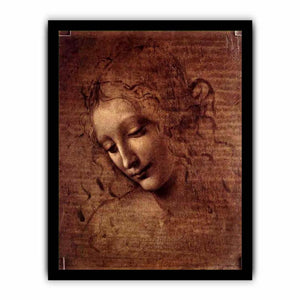
Female Head (The Lady of the Dishevelled Hair) (La Scapigliata) Painting by Leonardo da Vinci
Female Head (The Lady of the Dishevelled Hair) (La Scapigliata) Painting by Leonardo da Vinci is one of the most intimate and intellectually daring images of the Italian Renaissance, a work in which incompletion becomes meaning and suggestion surpasses finish. Created around the turn of the sixteenth century, this small yet monumental painting reveals Leonardo at his most experimental and philosophical, using restraint, ambiguity, and painterly economy to explore the nature of beauty, consciousness, and becoming. Unlike finished portraits meant for display or patronage, La Scapigliata exists in a liminal state—hovering between study and revelation—yet it achieves a level of psychological presence that rivals Leonardo’s most celebrated works.
The mind behind this radical subtlety, Leonardo da Vinci, approached painting as an inquiry into perception itself. For Leonardo, the act of seeing was inseparable from thinking, and representation was inseparable from understanding. In Female Head (La Scapigliata), his investigations into anatomy, optics, and the movement of the soul converge in an image that feels less painted than discovered. The work does not assert completion; it proposes awareness. It asks the viewer to participate in perception rather than consume an image.
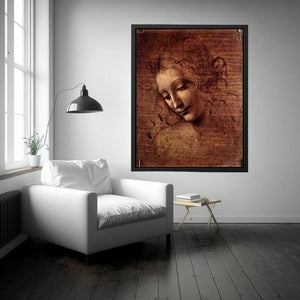
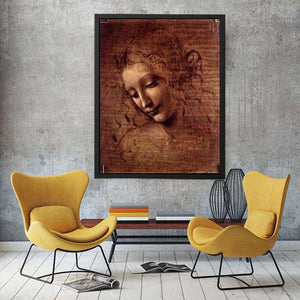
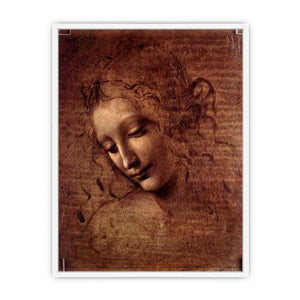
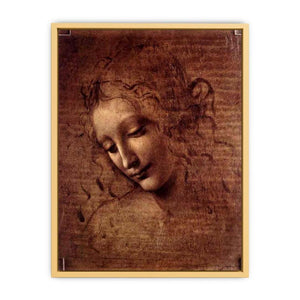
The subject is a young woman shown in three-quarter view, her head gently inclined, her gaze lowered and unfixed. Her hair—loose, swirling, and deliberately unresolved—frames the face in soft motion. There is no jewelry, no costume of rank, no narrative context. The absence of identifying markers shifts attention entirely to presence and interiority. She is not presented as a sitter performing identity, but as a being absorbed in thought. This refusal of portrait convention marks a decisive departure from Renaissance norms and situates the work at the frontier between representation and psychology.
Compositionally, the image is restrained to the point of austerity. The head emerges from an undefined ground, with no architectural setting or environmental cues. This isolation intensifies focus, allowing the viewer’s attention to rest entirely on the face and the flow of hair. The slight tilt of the head introduces a gentle asymmetry that prevents rigidity, creating a sense of organic movement and emotional openness. Balance is achieved not through geometry alone, but through tonal harmony and compositional silence.
Perspective is intimate and shallow. Leonardo places the viewer close, yet not intrusively so, establishing a contemplative distance that mirrors the subject’s inwardness. There is no illusionistic depth drawing the eye outward; instead, perception is drawn inward, toward nuance and transition. This compressed space reinforces the painting’s psychological register, transforming the image into a site of quiet encounter rather than observation.
Light is the painting’s most eloquent agent. Leonardo employs soft, enveloping illumination that allows the face to emerge gradually from shadow. There are no sharp edges, no decisive contours. Through sfumato, features dissolve into one another, creating a sense of perpetual becoming. The eyes, lips, and cheekbones are suggested rather than declared, inviting the viewer to complete what is left unresolved. Light here is not descriptive; it is experiential, modeling the face as thought rather than object.
The color palette is minimal and profoundly controlled. Earthy browns, warm flesh tones, and subdued shadows create a tonal unity that feels timeless. Color does not decorate; it stabilizes. By limiting chromatic variation, Leonardo heightens sensitivity to transition and nuance. The result is a surface that appears to breathe, its quiet modulation sustaining attention over prolonged viewing.
Leonardo’s technique in La Scapigliata is deliberately selective. The face is rendered with exquisite care, while the hair and surrounding areas remain loosely articulated, almost sketch-like. This contrast is not a sign of incompletion but a conceptual strategy. Leonardo privileges psychological presence over surface finish, suggesting that clarity of mind outweighs clarity of outline. The visible traces of process invite the viewer into the act of creation, collapsing the distance between thought and image.
Symbolically, the painting resists fixed allegory. The dishevelled hair—unbound and in motion—has been interpreted as a sign of natural beauty, inner freedom, or unidealized truth. Yet Leonardo avoids symbolism that resolves meaning. Instead, the image operates through resonance. The looseness of hair contrasts with the serenity of expression, creating a dialogue between movement and stillness, nature and consciousness. Beauty here is not order imposed, but harmony discovered.
Psychologically, Female Head (La Scapigliata) is among Leonardo’s most profound achievements. The subject’s lowered gaze and relaxed features suggest introspection rather than display. She does not perform for the viewer; she exists independently of being seen. This autonomy is central to the painting’s power. Leonardo presents a mind at rest, a consciousness momentarily turned inward. The viewer is permitted to witness, not to possess.
Within Leonardo’s body of work, this painting occupies a unique position. It is neither a finished portrait nor a preparatory study in the conventional sense. Instead, it represents Leonardo’s conviction that truth often resides in transition. Compared with the monumental assurance of the Mona Lisa, La Scapigliata is quieter, more provisional, yet equally radical. It reveals Leonardo’s belief that suggestion can surpass resolution, and that the incomplete can be complete in meaning.
Culturally, the painting anticipates modern ideas about process, abstraction, and psychological presence. Long before modern art questioned the necessity of finish, Leonardo recognized that perception itself is fluid. La Scapigliata feels strikingly contemporary in its embrace of ambiguity and its trust in the viewer’s intelligence. Its influence can be felt not only in Renaissance drawing practice but in later explorations of expressive incompletion.
In contemporary interiors across the United States, the United Kingdom, Canada, Australia, and Europe, Female Head (The Lady of the Dishevelled Hair) introduces an atmosphere of intellectual refinement and contemplative calm. In living rooms, it offers quiet authority without ostentation. In studies and private offices, it resonates with introspection and creative thought. In galleries and luxury residences, it anchors space with understated depth, integrating seamlessly into traditional, modern, minimalist, and eclectic décor through its restrained palette and psychological subtlety.
The painting remains meaningful today because it affirms the value of attentiveness in a culture often driven by immediacy and completion. Leonardo’s image does not rush toward resolution. It lingers, inviting sustained looking and reflective engagement. In doing so, it reminds the viewer that understanding unfolds gradually—and that beauty often resides in what is left unsaid.
Female Head (The Lady of the Dishevelled Hair) (La Scapigliata) Painting by Leonardo da Vinci endures as one of the most poetic and intellectually refined expressions of Renaissance humanism. Through selective finish, atmospheric light, and psychological restraint, Leonardo transformed a simple head study into a timeless meditation on presence, perception, and becoming. The painting does not conclude. It continues.
Buy museum qulaity 400- 450 canvas prints, framed prints, and 100% oil paintings of Female Head (The Lady of the Dishevelled Hair) (La Scapigliata) by Leonardo da Vinci at Alpha Art Gallery, where world-famous masterpieces are recreated with museum-quality detail, refined craftsmanship, and premium materials.
FAQs
What does La Scapigliata depict?
It depicts a young woman’s head rendered with selective finish, emphasizing psychological presence over detailed realism.
Why is the hair left loose and unresolved?
The dishevelled hair reflects Leonardo’s interest in natural movement and expressive suggestion rather than formal order.
Is this painting considered unfinished?
While it appears incomplete, the selective finish is intentional and central to its meaning.
What technique gives the face its softness?
Leonardo’s use of sfumato allows features to emerge gradually through subtle tonal transitions.
Does the painting represent a specific person?
No definitive identification exists; the image transcends individual portraiture.
How does this work relate to the Mona Lisa?
Both explore psychological presence, but La Scapigliata does so through restraint and incompletion rather than polished finish.
Why does the painting feel so modern?
Its embrace of ambiguity, visible process, and inward focus anticipates modern artistic concerns.
Where does this artwork work best in interiors?
It is ideal for living rooms, studies, offices, galleries, and spaces seeking quiet intellectual depth.