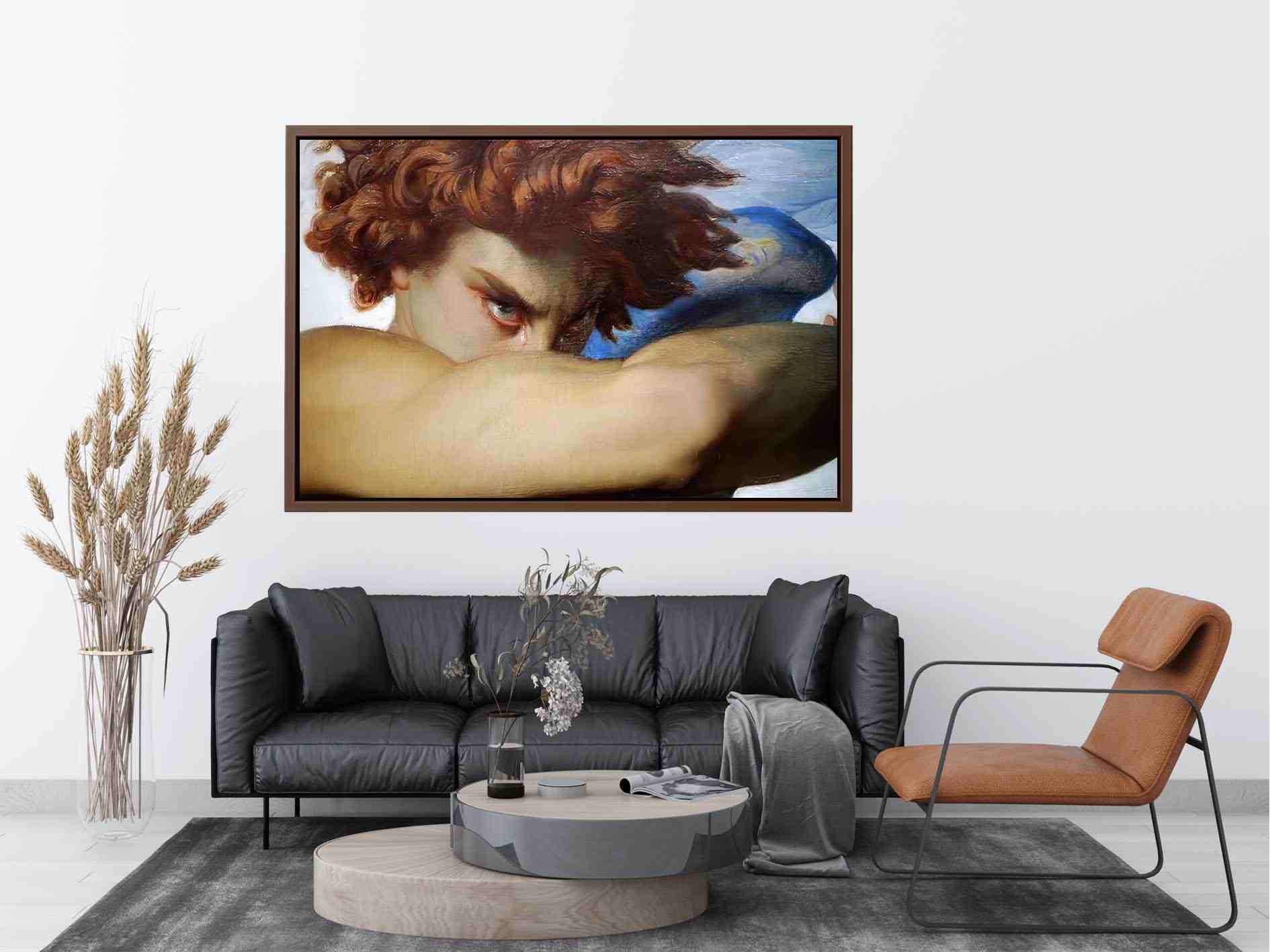
Fallen Angel Detailed Painting by Alexandre Cabanel
Painted in 1847, Fallen Angel by Alexandre Cabanel stands as one of the most psychologically charged and emotionally refined works of nineteenth-century academic painting. Few images in Western art capture inner torment with such seductive clarity. Rather than depicting the dramatic moment of expulsion from heaven, Cabanel chooses a far more unsettling instant: the pause after the fall, when rage, humiliation, grief, and wounded pride coexist within a single, exquisitely rendered figure. The result is not a religious illustration but a profound study of defiance, vulnerability, and the tragic complexity of rebellion.
The historical and cultural background of Fallen Angel is rooted in the Romantic fascination with moral ambiguity and the interior life of mythic figures. While academic art of the period often celebrated virtue, heroism, and divine order, Cabanel dared to humanise the archetype of evil itself. Drawing inspiration from literary sources such as Milton’s Paradise Lost, the painting reflects a nineteenth-century shift toward psychological realism, where emotional truth was valued as highly as theological clarity. Lucifer, traditionally portrayed as monstrous or grotesque, is here rendered devastatingly beautiful, forcing the viewer into an uncomfortable confrontation with empathy.
Within Cabanel’s artistic career, Fallen Angel represents an early yet remarkably assured statement of his mastery. Trained in the strict traditions of the French академie, Cabanel possessed extraordinary technical control, particularly in the depiction of the human body. However, this painting reveals more than skill; it reveals intellectual daring. Cabanel demonstrates that academic technique need not serve moral simplicity. Instead, it can be used to explore emotional contradiction and psychological depth with surgical precision.
The painting occupies a complex position within nineteenth-century art movements. While Cabanel is often associated with Academic Classicism, Fallen Angel carries a strong Romantic undercurrent. It rejects moral didacticism in favour of emotional tension. The figure is neither redeemed nor damned in visual terms; he exists in a liminal state, suspended between celestial memory and earthly exile. This ambiguity aligns the work with broader Romantic concerns about individual will, alienation, and the cost of defiance.
Compositionally, Fallen Angel is both restrained and powerful. The figure lies diagonally across the canvas, his body relaxed yet coiled with tension. This diagonal placement disrupts classical stability, subtly signalling inner turmoil. The wings, once instruments of ascent, now press heavily against the earth, their scale emphasising the magnitude of what has been lost. Cabanel avoids excessive narrative detail, stripping the scene to its emotional essentials. There is no crowd, no divine presence, no landscape spectacle—only the fallen figure and the weight of consequence.
Perspective plays a critical psychological role. The viewer is positioned close, almost uncomfortably so, drawn into the angel’s private moment of reckoning. There is no distance from the subject’s gaze. One eye, filled with unshed tears, locks outward, while the other retreats into shadow. This asymmetry creates a sense of fractured identity, as though the angel is simultaneously aware of himself and the world that has rejected him. The painting does not invite judgment; it demands recognition.
Cabanel’s use of colour and light is central to the painting’s emotional resonance. The flesh is rendered with luminous softness, recalling classical ideals of beauty, yet the surrounding tones are subdued, cooling the sensuality with melancholy. Light grazes the body rather than flooding it, creating a quiet intimacy that heightens vulnerability. The wings, darker and heavier in tone, anchor the figure to the ground, visually reinforcing the theme of fall and confinement. Texture is meticulously controlled, allowing skin, feathers, and stone to coexist without competing for attention.
Symbolism in Fallen Angel is deliberate and disciplined. The clenched fist pressed against the earth conveys suppressed fury and resistance. The tear at the corner of the eye suggests not repentance, but wounded pride. This is not a figure seeking forgiveness; it is one struggling to reconcile loss with identity. Cabanel’s Lucifer is tragic not because he has fallen, but because he remains conscious of what he once was. The painting thus becomes an exploration of memory as suffering.
Emotionally, the work is devastating in its restraint. Cabanel avoids theatrical anguish, choosing instead to depict a moment of contained intensity. The angel’s expression communicates rage, sorrow, and defiance without exaggeration. This emotional economy is precisely what gives the painting its enduring power. Viewers are not told how to feel; they are compelled to feel through recognition of inner conflict.
Culturally, Fallen Angel occupies a unique position as one of the most iconic representations of Lucifer in Western art. It reshaped visual interpretations of rebellion, influencing later artists, writers, and popular culture by presenting the fallen figure as psychologically complex rather than purely malevolent. The painting’s legacy lies in its refusal to reduce moral narratives to binaries. It acknowledges that beauty, intelligence, and suffering can coexist with transgression.
The painting remains deeply relevant today. In a modern world increasingly attuned to psychological nuance and moral ambiguity, Fallen Angel speaks with striking immediacy. It resonates with contemporary reflections on exile, identity, pride, and emotional isolation. Its power lies not in religious doctrine, but in its understanding of the human condition—how loss reshapes selfhood, and how defiance can coexist with vulnerability.
Within contemporary interiors across the United States, United Kingdom, Canada, Australia, and Europe, Fallen Angel integrates with extraordinary authority. In living rooms, it functions as a dramatic focal point, introducing emotional depth and intellectual gravitas. In studies and offices, it reinforces an atmosphere of introspection and psychological seriousness. Galleries and luxury residences benefit from its iconic status and sustained visual engagement, as the painting continues to reveal new dimensions over time.
The artwork adapts seamlessly across décor styles. In modern and minimalist interiors, its controlled palette and sculptural clarity provide striking contrast without visual excess. In traditional settings, it complements classical furnishings while challenging complacency through emotional complexity. Eclectic spaces benefit from its ability to anchor diverse elements with symbolic coherence. The painting does not merely decorate; it transforms the emotional register of a space.
Ultimately, Fallen Angel by Alexandre Cabanel endures because it confronts viewers with a truth both unsettling and universal: that the deepest conflicts are internal, and that beauty and suffering are often inseparable. Through technical mastery, psychological insight, and emotional restraint, Cabanel created a work that transcends its religious origins to become one of the most haunting visual meditations on pride, loss, and consciousness in the history of art.
Buy museum qulaity 400- 450 canvas prints, framed prints, and 100% oil paintings of Fallen Angel by Alexandre Cabanel at Alpha Art Gallery, where world-famous masterpieces are recreated with museum-quality detail, refined craftsmanship, and premium materials.
FAQS
What is the central meaning of Fallen Angel by Alexandre Cabanel?
The painting explores inner conflict, wounded pride, and the psychological aftermath of rebellion rather than moral condemnation.
Why is the angel portrayed as beautiful rather than monstrous?
Cabanel emphasises emotional complexity, suggesting that beauty and suffering can coexist even within transgression.
Is this painting based on a specific religious text?
It is broadly inspired by Christian theology and literary interpretations such as Paradise Lost, rather than a single scripture.
What makes this work psychologically powerful?
The direct gaze, restrained emotion, and intimate composition create a profound sense of internal struggle.
Does Fallen Angel suit contemporary interiors?
Yes. Its controlled palette and emotional depth integrate well into modern, traditional, and minimalist spaces.
Why does this painting remain relevant today?
Its themes of identity, exile, pride, and emotional isolation resonate strongly with modern psychological understanding.
Is Fallen Angel considered a major work of academic art?
Yes. It is widely regarded as one of the most iconic and emotionally complex works of nineteenth-century academic painting.
Where is the best place to display this artwork?
It is especially effective in living rooms, studies, offices, galleries, and luxury residences where thoughtful engagement is encouraged.