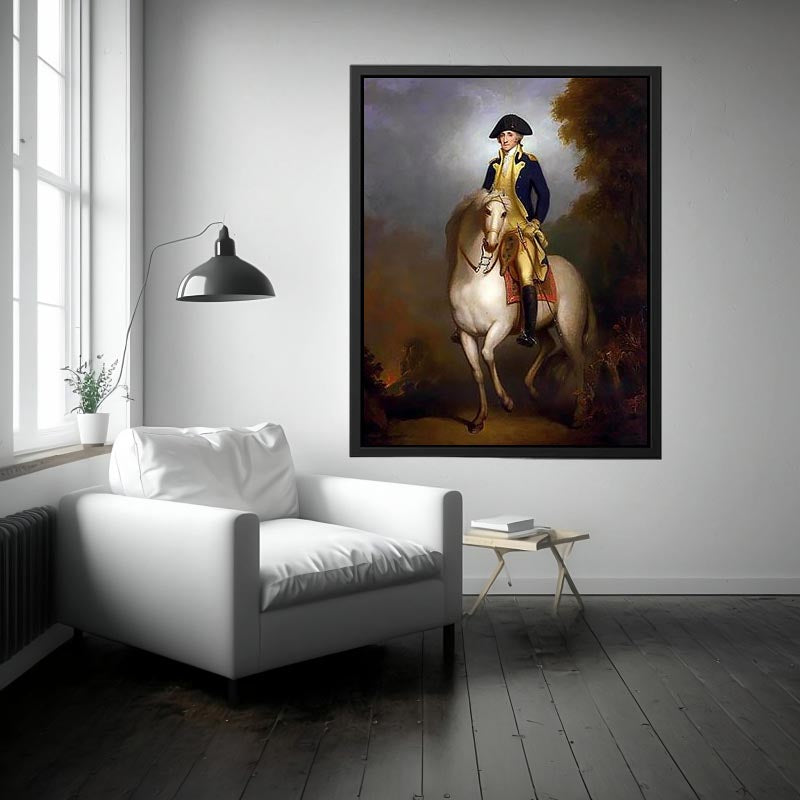
Equestrian Portrait of George Washington Painting by Rembrandt Peale
Equestrian Portrait of George Washington stands as one of Rembrandt Peale’s most ambitious and ideologically charged works, a painting in which leadership, restraint, and republican virtue are articulated through the language of classical grandeur adapted to a modern nation. Rather than offering a literal record of a specific military event, Peale constructs an image of authority shaped by moral purpose and historical consciousness. The result is not a spectacle of conquest, but a measured vision of command, presenting George Washington as a figure whose power is inseparable from discipline, responsibility, and civic resolve.
Rembrandt Peale belonged to the first generation of American artists tasked with giving visual form to a new political identity. Trained within the intellectual legacy of Enlightenment ideals and European academic traditions, he sought to reconcile classical models of heroism with the distinctly non-monarchical values of the American republic. In the equestrian format—long associated with emperors and kings—Peale faced a profound challenge. To depict Washington on horseback without betraying the principles of humility and restraint that defined his leadership required exceptional conceptual balance. This painting represents Peale’s solution.
George Washington is presented mounted and composed, commanding space through presence rather than force. The horse, traditionally a symbol of power and control, is rendered with disciplined energy, its movement contained rather than explosive. Washington’s posture is upright and calm, conveying mastery without aggression. Peale avoids the theatrical dynamism often associated with equestrian portraits of European rulers. Instead, he transforms the genre into a republican statement, where authority arises from character rather than domination.
The composition is carefully structured to maintain equilibrium between figure, mount, and setting. Washington occupies the central axis of the painting, yet nothing crowds or overwhelms him. The surrounding landscape functions not as dramatic backdrop but as contextual ground, anchoring the figure within the world he serves. The spatial arrangement reinforces clarity and order, suggesting leadership exercised within limits rather than imposed through excess.
Perspective plays a crucial role in shaping the painting’s tone. The viewer encounters Washington at a respectful distance, neither elevated into untouchable monumentality nor reduced to anecdotal familiarity. This calibrated distance mirrors the relationship Washington cultivated with the public—authoritative yet accountable. The viewer is invited to contemplate rather than revere, to recognise leadership as a public trust rather than a personal possession.
Light is employed with controlled restraint. Peale illuminates Washington and horse clearly, avoiding dramatic chiaroscuro or symbolic radiance. Light reveals form, structure, and composure without transforming the figure into myth. This clarity aligns with Enlightenment ideals of transparency and reason. The illumination suggests moral visibility rather than divine sanction, reinforcing the painting’s republican ethos.
Colour is sober and purposeful. Peale favours a restrained palette of earth tones, muted blues, and disciplined contrasts that support form rather than spectacle. There is no indulgence in luxurious colour or ornamental flourish. The chromatic restraint directs attention to posture, gesture, and bearing, ensuring that meaning emerges through structure rather than surface.
Peale’s handling of paint reflects academic discipline and intellectual intent. Brushwork is controlled and deliberate, subordinating painterly display to clarity of representation. The horse is rendered with anatomical precision, conveying strength tempered by control. Washington’s figure is modelled with firmness and dignity, avoiding both idealisation and excessive realism. The surface resolves smoothly, reinforcing the painting’s aspiration toward permanence.
Emotionally, Equestrian Portrait of George Washington conveys calm authority and moral seriousness. There is no triumph, no urgency, no overt drama. The emotional register is measured, reflecting a leader defined by endurance and foresight rather than impulse. Peale captures Washington not at a moment of action, but in a state of readiness—a figure prepared to act, yet governed by restraint.
Symbolically, the painting operates through adaptation rather than rejection of tradition. By adopting the equestrian format while stripping it of monarchical excess, Peale reclaims a classical symbol for republican values. Washington becomes not a conqueror, but a guardian of civic order. The horse, responsive and controlled, mirrors the ideal relationship between power and principle.
Within Rembrandt Peale’s broader body of work, this painting represents a crucial attempt to expand American portraiture beyond likeness into historical synthesis. While Peale is best known for his iconic images of Washington in civilian dress, the equestrian portrait demonstrates his willingness to engage with grand tradition while redefining its meaning. It stands as evidence of an artist negotiating between inherited forms and emerging national ideals.
The painting’s relevance today remains strong across the United States, the United Kingdom, Canada, Australia, and Europe. Contemporary viewers continue to engage with questions of leadership, authority, and ethical power. In an age often marked by spectacle and immediacy, Peale’s Washington offers a vision of command grounded in patience, clarity, and responsibility.
In interior settings, Equestrian Portrait of George Washington introduces gravitas, historical depth, and architectural presence. In living rooms, it becomes a commanding focal point that invites reflection on leadership and history. In studies and offices, it reinforces values of discipline, foresight, and public service. In galleries and luxury residences, it signals engagement with foundational moments of modern political culture.
The painting integrates seamlessly into traditional, modern, minimalist, and eclectic décor. Traditional interiors resonate with its classical structure and historical authority. Modern spaces benefit from its compositional clarity and ethical restraint. Minimalist environments amplify its seriousness, while eclectic interiors draw cohesion from its balanced palette and symbolic weight.
The enduring importance of Equestrian Portrait of George Washington lies in its successful redefinition of heroism. Peale does not glorify power; he civilises it. The painting endures because it recognises that true leadership is measured not by spectacle, but by the ability to wield authority without surrendering principle.
To live with Equestrian Portrait of George Washington is to engage daily with a work that affirms the dignity of restraint. Through its disciplined composition, measured symbolism, and intellectual clarity, the painting continues to affirm Rembrandt Peale’s role as a foundational interpreter of American identity. It stands as a testament to his belief that art, when guided by reason and historical consciousness, can give enduring form to the ideals of a republic.
Buy museum qulaity 400- 450 canvas prints, framed prints, and 100% oil paintings of Equestrian Portrait of George Washington by Rembrandt Peale at Alpha Art Gallery, where world-famous masterpieces are recreated with museum-quality detail, refined craftsmanship, and premium materials.
FAQS
What is depicted in Equestrian Portrait of George Washington?
It depicts George Washington mounted on horseback, presented as a composed and disciplined leader rather than a triumphant conqueror.
Why did Rembrandt Peale choose the equestrian format?
He adapted a classical tradition of leadership portraiture to express republican authority grounded in restraint and moral responsibility.
Is this painting based on a specific historical event?
No. It is an idealised representation intended to convey character and leadership rather than document a particular moment.
How does the painting portray Washington’s leadership style?
Through calm posture, compositional balance, and controlled symbolism that emphasise discipline over spectacle.
What emotional tone does the painting convey?
It conveys steadiness, readiness, and moral seriousness rather than drama or triumph.
Is Equestrian Portrait of George Washington suitable for contemporary interiors?
Yes. Its clarity, authority, and timeless structure integrate seamlessly into modern and traditional spaces.
Does this artwork have lasting cultural importance?
As a reinterpretation of classical heroism for a modern republic, it holds enduring historical and artistic significance.
Where is the best place to display Equestrian Portrait of George Washington?
It is especially well suited to studies, offices, libraries, galleries, and spaces that value leadership, history, and reflection.