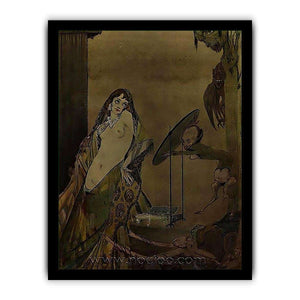
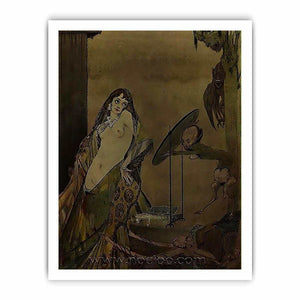
“Drest thus, I seem a different creature”, illustration from Faust by Goethe Painting by Harry Clarke
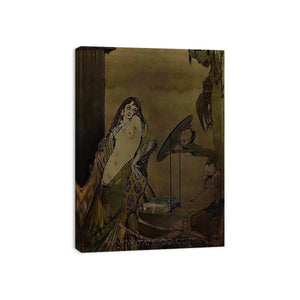
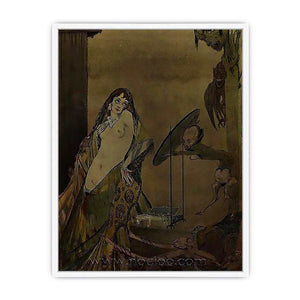
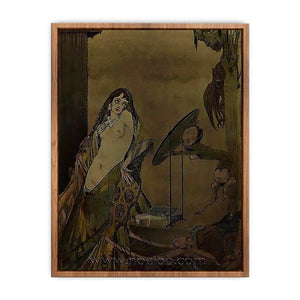
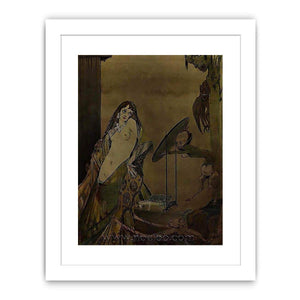
“Drest thus, I seem a different creature”, illustration from Faust by Goethe Painting by Harry Clarke is a work of extraordinary psychological intensity and visual imagination, standing among the most sophisticated literary illustrations of the early twentieth century. Created as part of Clarke’s celebrated illustrations for Goethe’s Faust, the image does not merely accompany text; it penetrates it. Clarke translates a moment of transformation—external, internal, and metaphysical—into a highly charged visual language where line, ornament, and symbolism merge into a single, hypnotic vision of altered identity.
Harry Clarke was one of the most distinctive artists of the Symbolist tradition, renowned for his mastery of line, his jewel-like tonal richness, and his ability to give visual form to psychological and spiritual states. Working at the intersection of illustration, decorative art, and fine art, Clarke approached literature not as narrative to be explained, but as inner experience to be embodied. His illustrations for Faust are widely regarded as the pinnacle of his achievement, and this image encapsulates his unique ability to render transformation as both seductive and unsettling.
The moment illustrated comes from Goethe’s Faust, when Faust, newly altered by Mephistopheles’ influence, contemplates his changed appearance and condition. It is a line charged with irony, self-awareness, and latent danger. Clarke seizes upon this ambiguity. Rather than portraying a simple change of costume or demeanor, he presents transformation as a profound reconfiguration of the self. The figure appears elongated, stylized, and almost otherworldly, suspended between human presence and symbolic abstraction.
Compositionally, the image is constructed with vertical emphasis, drawing the eye upward and inward. Clarke’s figures rarely exist comfortably within natural space; instead, they inhabit a realm of patterned surfaces, ornamental frames, and compressed depth. In this illustration, the figure is enveloped by decorative elements that both define and confine him, suggesting that transformation is inseparable from constraint. Identity is not merely expanded; it is reshaped by forces beyond the self.
Line is the dominant expressive force. Clarke’s sinuous, precise contours carve the figure with deliberate elegance, emphasizing elongation and tension rather than naturalistic proportion. The line is not descriptive alone; it is psychological. Each curve and edge seems to pulse with intention, reinforcing the sense that the figure’s new state is both alluring and precarious. Clarke’s line work guides the viewer into a slow, almost ritualistic reading of the image.
Clarke’s use of pattern intensifies the work’s symbolic density. Garments, background, and surrounding motifs interlock in a dense visual field where figure and environment are inseparable. This fusion suggests that Faust’s transformation is not superficial. His altered appearance reflects an altered reality, one in which boundaries between inner desire and external form have dissolved. Pattern becomes a metaphor for enchantment—beautiful, intricate, and potentially entrapping.
Colour, though often restrained in Clarke’s printed illustrations, is implied with jewel-like richness through tonal contrast and density. Dark grounds offset pale flesh and luminous highlights, creating a visual rhythm that feels both luxurious and ominous. Light does not illuminate; it accentuates. The figure emerges from darkness not as redeemed, but as redefined, marked by the cost of transformation.
Symbolism operates at every level of the image. The refined elegance of the figure hints at power and privilege newly acquired, while the exaggerated stylization suggests artifice rather than authenticity. Clarke captures the dual nature of Faust’s condition: the exhilaration of becoming “different” and the subtle loss of grounding that accompanies such change. The illustration does not judge overtly; it observes with unsettling clarity.
Emotionally, the image is charged with introspection rather than action. The figure does not move forward; he contemplates himself. This inward focus is crucial. Clarke presents transformation not as triumph, but as a moment of self-recognition tinged with unease. The viewer senses that the declaration “I seem a different creature” carries both wonder and alarm. Identity, once altered, cannot easily be reclaimed.
Within Clarke’s broader artistic practice, this illustration exemplifies his genius for visualizing psychological thresholds. Like his illustrations for Poe and other literary works, this image occupies a liminal space between beauty and dread. Clarke does not illustrate events; he illustrates states of being. The work stands as a mature expression of Symbolist thought, where external form becomes the language of inner transformation.
Culturally, the illustration belongs to a period deeply concerned with identity, duality, and moral ambiguity. Created in the aftermath of profound social and spiritual upheaval, Clarke’s Faust illustrations resonate with early twentieth-century anxieties about power, desire, and self-reinvention. His Faust is not merely a scholar tempted by knowledge, but a modern figure confronting the consequences of chosen transformation.
In contemporary interiors across the United States, the United Kingdom, Canada, Australia, and Europe, this work carries striking intellectual and visual authority. In living rooms, it introduces dramatic depth and literary sophistication. In studies, libraries, and private offices, it resonates with themes of identity, ambition, and self-examination. In galleries and luxury residences, it signals connoisseurship and an appreciation for illustration as a serious and culturally significant art form.
The artwork integrates seamlessly into modern and minimalist interiors, where its linear precision and symbolic intensity provide contrast and focus. It also complements eclectic and traditional settings, where its decorative complexity and literary heritage enrich layered environments. Wherever it is placed, the image demands attention and contemplation rather than passive viewing.
The long-term artistic importance of “Drest thus, I seem a different creature” lies in its uncompromising psychological insight. Clarke demonstrates that illustration can rival painting in depth and authority, and that literature’s most profound moments often occur not in action, but in recognition. The work endures because it visualizes transformation as a condition that is at once seductive, unsettling, and irreversible.
Today, the illustration remains profoundly relevant. In an age preoccupied with reinvention and identity, Clarke’s vision of transformation feels uncannily contemporary. Through disciplined line, symbolic density, and emotional intelligence, Harry Clarke created an image that continues to speak across time, offering a haunting meditation on what it means to become “a different creature.”
Buy museum qulaity 400- 450 canvas prints, framed prints, and 100% oil paintings of “Drest thus, I seem a different creature”, illustration from Faust by Goethe by Harry Clarke at Alpha Art Gallery, where world-famous masterpieces are recreated with museum-quality detail, refined craftsmanship, and premium materials.
FAQS
What literary work does this illustration come from?
It is an illustration from Goethe’s Faust, depicting a moment of Faust’s transformation.
What does the phrase “Drest thus, I seem a different creature” signify?
It reflects Faust’s recognition of his altered identity after embracing supernatural influence.
How does Harry Clarke interpret this moment visually?
He presents transformation as psychological and symbolic rather than merely physical, using stylization and ornament.
Is this artwork decorative or symbolic?
It is both, combining decorative richness with deep symbolic and psychological meaning.
Where does this artwork work best in interior spaces?
It is ideal for studies, libraries, living rooms, offices, galleries, and refined residential interiors.
Is this illustration suitable for modern décor?
Yes, its linear precision and dramatic intensity integrate powerfully into modern and minimalist settings.
Does this work have lasting artistic significance?
Its fusion of literary depth, Symbolist aesthetics, and psychological insight ensures enduring relevance.