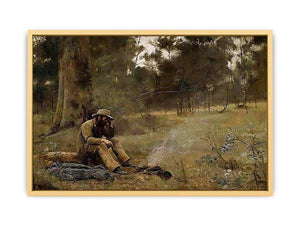
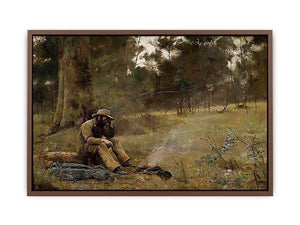
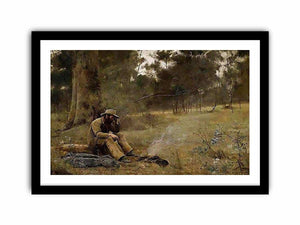
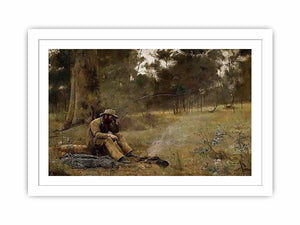
Down on His Luck Painting by Frederick McCubbin
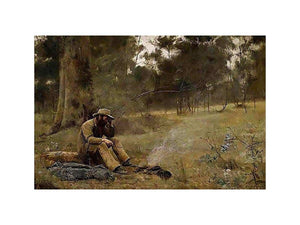
Down on His Luck stands as one of Frederick McCubbin’s most quietly devastating and psychologically profound works, a painting in which the hardships of colonial life, human endurance, and existential uncertainty are rendered with exceptional restraint and moral clarity. Painted in 1889, during the formative years of Australian Impressionism, the work occupies a central position not only in McCubbin’s career but also in the visual history of Australia itself. Rather than presenting heroism, conquest, or pastoral ideal, McCubbin confronts the human cost of aspiration, depicting solitude and failure with a dignity that transforms despair into contemplative presence.
Frederick McCubbin was a founding member of the Heidelberg School, a movement that sought to articulate a distinctly Australian visual language rooted in lived experience rather than inherited European idealism. While many of his contemporaries focused on landscape and light, McCubbin consistently turned toward narrative and psychology. In Down on His Luck, this narrative impulse is stripped to its essentials. The painting does not describe an event; it describes a condition. The viewer is presented not with action, but with pause—an interval in which time seems suspended and meaning uncertain.
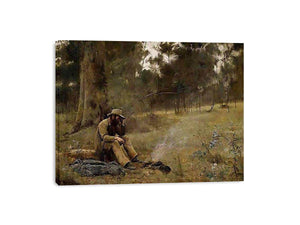
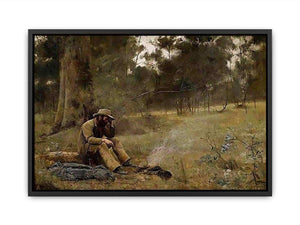
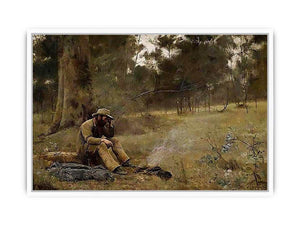
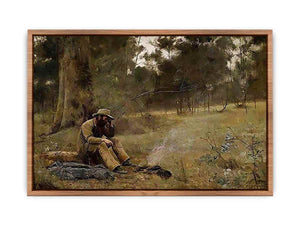
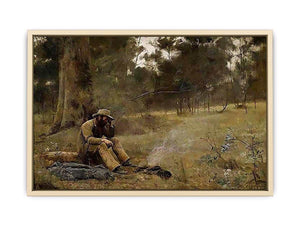
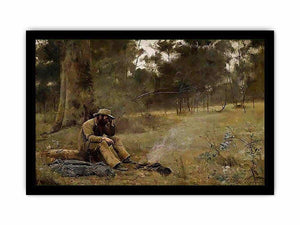
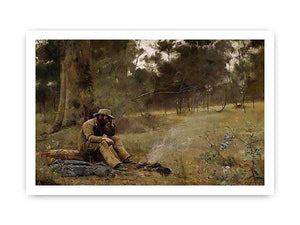
The composition is deceptively simple. A solitary figure sits on the ground beneath the trees, his body slumped forward, his posture heavy with exhaustion and defeat. McCubbin places him slightly off-centre, allowing the surrounding bushland to press inward rather than open outward. This spatial choice reinforces the sense of enclosure and isolation. Nature does not threaten, but neither does it console. It exists with indifferent continuity, framing the human figure as vulnerable and transient.
The man’s posture is central to the painting’s emotional impact. He leans forward, elbows resting on his knees, hands loosely clasped, head inclined downward. There is no dramatic gesture, no expression of anguish. McCubbin avoids melodrama entirely. Instead, he allows fatigue and resignation to manifest through weight and stillness. The body communicates what the face withholds. This restraint intensifies the painting’s psychological realism, inviting the viewer to infer rather than observe emotion.
Light is handled with subtle deliberation. McCubbin employs a muted, filtered illumination that penetrates the bush in broken patches rather than flooding the scene. This dappled light neither redeems nor condemns the figure. It suggests time passing—perhaps afternoon waning—without offering narrative resolution. The light situates the figure firmly within the environment, denying both spotlight and obscurity. He is seen, but not elevated.
Colour is restrained and earthy. McCubbin favours browns, muted greens, ochres, and subdued flesh tones, harmonised to reflect the Australian bush without romantic embellishment. The palette reinforces emotional sobriety. There are no chromatic accents to distract or dramatise. Colour functions structurally, binding figure and landscape into a unified emotional field.
McCubbin’s brushwork is controlled yet expressive. The landscape is rendered with broad, economical strokes that suggest texture and density without descriptive excess. The figure, by contrast, is handled with greater solidity, anchoring human presence within the scene. This contrast reinforces the painting’s thematic tension: the enduring continuity of nature versus the precariousness of human fortune.
Symbolically, Down on His Luck resists easy interpretation. The figure may be a swagman, a prospector, or an itinerant worker—an everyman shaped by colonial ambition and its frequent disappointments. McCubbin does not specify biography or outcome. There is no visible path forward, no sign of return. The absence of narrative closure is deliberate. The painting becomes a meditation on uncertainty itself, on the moment when effort has not yet yielded meaning.
Emotionally, the work is profoundly restrained. It does not seek pity or outrage. Instead, it invites recognition. The man’s solitude is not theatrical; it is ordinary. McCubbin presents hardship as a lived condition rather than a moral lesson. This emotional honesty is central to the painting’s enduring power. It allows the viewer to encounter vulnerability without sentimentality.
Within McCubbin’s oeuvre, Down on His Luck represents a turning point toward deeper psychological engagement. While he painted heroic narratives of pioneering life elsewhere, this work strips away collective mythology to focus on individual cost. It reflects McCubbin’s belief that national identity is forged not only through triumph, but through endurance and loss.
The painting’s relevance today remains striking across Australia and internationally, including the United States, the United Kingdom, Canada, and Europe. Contemporary audiences continue to respond to its quiet portrayal of uncertainty and resilience. In a modern world shaped by economic precarity and displacement, Down on His Luck speaks with renewed clarity. Its power lies in its refusal to offer consolation without truth.
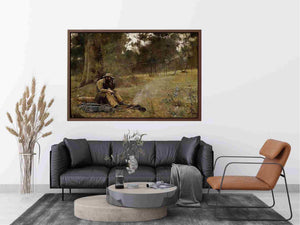
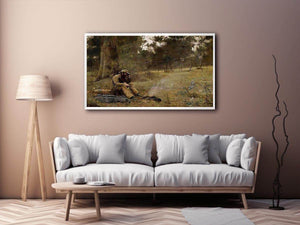
In interior settings, the painting introduces gravity, introspection, and emotional depth. In living rooms, it functions as a contemplative anchor rather than decorative object. In studies and offices, it reinforces awareness of responsibility, perseverance, and humility. In galleries and luxury residences, it signals engagement with art that values psychological truth over spectacle.
The painting integrates seamlessly into traditional, modern, minimalist, and eclectic décor. Traditional interiors resonate with its narrative realism and tonal restraint. Modern spaces benefit from its compositional clarity and emotional honesty. Minimalist environments amplify its stillness and moral weight, while eclectic interiors draw cohesion from its grounded palette and universal theme.
The enduring importance of Down on His Luck lies in its refusal to romanticise struggle or resolve it artificially. McCubbin presents hardship as a pause rather than an endpoint—a moment when identity, purpose, and future remain unresolved. The painting endures because it recognises that failure, like success, is a defining human experience.
To live with Down on His Luck is to engage daily with a work that honours dignity without illusion. Through its restrained composition, psychological depth, and moral seriousness, the painting continues to affirm Frederick McCubbin’s position as one of the most humane and insightful painters of the Australian experience. It stands as a testament to his belief that art, when grounded in truth and empathy, possesses enduring cultural and emotional resonance.
Buy museum qulaity 400- 450 canvas prints, framed prints, and 100% oil paintings of Down on His Luck by Frederick McCubbin at Alpha Art Gallery, where world-famous masterpieces are recreated with museum-quality detail, refined craftsmanship, and premium materials.
FAQS
What does Down on His Luck depict?
It depicts a solitary man resting in the Australian bush, capturing a moment of exhaustion, uncertainty, and reflection rather than action.
Why is this painting considered important in Australian art?
It presents a psychologically honest portrayal of hardship, contributing to a distinctly Australian narrative of endurance and realism.
Is the figure meant to represent a specific individual?
No. He functions as an everyman, embodying the broader experience of colonial struggle and uncertainty.
How does McCubbin use the landscape in this work?
The bush frames the figure with quiet indifference, reinforcing isolation without overt threat or comfort.
Is Down on His Luck suitable for contemporary interiors?
Yes. Its restrained palette and emotional depth integrate effectively into modern and traditional spaces.
What emotional tone does the painting convey?
It conveys quiet resignation, introspection, and dignity rather than despair or melodrama.
Does this artwork have lasting cultural relevance?
As a foundational work of Australian realism, it holds enduring artistic and social significance.
Where is the best place to display Down on His Luck?
It is especially well suited to studies, living rooms, galleries, and spaces intended for thoughtful reflection.