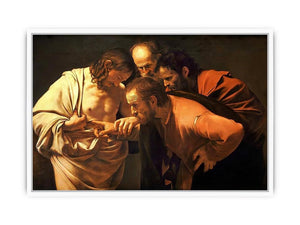
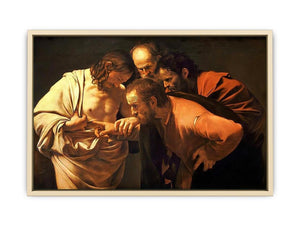
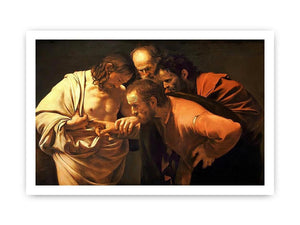
Doubting Thomas Painting by Caravaggio
Doubting Thomas stands as one of the most uncompromising and psychologically intense interpretations of biblical narrative in Western art, a painting in which Caravaggio collapses the distance between sacred history and human experience with startling immediacy. Painted around 1601–1602, the work exemplifies Caravaggio’s revolutionary approach to religious subject matter: scripture is not idealised or softened, but rendered as a confrontation between flesh, belief, and uncertainty. In this painting, faith is not presented as abstraction or doctrine; it is tested through touch, proximity, and visceral proof.
Caravaggio produced Doubting Thomas during a period of extraordinary creative power, when his radical naturalism was redefining the visual language of Baroque art. Rejecting the polished idealism of late Renaissance convention, he turned instead to models drawn from everyday life, dramatic contrasts of light and shadow, and moments of psychological extremity. The story of the apostle Thomas, who demands physical evidence of Christ’s resurrection, provided Caravaggio with the perfect subject through which to explore doubt not as weakness, but as a deeply human condition.
The composition is tightly compressed, bringing the figures into a shallow, intimate space that denies any sense of distance or detachment. Christ stands at the centre, guiding Thomas’s hand directly into the wound in his side. The gesture is unflinching. The wound is not symbolically suggested; it is anatomically precise, opened, and palpably real. Two other apostles lean in closely, their brows furrowed, their faces marked by age, labour, and concentration. The scene unfolds as a collective act of scrutiny, not a private revelation.
Perspective is crucial to the painting’s impact. Caravaggio positions the viewer at the same level as the figures, close enough to feel implicated in the act of inspection. There is no elevated vantage point, no divine distance. The space is crowded, the air thick with attention. The figures press toward the wound as though truth itself requires physical closeness. This compositional choice transforms the biblical episode into an event that unfolds before the viewer rather than beyond them.
Light is the painting’s most powerful expressive force. Emerging from darkness, it cuts sharply across the figures, illuminating flesh, fabric, and gesture with surgical clarity. Caravaggio’s chiaroscuro does not merely model form; it directs meaning. Light falls most intensely on Christ’s torso and Thomas’s probing finger, forcing the viewer’s gaze toward the precise point of contact between belief and evidence. The surrounding darkness absorbs everything else, eliminating distraction and heightening focus.
Colour is restrained and earthbound. Flesh tones dominate the composition, rendered with an unidealised honesty that emphasises weight, texture, and vulnerability. The garments of the apostles are muted, their browns and ochres reinforcing the scene’s material gravity. There is no decorative palette, no chromatic symbolism to soften the encounter. Colour serves realism and immediacy, anchoring the sacred narrative firmly within the physical world.
Caravaggio’s handling of paint intensifies the sense of presence. His figures are sculpted through light rather than line, emerging from shadow with tactile solidity. Wrinkles, dirt under fingernails, coarse fabric, and strained musculature are all rendered without concession. The body of Christ, though resurrected, is not ethereal. It is substantial, vulnerable, and open. This insistence on corporeality redefines the nature of the miracle itself. Resurrection is affirmed not by transcendence, but by continuity of flesh.
Symbolically, Doubting Thomas confronts the relationship between faith and empiricism. Thomas’s doubt is not condemned or ridiculed. Instead, it is acknowledged and met. Christ does not withdraw from scrutiny; he invites it. The wound becomes both evidence and threshold, a site where belief must pass through physical reality. Caravaggio thus reframes doubt as part of the path to understanding rather than its negation.
Emotionally, the painting is charged with tension and concentration rather than exaltation. There is no outward expression of joy or revelation. The faces of the apostles register focus, curiosity, and gravity. This restraint amplifies the scene’s seriousness. Faith here is not ecstatic; it is earned. The viewer senses the weight of the moment not through gesture, but through stillness and attention.
Within Caravaggio’s career, Doubting Thomas represents a mature synthesis of his artistic principles. It demonstrates his commitment to truthfulness, his refusal to idealise the sacred, and his belief that spiritual meaning emerges most powerfully when grounded in human experience. The painting exemplifies the Counter-Reformation emphasis on direct engagement with scripture, yet Caravaggio’s interpretation remains singular in its intensity and honesty.
Culturally, the work has exerted profound influence on the development of Baroque art. Its dramatic realism challenged artists to reconsider how religious narratives could be made immediate and persuasive. By collapsing the distance between viewer and event, Caravaggio altered expectations of devotional imagery, encouraging engagement not through ornament or ideal beauty, but through recognition and confrontation.
In contemporary interiors, Doubting Thomas carries exceptional gravitas and intellectual presence. In living rooms, it functions as a powerful focal point that invites contemplation and discussion. In studies and offices, it communicates seriousness, inquiry, and moral depth. In galleries and refined residences across the United States, United Kingdom, Canada, Australia, and Europe, the painting integrates most effectively within spaces that value cultural significance and emotional intensity. Its restrained palette and dramatic lighting complement both traditional and modern interiors, anchoring space through meaning rather than decoration.
The enduring relevance of Doubting Thomas lies in its uncompromising honesty about belief. Caravaggio presents faith not as passive acceptance, but as something tested by experience, doubt, and contact with reality. The painting acknowledges the human need to know, to touch, and to verify, without stripping belief of its power. In doing so, it remains one of the most profound visual meditations on faith and doubt ever created, confronting viewers across centuries with the same question it posed to Thomas himself: what does it mean to believe?
Buy museum qulaity 400- 450 canvas prints, framed prints, and 100% oil paintings of Doubting Thomas by Caravaggio at Alpha Art Gallery, where world-famous masterpieces are recreated with museum-quality detail, refined craftsmanship, and premium materials.
FAQS
What moment does Doubting Thomas by Caravaggio depict?
It depicts the moment when the apostle Thomas physically touches Christ’s wound to verify the Resurrection.
Why is the painting considered so realistic?
Caravaggio uses ordinary models, unidealised anatomy, and dramatic light to emphasise physical truth.
Is Thomas portrayed negatively for his doubt?
No, his doubt is presented as a human response that becomes part of the path to belief.
What role does light play in the painting?
Light directs attention to the wound and the act of touch, reinforcing the theme of verification through experience.
Why are the figures shown so close together?
The compressed space intensifies psychological focus and draws the viewer into the act of scrutiny.
How does this painting reflect Caravaggio’s style?
It exemplifies his dramatic realism, chiaroscuro, and refusal to idealise sacred subjects.
Is Doubting Thomas suitable for contemporary interiors?
Yes, particularly in spaces that value intellectual depth, narrative power, and emotional intensity.
Why does Doubting Thomas remain relevant today?
Its exploration of doubt, evidence, and belief continues to resonate in modern discussions of faith and reason.