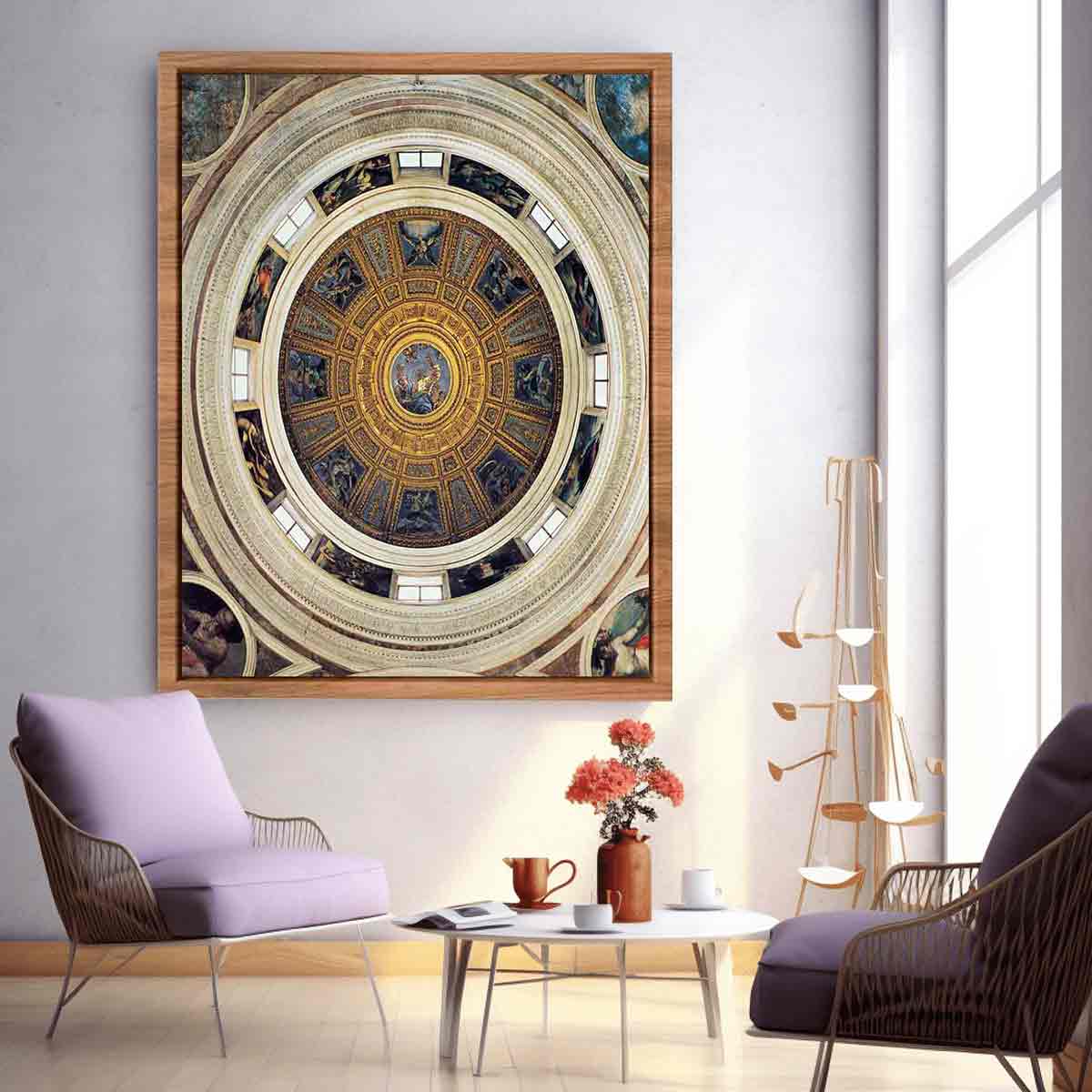
Dome of the Chigi Chapel by Raphael: A Renaissance Universe in Mosaic
Raphael's Dome of the Chigi Chapel is one of the most ambitious architectural and decorative achievements of his Roman period. Designed for the Chigi Chapel in the Basilica of Santa Maria del Popolo, Rome, the dome transforms a funerary chapel into a vision of the heavens. At its center is God the Father, while surrounding compartments present the planets and celestial imagery within a carefully organized circular design. Raphael created the cartoons for the mosaic decoration, which was executed in 1516 by the Venetian mosaicist Luigi da Pace.
For collectors seeking Raphael architecture, Renaissance ceiling art or distinctive Italian wall decor, this subject offers something different from a conventional framed painting. The composition was conceived for a curved architectural surface and therefore has a natural sense of movement, symmetry and upward expansion. Reproduced as a large print, canvas or framed architectural artwork, the dome can become a dramatic focal point in a study, library, dining room, office, classical interior or space devoted to Renaissance art.
Agostino Chigi's Chapel in Rome
The Chigi Chapel was commissioned by Agostino Chigi, one of the most influential bankers and patrons in Renaissance Rome. Raphael designed the chapel as a family funerary space within Santa Maria del Popolo. The commission brought together architecture, sculpture, painting and mosaic in a unified program, reflecting the ambitions of a patron who wanted his memorial to embody learning, wealth, faith and artistic sophistication.
The Royal Collection Trust records that Raphael was responsible for designing the chapel and its decorative scheme, including mosaics, sculpture, tombs and probably the altarpiece. The chapel remained unfinished at the deaths of both Raphael and Chigi, but the central visual concept survived and was developed by later artists.
This patronage history is important because the dome is not simply a decorative ceiling. It belongs to a carefully planned Renaissance environment in which architecture itself becomes an instrument of meaning. The upward-looking design links the buried patron with the celestial order above him.
God the Father at the Center
The central roundel presents God the Father as creator. Around him, the surrounding celestial imagery expands into a symbolic universe. The composition is organized so that the viewer standing below looks upward toward a visual hierarchy that begins with the divine center and radiates outward.
This arrangement gives the dome a strong sense of movement even though the individual compartments are carefully bounded. The circular format naturally directs the eye around the vault, while the central medallion remains the visual anchor. It is an excellent example of Renaissance artists adapting pictorial composition to architecture rather than treating a ceiling as though it were simply a flat canvas.
As wall art, this quality can be preserved by choosing a reproduction that respects the original circular structure. A large-format print can make the planetary sequence readable, while a canvas can emphasize the warm decorative character of the mosaic-inspired composition.
The Seven Planets and the Renaissance Cosmos
The celestial program includes personifications associated with the seven planets known to Renaissance astronomy and astrology: the visible planetary bodies that governed the traditional cosmological system. Each is paired with an angelic figure. The result is a sequence that combines Christian theology with the intellectual culture of Renaissance Rome.
This mixture is one of the most fascinating aspects of the chapel. Raphael did not create a narrow image of heaven. Instead, he built a visual universe in which divine creation, planetary order and human knowledge could coexist. The planets appear as part of a larger hierarchy, demonstrating the Renaissance fascination with the relationship between God, nature and the cosmos.
For buyers interested in celestial art, mythology, astronomy or Renaissance symbolism, the dome has an unusual appeal. It can function as historical art while also bringing planetary imagery into a contemporary interior.
Raphael's Architectural Intelligence
Raphael is often celebrated primarily as a painter, but the Chigi Chapel demonstrates the breadth of his architectural imagination. The chapel was designed as a centralized, highly coordinated environment in which the geometry of the building and the decoration work together.
The dome is especially effective because its circular structure is not ignored by the imagery. Instead, the pictures follow the architecture. The eight surrounding compartments and central roundel establish a rhythm that reinforces the curvature of the vault. This is architectural thinking expressed through visual composition.
That quality makes the work attractive to collectors who appreciate architectural drawings, historic interiors and Renaissance design as much as painting. A reproduction can be displayed as a piece of architectural history rather than only as religious art.
From Raphael's Cartoons to Mosaic
The dome's final surface is mosaic rather than fresco. Raphael supplied the designs, while Luigi da Pace executed the mosaics in 1516. This distinction is significant because mosaic requires an artist to think differently about color, surface and scale. Small tesserae catch and reflect light, allowing the ceiling to change subtly as the viewer moves beneath it.
Raphael's cartoons therefore had to communicate forms that could survive translation into another medium. The surviving preparatory studies demonstrate the importance of his designs even though the original full cartoons were lost. The completed mosaic remains evidence of how Raphael's pictorial ideas could be transferred into a durable architectural material.
A modern canvas reproduction cannot duplicate the physical properties of ancient mosaic, but it can preserve the overall composition and celestial structure. For buyers who want the visual character of the Chigi dome without requiring a monumental architectural installation, a carefully produced print or canvas provides a practical way to display the design.
Why the Chigi Dome Is a High Renaissance Masterpiece
The dome belongs to Raphael's mature Roman period, when his work was increasingly connected with large architectural commissions and the intellectual culture of the papal city. The Chigi project demonstrates his ability to move beyond individual pictures and conceive complete environments.
The composition also reflects the High Renaissance preference for order, ideal proportion and harmony. Every section relates to the central axis. The surrounding figures are arranged so that the circular field feels unified rather than fragmented. The result is monumental without depending on narrative action.
That visual discipline is one reason the design remains effective when enlarged for contemporary wall display. The viewer can read the whole arrangement from a distance and then move closer to explore individual figures and symbols.
A Chapel Designed for a Powerful Patron
Agostino Chigi's patronage shaped the ambitious character of the chapel. As a wealthy banker and cultural figure, Chigi could commission leading artists and demand a design that expressed both his devotion and his social standing. Raphael's solution was not merely luxurious; it was intellectually sophisticated.
The chapel connected the Chigi family with the broader cultural language of Renaissance Rome. Its celestial imagery suggested an ordered universe, while its architecture created a setting worthy of a major family monument. Later additions by artists including Gian Lorenzo Bernini changed aspects of the chapel, but Raphael's central conception remained a defining feature.
For collectors, this patronage story gives the dome a strong historical identity. It can be displayed alongside other works connected with Renaissance architecture, banking families, papal Rome and the culture of elite patronage.
Renaissance Ceiling Art for a Modern Interior
A reproduction of the Chigi dome can produce a dramatic effect in a room because the original design was intended to draw the eye upward. Even when displayed vertically on a wall, the circular composition retains its sense of celestial expansion. The central God the Father surrounded by planetary imagery creates a strong visual center, while the surrounding figures provide rhythm.
A large canvas can make the dome feel almost architectural. A framed print offers a more restrained presentation suitable for a library or office. For collectors who favor traditional techniques, a hand-painted reproduction can emphasize the tonal variations and decorative richness associated with Renaissance sacred art.
The subject also works especially well in interiors with classical furnishings, dark wood, architectural photography, maps, astronomical references or other European Old Master pieces. Its combination of religion and cosmology gives it a broader decorative vocabulary than many strictly devotional works.
The Chigi Chapel and Renaissance Rome
Santa Maria del Popolo was one of the important artistic settings of Renaissance Rome, and the Chigi Chapel sits within a church filled with works by leading artists. Raphael's involvement places the chapel directly within the cultural transformation of early sixteenth-century Rome, when architecture and visual art were being used to express new ideas about space, antiquity and patronage.
The dome's celestial imagery is particularly appropriate to that environment. Renaissance Rome looked simultaneously backward to classical antiquity and forward toward new forms of scientific and artistic inquiry. The planets, angels and divine center make the chapel a visual expression of a world understood as ordered and intelligible.
Own a Piece of Raphael's Architectural Vision
For buyers searching for Raphael wall art that feels distinctive, the Dome of the Chigi Chapel is an unusually strong choice. It combines sacred imagery with astronomy, architecture and Renaissance patronage. Unlike a conventional portrait or Madonna, it offers an entire visual universe.
Whether selected as a fine art print, architectural canvas, framed Renaissance reproduction or hand-painted interpretation, the work can bring the atmosphere of Santa Maria del Popolo into a private collection. It is particularly suited to buyers who appreciate Raphael's role not only as a painter but as a designer of complete Renaissance environments.
The dome ultimately demonstrates the breadth of Raphael's imagination. God the Father occupies the center, the planets form a celestial ring, angels animate the heavens and the architecture gives the entire design physical direction. Created for Agostino Chigi's chapel and executed in mosaic from Raphael's designs in 1516, it remains one of the clearest examples of how Renaissance art could unite painting, architecture, theology and cosmology in one coherent vision.