Dickens’ Dream Painting by Robert William Buss
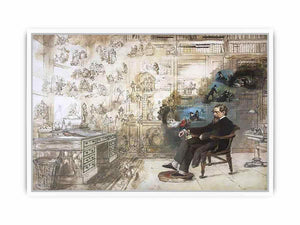
Dickens’ Dream Painting by Robert William Buss is a work of extraordinary literary sensitivity and psychological richness, standing as one of the most evocative visual tributes ever created to a writer’s imaginative world. Painted in the mid-nineteenth century, the work occupies a unique position between portraiture, allegory, and literary homage. Buss does not depict Charles Dickens as a public celebrity or social reformer, but as a solitary creator suspended between consciousness and imagination, surrounded by the figures born of his own mind. The painting transforms authorship itself into subject matter, presenting creativity as an inward, almost dreamlike condition.
Robert William Buss was closely connected to Dickens’s circle and deeply attuned to the literary culture of Victorian England. Though his career was uneven and often overshadowed by circumstance, Buss possessed an acute understanding of narrative and character. Dickens’ Dream reveals his most profound strength: the ability to translate literary imagination into visual form without reducing it to illustration. Instead of narrating a specific scene from a novel, Buss constructs a mental landscape in which fiction, memory, and creative labor coexist.
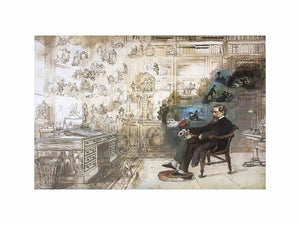
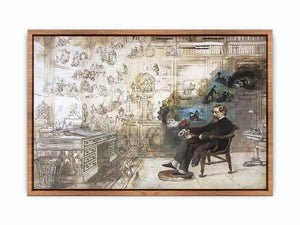
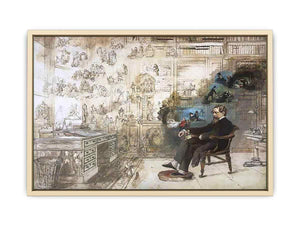
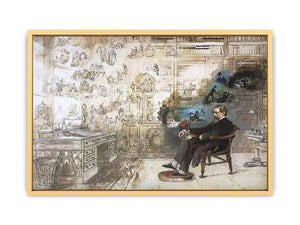
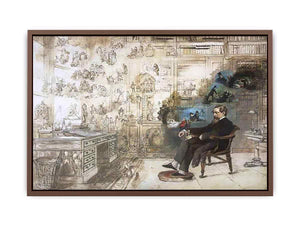
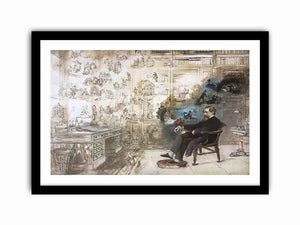
The painting presents Dickens seated at his desk, head resting upon his hand, caught in a moment of reverie. He is neither writing nor addressing the viewer. His posture suggests fatigue as much as contemplation, implying the physical and mental toll of sustained creation. This choice immediately distinguishes the work from celebratory portraits. Buss portrays not the triumph of authorship, but its inward cost—the solitude, concentration, and vulnerability that underlie imaginative power.
Surrounding Dickens are the spectral figures of his fictional characters, emerging as if from thought itself. They do not intrude violently upon the scene, nor do they demand attention individually. Instead, they gather quietly, occupying the space above and around the writer, forming a cloud of memory and invention. Buss arranges them with deliberate restraint, allowing recognition without theatrical emphasis. The figures appear real yet insubstantial, reinforcing their status as creations rather than living presences.
Compositionally, the painting is structured to emphasize interiority. Dickens occupies the lower portion of the canvas, anchored firmly in the physical world of desk, papers, and books. Above him unfolds the imaginative realm, where characters float without clear spatial boundaries. This vertical division reflects the dual existence of the writer: grounded in labor, yet perpetually engaged with imagined worlds. Buss manages this division without rupture, ensuring visual continuity between reality and dream.
Perspective reinforces this psychological structure. The viewer observes Dickens from a respectful distance, close enough to sense intimacy but not so close as to intrude. The imagined figures are positioned beyond ordinary perspective, existing in a compressed, dreamlike space that resists rational depth. This contrast underscores the painting’s central theme: the coexistence of tangible effort and intangible vision.
Light plays a crucial symbolic role. Illumination falls gently upon Dickens, clarifying his features and the immediate objects of work. The surrounding figures are rendered with softer, more diffuse light, reinforcing their immaterial nature. There is no dramatic contrast, no divine spotlight. Light here suggests consciousness itself, fading gradually into imagination rather than separating worlds abruptly.
Colour is handled with restraint and intelligence. The palette is subdued, dominated by warm browns, muted blues, and soft greys. Dickens’s physical environment is rendered with earthy solidity, while the imagined figures appear in lighter, cooler tones. This chromatic distinction supports the conceptual division between material reality and creative vision without resorting to visual excess.
Buss’s brushwork is controlled and unobtrusive. He avoids ostentatious technique, allowing form and meaning to take precedence. Figures are clearly articulated but never overly detailed, ensuring that no single character overwhelms the composition. This restraint preserves the painting’s unity and reinforces its contemplative mood.
Emotionally, Dickens’ Dream is marked by quiet intensity. There is no overt drama, no gesture of revelation. Instead, the painting conveys the weight of imagination sustained over time. Dickens appears absorbed, perhaps even burdened, by the world he has created. The surrounding characters do not celebrate him; they depend upon him. This reversal is crucial. Buss suggests that the creator serves the creation as much as the creation serves the creator.
Symbolically, the painting operates as a meditation on authorship, memory, and legacy. The characters represent more than narrative invention; they embody the emotional and moral concerns that animated Dickens’s work. Their presence implies that once created, fictional lives acquire a form of autonomy, inhabiting the mind of the writer long after they have been set on the page. The dream becomes not escape, but responsibility.
Within Buss’s career, Dickens’ Dream stands as his most enduring achievement. While he produced other narrative and historical works, none approach the psychological coherence and cultural resonance of this painting. It demonstrates his capacity to engage literature not as illustration, but as intellectual and emotional terrain. The painting has endured precisely because it transcends anecdote, offering instead a universal image of creative consciousness.
Culturally, the work holds exceptional importance as a Victorian reflection on the nature of imagination. In an era fascinated by authorship, industry, and moral influence, Buss presents creativity as introspective rather than performative. Dickens is not shown addressing society; he is shown listening inwardly. This portrayal complicates the myth of the public writer, emphasizing solitude over spectacle.
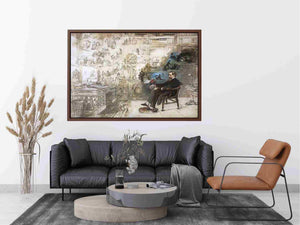
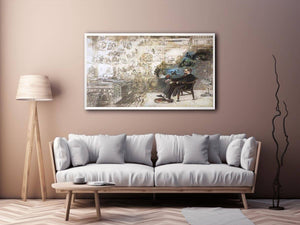
In contemporary interiors across the United States, the United Kingdom, Canada, Australia, and Europe, Dickens’ Dream integrates with remarkable depth and refinement. In living rooms, it introduces narrative richness and intellectual warmth. In studies, libraries, and private offices, it resonates profoundly, reflecting the relationship between thought, labor, and imagination. In galleries and curated residences, it communicates cultural literacy and a deep appreciation for the intersection of art and literature.
The painting adapts naturally to traditional interiors, where its Victorian sensibility and literary subject align with classic design. At the same time, it functions powerfully in modern and minimalist spaces, where its psychological focus and muted palette provide contrast without ornament. In eclectic settings, it serves as a contemplative anchor, uniting diverse elements through shared introspection.
The long-term artistic importance of Dickens’ Dream lies in its refusal to romanticize creativity. Buss presents imagination as sustained effort rather than sudden inspiration, as accumulation rather than spectacle. This honesty ensures the painting’s enduring relevance, speaking to writers, artists, and thinkers across generations.
Today, Dickens’ Dream remains deeply compelling because it recognizes creativity as a form of quiet endurance. It does not glorify the writer as hero; it honors the act of imagining as labor, responsibility, and inward dialogue. Through compositional intelligence, symbolic restraint, and emotional depth, Robert William Buss created a painting that continues to illuminate the inner life of creation, securing its place as one of the most thoughtful literary portraits in Western art.
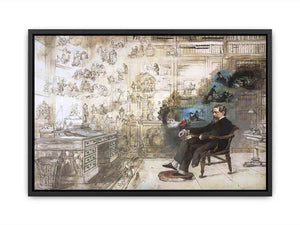
Buy museum qulaity 400- 450 canvas prints, framed prints, and 100% oil paintings of Dickens’ Dream by Robert William Buss at Alpha Art Gallery, where world-famous masterpieces are recreated with museum-quality detail, refined craftsmanship, and premium materials.
FAQS
What is the subject of Dickens’ Dream by Robert William Buss?
It depicts Charles Dickens in a moment of reverie, surrounded by the characters created from his imagination.
Is this painting a literal illustration of a Dickens novel?
No, it is an allegorical portrait representing the act of authorship rather than a specific story.
Why are the characters shown as spectral figures?
They symbolize imagination and memory, existing between thought and creation rather than physical reality.
What emotional tone does the painting convey?
It conveys introspection, mental fatigue, and the quiet intensity of sustained creative work.
Where does this artwork work best in interior spaces?
It is ideal for studies, libraries, living rooms, offices, galleries, and literary or contemplative interiors.
Is Dickens’ Dream suitable for modern décor?
Yes, its restrained palette and psychological depth integrate well into modern, traditional, and minimalist spaces.
Does the painting have lasting cultural significance?
Its insight into creativity, authorship, and imagination ensures enduring relevance across generations.