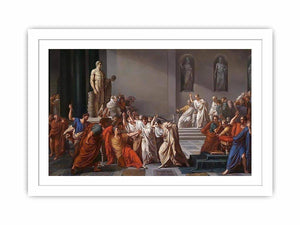
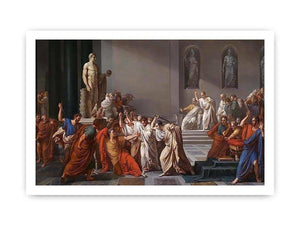
Death of Julius Caesar Painting by Vincenzo Camuccini
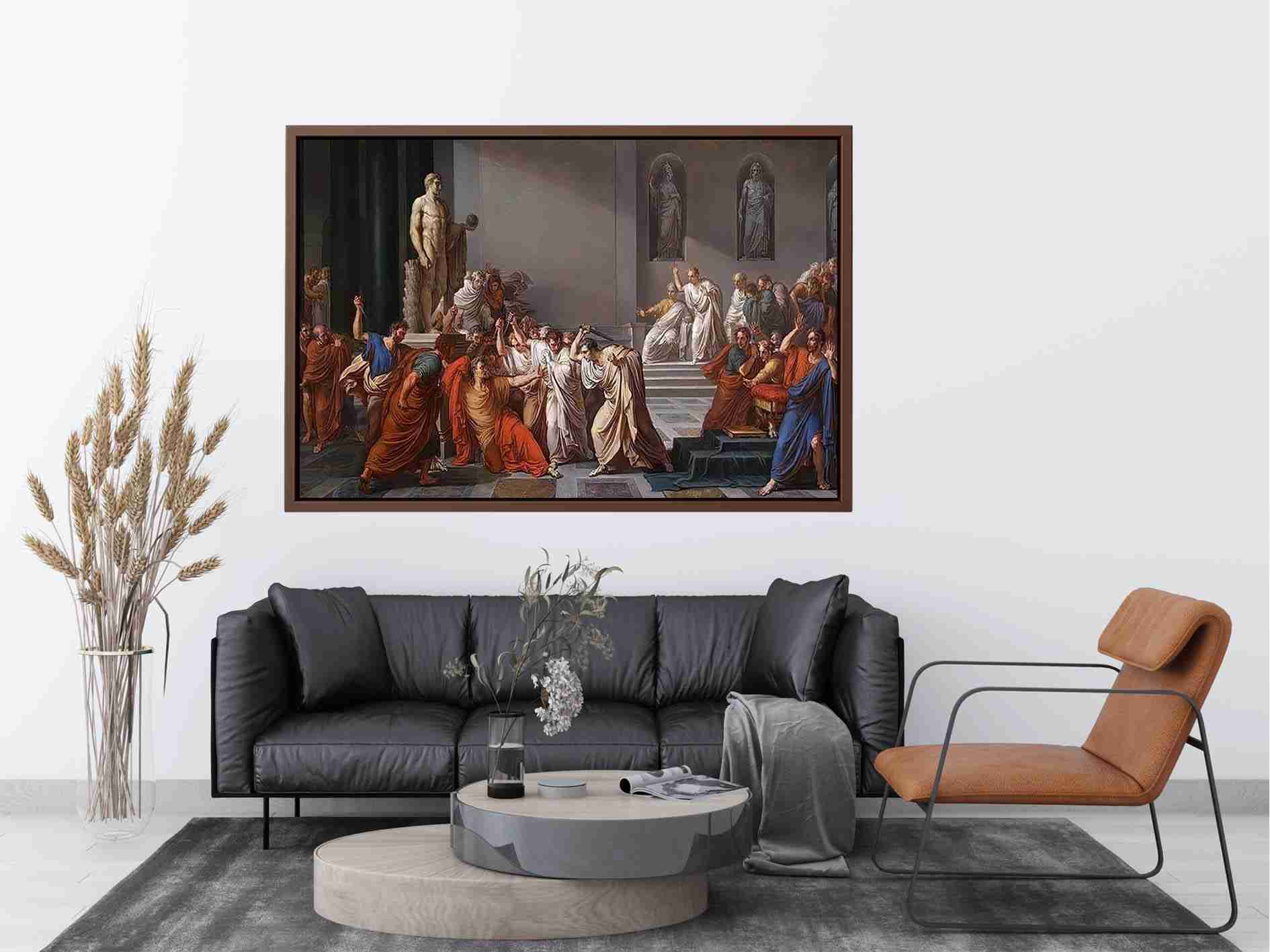
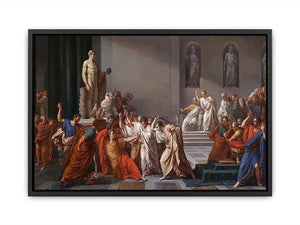
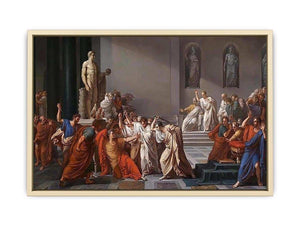
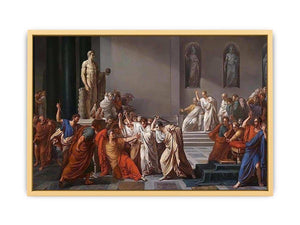
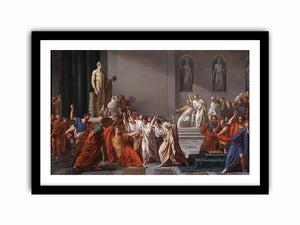
Death of Julius Caesar Painting by Vincenzo Camuccini is a monumental statement of Neoclassical history painting, conceived with intellectual rigor, moral gravity, and compositional authority. Executed at the turn of the nineteenth century, the work transforms one of antiquity’s most charged political assassinations into a timeless meditation on power, betrayal, civic duty, and the tragic costs of political idealism. Camuccini does not sensationalize violence; instead, he constructs a scene of measured intensity in which every gesture, posture, and spatial relationship contributes to an ethical reading of history.
Vincenzo Camuccini was the leading Italian history painter of his generation and a central figure of Roman Neoclassicism. Deeply influenced by classical sculpture, Renaissance harmony, and Enlightenment ideals, Camuccini believed history painting should instruct the intellect and elevate moral understanding. Death of Julius Caesar stands as his most famous and intellectually ambitious work, demonstrating his conviction that the past could be rendered with clarity, restraint, and philosophical seriousness.
The subject depicts the assassination of Julius Caesar in the Roman Senate on the Ides of March, 44 BCE, a moment that has long symbolized the collapse of republican virtue into chaos and civil war. Camuccini approaches this event not as a narrative of bloodshed, but as a structured moral drama. Caesar’s fall is shown as the consequence of collective action, shaped by ideology and fear as much as by ambition. The painting refuses to reduce the event to hero and villain; instead, it exposes the complexity of political violence carried out in the name of liberty.
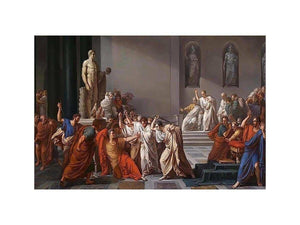
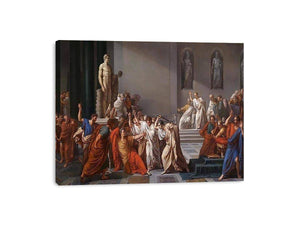
Compositionally, the painting is organized with architectural precision. Caesar’s body occupies the center of the pictorial field, forming the gravitational core around which the conspirators are arranged. The figures create a circular tension, their gestures converging inward while their gazes fragment outward. This compositional strategy reinforces the sense of irreversible rupture: unity has collapsed into multiplicity. The Senate chamber functions as a rational frame now violated by human action, underscoring the tragedy of ideals undone by their execution.
Perspective is classical and legible. Camuccini situates the viewer at a measured distance, allowing the entire scene to be read clearly. There is no dramatic foreshortening or destabilizing viewpoint. Instead, the clarity of space mirrors the clarity of judgment the artist demands from the viewer. The event is presented not as spectacle, but as evidence—inviting reflection rather than emotional surrender.
Light is employed with disciplined control. Illumination falls evenly across the scene, revealing form and gesture without theatrical emphasis. Caesar’s figure is clearly visible, yet not isolated by divine radiance. The conspirators are equally exposed, their actions laid bare to scrutiny. Light functions as moral revelation rather than dramatic device, aligning with Neoclassical values of reason and accountability.
Colour is restrained and purposeful. Camuccini favors a sober palette of whites, earth tones, muted reds, and stone greys, echoing classical sculpture and Roman architecture. Blood is present but not exaggerated, reinforcing the painting’s refusal to sensationalize violence. Colour serves structure and hierarchy, guiding the eye while preserving compositional balance.
The handling of the human figure reflects Camuccini’s academic mastery. Anatomy is precise, gestures are deliberate, and expressions are controlled. Caesar’s body, rendered with dignity even in death, suggests fallen authority rather than disgrace. The conspirators are differentiated through posture and movement, each embodying a distinct psychological response—resolve, hesitation, fear, or grim determination. This variety prevents moral simplification and deepens the painting’s ethical complexity.
Emotionally, Death of Julius Caesar is marked by tension rather than outburst. There is no chaos of screaming or frenzy. The violence has already occurred; what remains is the charged stillness that follows decisive action. This restraint intensifies the painting’s impact, allowing the viewer to confront consequence rather than action. The silence implied by the scene becomes a space for judgment.
Symbolically, the painting operates as a meditation on political idealism and its limits. The conspirators believed they were saving the Republic; Camuccini presents their act as the beginning of its end. Caesar’s death, rather than restoring order, fractures it. Through composition and restraint, the painting suggests that moral certainty does not guarantee moral outcome. History, Camuccini implies, is shaped as much by unintended consequence as by intention.
Within Camuccini’s career, Death of Julius Caesar represents the pinnacle of his Neoclassical vision. It synthesizes his belief in classical order, Enlightenment ethics, and the didactic role of art. Unlike Romantic history painting, which would soon emphasize emotion and individual drama, Camuccini insists on collective responsibility and rational structure. The painting thus stands at a critical moment of transition in European art.
Culturally, the work resonated strongly with audiences shaped by revolutionary and post-revolutionary politics. Created in an era grappling with the legacies of regicide and republican aspiration, the painting offered a historical mirror through which contemporary viewers could reflect on their own political realities. Its relevance endures because the questions it raises—about power, legitimacy, and violence in the name of ideals—remain unresolved.
In contemporary interiors across the United States, the United Kingdom, Canada, Australia, and Europe, Death of Julius Caesar commands intellectual and visual authority. In living rooms, it introduces historical gravitas and philosophical depth. In studies, libraries, and offices, it supports reflection on leadership, ethics, and political consequence. In galleries and luxury residences, it signals connoisseurship and engagement with the highest traditions of European history painting.
The painting integrates naturally into traditional interiors, where its classical composition and subject align with established aesthetics. It also functions powerfully in modern and minimalist spaces, where its clarity, structure, and moral seriousness provide contrast to visual austerity. In eclectic settings, it serves as a conceptual anchor, grounding diverse elements through shared historical weight.
The long-term artistic importance of Death of Julius Caesar lies in its demonstration that history painting can be both intellectually rigorous and emotionally resonant without sacrificing restraint. Camuccini proves that clarity is not the enemy of depth, and that moral inquiry can be conducted through balance rather than excess.
Today, Death of Julius Caesar remains profoundly compelling because it refuses easy answers. It does not glorify tyranny or celebrate rebellion. Instead, it presents a moment when conviction, fear, and ambition collide, leaving history irrevocably altered. Through compositional discipline, ethical seriousness, and classical mastery, Vincenzo Camuccini created a work that continues to challenge viewers to consider the true cost of political action, securing its place as one of the defining masterpieces of Neoclassical art.
Buy museum qulaity 400- 450 canvas prints, framed prints, and 100% oil paintings of Death of Julius Caesar by Vincenzo Camuccini at Alpha Art Gallery, where world-famous masterpieces are recreated with museum-quality detail, refined craftsmanship, and premium materials.
FAQS
What historical event does Death of Julius Caesar depict?
It depicts the assassination of Julius Caesar in the Roman Senate on the Ides of March, 44 BCE.
Why is Camuccini’s interpretation considered Neoclassical?
It emphasizes clarity, balance, moral inquiry, and classical restraint rather than emotional excess.
How is Julius Caesar portrayed in the painting?
He is shown with dignity in death, emphasizing fallen authority rather than humiliation.
Does the painting glorify the conspirators?
No, it presents them with psychological complexity, highlighting consequence rather than heroism.
What themes does the painting explore?
It explores power, political idealism, collective responsibility, and unintended consequence.
Where does this artwork work best in interior spaces?
It is well suited to living rooms, studies, libraries, offices, galleries, and refined residential interiors.
Does the painting have lasting cultural and artistic value?
Yes, its ethical depth, compositional mastery, and historical insight ensure enduring relevance.