Dawn at the Alamo Painting by Henry Arthur McArdle
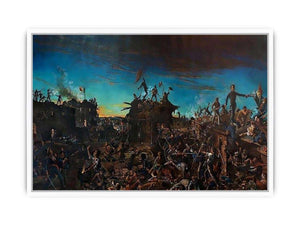
Dawn at the Alamo stands as one of Henry Arthur McArdle’s most solemn and historically resonant works, a painting in which sacrifice, memory, and national identity are rendered with restrained gravity and narrative clarity. Executed by an artist deeply committed to documenting the formative moments of Texas history, the painting does not seek spectacle or heroic exaggeration. Instead, McArdle presents the aftermath of resolve—an atmosphere of silence and consequence—inviting the viewer to confront history not at the height of battle, but in the quiet hour when meaning settles and loss becomes irrevocable.
Henry Arthur McArdle devoted much of his artistic life to visualising the history of Texas and the American frontier. Unlike artists who approached historical subjects from a distance, McArdle worked in close proximity to his material, both geographically and culturally. His paintings are marked by a documentary seriousness and moral attentiveness that privilege accuracy, emotional restraint, and reverence for lived history. In Dawn at the Alamo, these qualities coalesce into a composition that functions as both memorial and meditation.
The choice of moment is central to the painting’s power. McArdle does not depict the violence of the Battle of the Alamo itself. Instead, he chooses dawn—the hour immediately following devastation. This temporal decision transforms the work from an action scene into a reflective one. The absence of motion heightens emotional weight. What remains is evidence: the aftermath, the cost, and the enduring silence of sacrifice. The painting asks not how the battle was fought, but what it meant.
The composition is carefully ordered to reinforce solemnity. Architectural remnants of the Alamo mission structure anchor the scene, their solidity contrasting with the vulnerability of the human figures. Bodies lie still, arranged not for dramatic effect but for truthful acknowledgment. McArdle avoids theatrical staging, choosing balance and clarity over chaos. The eye moves slowly across the canvas, guided by structural lines and tonal shifts rather than dramatic focal points. This deliberate pacing mirrors the emotional experience of contemplation.
Perspective places the viewer at a respectful distance. McArdle does not immerse the viewer within the scene as participant, nor does he elevate them above it as judge. Instead, the vantage point suggests witness. This ethical positioning is crucial. The viewer is invited to observe with gravity, to recognise loss without voyeurism. The painting becomes an act of remembrance rather than consumption.
Light is the painting’s defining expressive element. Dawn’s early illumination filters gently across the scene, neither harsh nor redemptive. McArdle uses light to reveal rather than to dramatise. Shadows recede slowly, allowing forms to emerge with quiet inevitability. This transitional light symbolises both ending and beginning—the conclusion of conflict and the beginning of historical memory. Light here does not console; it clarifies.
Colour is restrained and purposeful. McArdle employs muted earth tones, subdued greys, and softened highlights that reinforce the painting’s somber mood. There is no chromatic excess, no visual flourish to distract from meaning. Flesh tones are rendered with respect and restraint, integrated into the environment rather than isolated. Colour functions as emotional architecture, supporting contemplation rather than spectacle.
McArdle’s handling of texture reflects his disciplined realism. Stone surfaces are solid and weathered, bearing the weight of history. Fabric and ground are rendered with quiet precision, avoiding decorative detail. Brushwork remains controlled and unobtrusive, allowing the scene to speak through composition and atmosphere rather than technique. This restraint reinforces the painting’s documentary seriousness.
Human presence in Dawn at the Alamo is defined by stillness rather than action. The fallen figures are not idealised martyrs nor anonymous casualties. They are individuals whose presence is acknowledged through posture and placement rather than facial expression. McArdle avoids sentimentality, allowing dignity to arise through quiet representation. The absence of overt emotion intensifies the painting’s impact, compelling the viewer to supply reflection rather than receive instruction.
Symbolically, the painting operates through absence as much as presence. The silence after battle, the unoccupied space, and the subdued dawn all point toward the cost of resolve. McArdle frames the Alamo not merely as a site of conflict, but as a locus of memory. The painting becomes an ethical space where sacrifice is neither glorified nor diminished, but recognised as foundational.
Emotionally, Dawn at the Alamo conveys gravity, respect, and sober reflection. There is no triumph, no consolation within the frame. The work resists closure, leaving the viewer with unresolved weight. This emotional discipline distinguishes McArdle’s historical painting from more romanticised treatments of frontier conflict. The painting honours loss without converting it into spectacle.
Within McArdle’s broader oeuvre, this work represents a mature articulation of his historical vision. While he produced numerous paintings depicting battles and key moments, Dawn at the Alamo stands apart for its focus on consequence rather than action. It demonstrates his belief that history’s deepest truths often emerge after events conclude, in the spaces where memory begins to form.
The painting’s relevance today remains profound across the United States, the United Kingdom, Canada, Australia, and Europe. Contemporary audiences respond to its ethical seriousness and its refusal to sensationalise violence. In a modern context increasingly attentive to how history is remembered and represented, Dawn at the Alamo offers a model of commemoration grounded in restraint and respect.
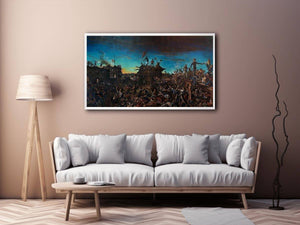
In interior settings, Dawn at the Alamo introduces depth, gravity, and historical consciousness. In living rooms, it becomes a focal point for reflection and conversation. In studies and offices, it reinforces themes of responsibility, sacrifice, and historical awareness. In galleries and luxury residences, it signals engagement with American historical art that values meaning over drama.
The painting integrates seamlessly into traditional, modern, minimalist, and eclectic décor. Traditional interiors resonate with its historical subject and architectural clarity. Modern spaces benefit from its compositional restraint and tonal balance. Minimalist environments amplify its stillness and moral weight, while eclectic interiors draw cohesion from its grounded palette and narrative seriousness.
The enduring importance of Dawn at the Alamo lies in its refusal to simplify history. McArdle presents sacrifice without spectacle and memory without instruction. The painting endures because it recognises that national identity is shaped not only by action, but by how loss is acknowledged and carried forward.
To live with Dawn at the Alamo is to engage daily with a work that honours remembrance through quiet clarity. Through its disciplined composition, restrained light, and moral seriousness, the painting continues to affirm Henry Arthur McArdle’s role as one of the most thoughtful interpreters of American historical memory. It stands as a testament to his belief that art, when guided by respect and truth, can preserve history with enduring dignity.
Buy museum qulaity 400- 450 canvas prints, framed prints, and 100% oil paintings of Dawn at the Alamo by Henry Arthur McArdle at Alpha Art Gallery, where world-famous masterpieces are recreated with museum-quality detail, refined craftsmanship, and premium materials.
FAQS
What moment does Dawn at the Alamo depict?
It depicts the dawn following the Battle of the Alamo, focusing on aftermath and remembrance rather than combat.
Why did Henry Arthur McArdle choose this moment instead of the battle itself?
He emphasised consequence and memory, allowing reflection on sacrifice rather than spectacle.
Is the painting historically accurate?
Yes. It reflects McArdle’s documentary approach and deep engagement with Texas history.
What emotional tone does the painting convey?
It conveys solemnity, respect, and quiet gravity rather than triumph or drama.
Is Dawn at the Alamo suitable for contemporary interiors?
Yes. Its restrained palette and compositional clarity integrate well into both modern and traditional spaces.
What role does light play in the painting?
Dawn light symbolises transition from conflict to memory, revealing without dramatizing.
Does this artwork have lasting cultural importance?
As a significant work of American historical painting, it holds enduring educational and commemorative value.
Where is the best place to display Dawn at the Alamo?
It is especially well suited to studies, offices, galleries, and living spaces that value history and reflection.