Dashing Wave' Clipper Ship off Boston Light Painting by William Bradford
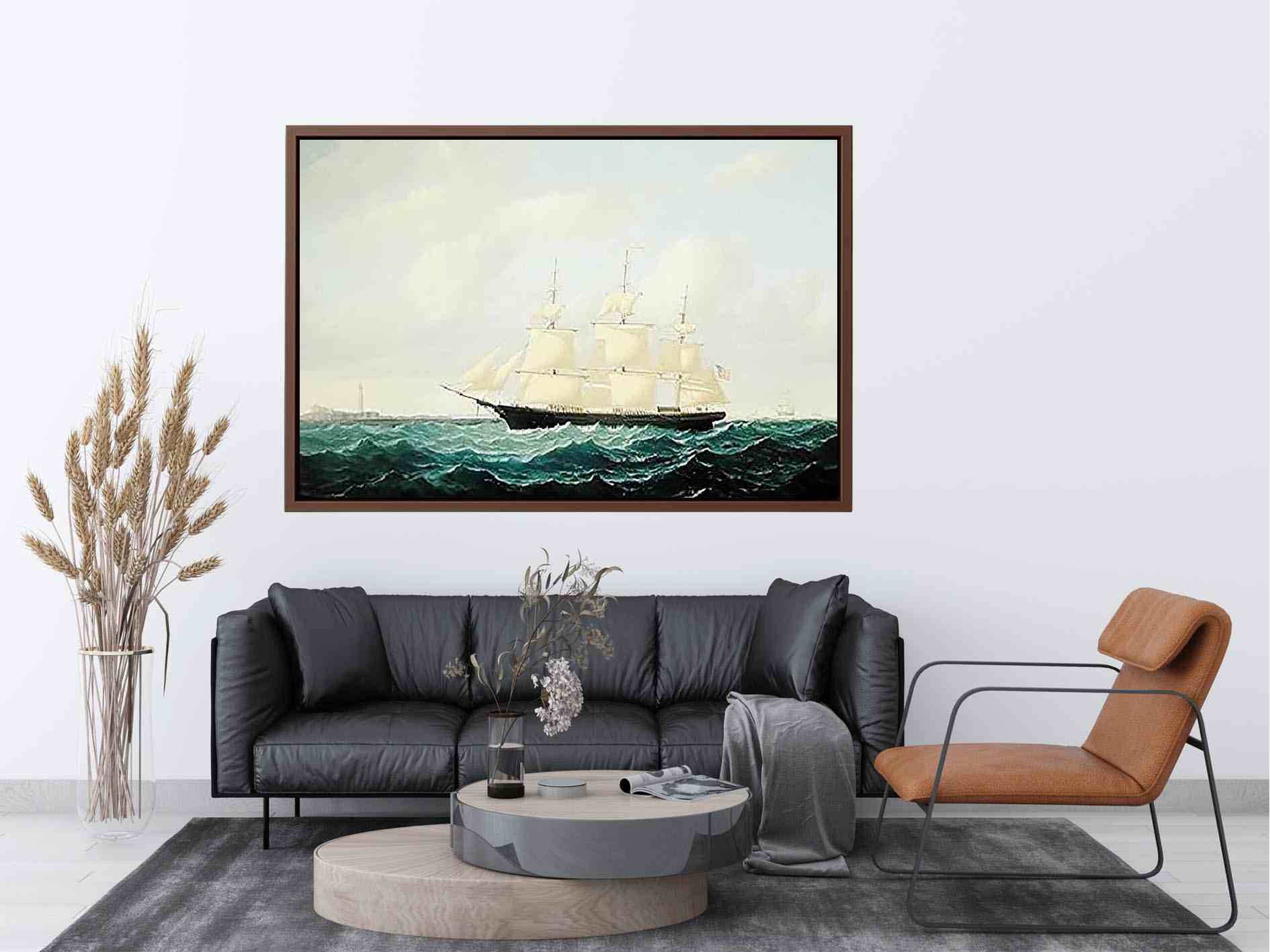
Dashing Wave’ Clipper Ship off Boston Light stands as a powerful testament to William Bradford’s mastery of maritime painting and his deep understanding of the sea as both a physical force and a cultural symbol. In this work, Bradford captures not merely a vessel in motion, but an entire ethos of nineteenth-century maritime ambition—speed, skill, risk, and national confidence—embodied in the elegant form of the clipper ship cutting decisively through open water. The painting situates human ingenuity against the vastness of the Atlantic, presenting the sea not as a backdrop, but as an active and commanding presence.
William Bradford occupies a distinguished place in American art as one of the foremost marine painters of the nineteenth century. His work is characterised by meticulous observation, technical precision, and a profound respect for the realities of seafaring life. Unlike romanticised or purely decorative marine scenes, Bradford’s paintings are grounded in firsthand experience and careful study. He understood ships not as abstractions, but as complex instruments of commerce, exploration, and survival. In Dashing Wave’ Clipper Ship off Boston Light, this understanding is evident in every structural detail and atmospheric nuance.
The subject of the clipper ship is itself deeply significant. Clippers were the fastest sailing vessels of their time, engineered for speed and endurance rather than comfort. They represented the height of maritime innovation during the mid-nineteenth century, serving global trade routes and symbolising economic expansion and national pride. By depicting the Dashing Wave off Boston Light, Bradford anchors this symbol of progress within a recognisable geographic and cultural threshold—Boston, a historic centre of American maritime enterprise. The lighthouse functions not only as a navigational marker, but as a point of transition between harbour and open sea, safety and risk.
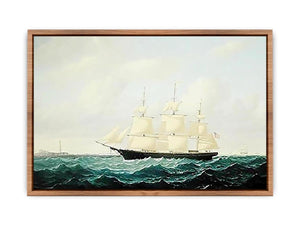
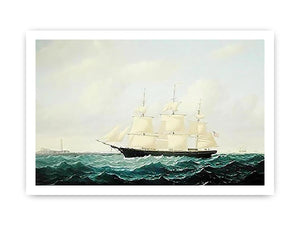
Compositionally, the painting is structured to emphasise forward momentum and command. The ship occupies a dominant yet balanced position within the frame, its hull angled to suggest purposeful movement through challenging waters. The sails are fully engaged, their taut lines revealing the wind’s force and the crew’s skill in harnessing it. Bradford carefully calibrates scale so that the vessel appears powerful without overwhelming the surrounding environment, reinforcing the idea of mastery achieved through harmony rather than domination.
Perspective places the viewer at a respectful distance, allowing the full drama of ship and sea to unfold. We are not positioned as passengers aboard the vessel, nor as detached observers from shore. Instead, Bradford situates us as witnesses to maritime endeavour itself. This vantage point heightens the painting’s sense of realism and authority, aligning observation with experience rather than fantasy.
Light plays a crucial role in shaping the painting’s emotional and visual impact. Bradford employs clear, natural illumination that defines form without theatrical exaggeration. Light glances across the sails and hull, revealing texture and structure while also animating the surface of the water. The sea reflects shifting tones, suggesting constant motion and instability beneath the ship’s steady advance. Light here functions as both descriptive tool and atmospheric force, reinforcing realism while sustaining visual drama.
Colour is disciplined and purposeful. Bradford favours a palette of deep blues, muted greys, and crisp whites, punctuated by subtle tonal variations that convey wind, spray, and distance. The restrained use of colour enhances the painting’s authenticity, avoiding romantic excess while maintaining visual richness. The relationship between sky and sea is carefully modulated, ensuring cohesion rather than contrast.
Bradford’s handling of paint demonstrates technical assurance and observational fidelity. Brushwork is controlled, particularly in the rendering of rigging, sails, and hull, where precision is essential. The sea, by contrast, is handled with greater fluidity, allowing texture and movement to emerge naturally. This contrast reinforces the thematic distinction between human order and natural force, without suggesting opposition. The ship moves because it understands the sea, not because it conquers it.
Emotionally, Dashing Wave’ Clipper Ship off Boston Light conveys confidence tempered by respect. There is no sense of peril exaggerated for effect, yet neither is the sea rendered as benign. The painting communicates the quiet intensity of professional skill exercised under demanding conditions. It honours discipline, preparation, and endurance rather than heroics or spectacle.
Symbolically, the painting speaks to broader narratives of exploration, commerce, and national identity. The clipper ship represents human aspiration and technological refinement, while the sea embodies uncertainty and scale beyond human control. Boston Light stands as a symbol of guidance and continuity, linking individual endeavour to collective maritime tradition. Bradford weaves these elements together without overt allegory, allowing meaning to emerge through realism and balance.
Within Bradford’s broader body of work, this painting exemplifies his commitment to truthful maritime representation. While he is often associated with polar scenes and icy waters, his depictions of ships in active service reveal the same disciplined eye and respect for environment. Dashing Wave’ Clipper Ship off Boston Light affirms his position as a painter who elevated marine art through knowledge, integrity, and restraint.
The painting’s relevance today remains strong across the United States, the United Kingdom, Canada, Australia, and Europe. Contemporary audiences continue to respond to images of craftsmanship, exploration, and purposeful movement within vast natural systems. In an era defined by technological change and global connection, the clipper ship retains its symbolic power as an emblem of transition, ambition, and human ingenuity.
In interior settings, Dashing Wave’ Clipper Ship off Boston Light introduces clarity, motion, and historical gravitas. In living rooms, it becomes a commanding focal point that evokes strength and direction. In studies and offices, it reinforces values of discipline, navigation, and long-term vision. In galleries and luxury residences, it signals informed appreciation of American maritime art and nineteenth-century realism.
The painting integrates seamlessly into traditional, modern, minimalist, and eclectic décor. Traditional interiors resonate with its historical authenticity and craftsmanship. Modern spaces benefit from its compositional clarity and dynamic structure. Minimalist environments amplify its form and movement, while eclectic interiors draw cohesion from its disciplined palette and strong narrative presence.
The enduring importance of Dashing Wave’ Clipper Ship off Boston Light lies in its affirmation of purposeful movement within an uncertain world. Bradford does not romanticise the sea or glorify risk. He presents a moment of balance, where knowledge, preparation, and respect for natural forces allow progress to occur. The painting endures because it recognises that true mastery is achieved not through domination, but through understanding.
To live with Dashing Wave’ Clipper Ship off Boston Light is to engage daily with a work that embodies direction, resolve, and professional excellence. Through its precise composition, atmospheric realism, and cultural resonance, the painting continues to affirm William Bradford’s position as one of the most authoritative voices in maritime art. It stands as a lasting tribute to the age of sail and to the enduring human impulse to venture forward with skill and purpose.
Buy museum qulaity 400- 450 canvas prints, framed prints, and 100% oil paintings of Dashing Wave' Clipper Ship off Boston Light by William Bradford at Alpha Art Gallery, where world-famous masterpieces are recreated with museum-quality detail, refined craftsmanship, and premium materials.
FAQS
What does Dashing Wave' Clipper Ship off Boston Light depict?
It depicts a nineteenth-century clipper ship sailing off Boston Light, emphasising speed, skill, and maritime expertise.
Why are clipper ships historically important?
They were among the fastest sailing vessels ever built, playing a vital role in global trade and maritime innovation.
Who was William Bradford?
He was a leading American marine painter known for his accurate, experience-based depictions of ships and the sea.
What is the significance of Boston Light in the painting?
Boston Light symbolises navigation, safety, and the transition between harbour and open ocean.
What emotional tone does the painting convey?
It conveys confidence, discipline, and respect for natural forces rather than danger or spectacle.
Is this painting suitable for contemporary interiors?
Yes. Its dynamic composition and restrained palette integrate seamlessly into modern and traditional spaces.
Does the artwork have lasting cultural value?
As a refined example of nineteenth-century American maritime painting, it holds enduring historical and artistic significance.
Where is the best place to display this painting?
It is especially well suited to living rooms, studies, offices, galleries, and spaces that value history, movement, and purposeful design.