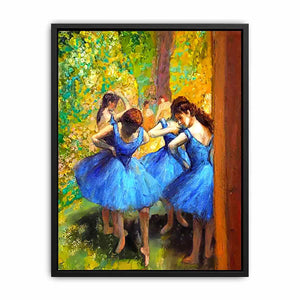
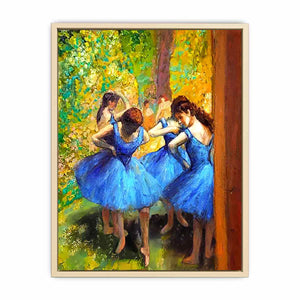
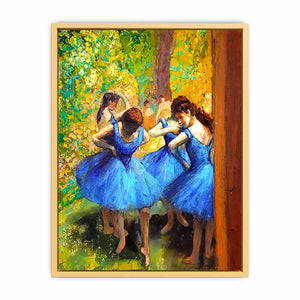
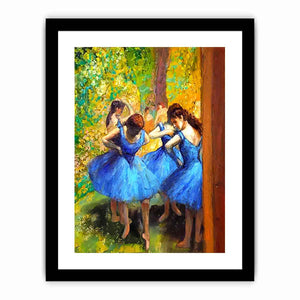
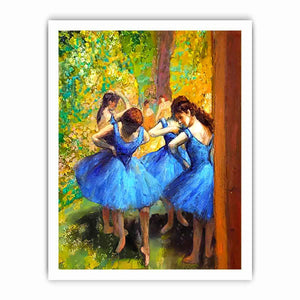
Dancer in Blue Painting by Edgar Degas
Dancer in Blue Painting by Edgar Degas is a concentrated study of movement, discipline, and modern vision, revealing the artist’s lifelong engagement with the ballet as both subject and structure. Created during Degas’s mature period, the work distills years of observation into a single, charged image where color, posture, and spatial tension articulate the paradox at the heart of performance: grace forged through rigor. Degas does not present ballet as spectacle meant for admiration alone; he presents it as labor, rhythm, and fleeting alignment between body and intention.
Edgar Degas occupied a singular position within nineteenth-century art. Although often associated with Impressionism, Degas resisted its emphasis on plein-air spontaneity, preferring controlled interiors, unconventional viewpoints, and sustained study of form. His dancers are not decorative ornaments of leisure culture; they are vehicles through which he examined balance, repetition, and the modern body in motion. Dancer in Blue exemplifies this approach, offering a vision at once intimate and analytical.
The subject appears mid-movement or poised at the threshold of motion, her body caught between effort and release. Degas selects not a climactic pose but an in-between moment, where preparation, adjustment, or recovery carries as much meaning as performance itself. This choice is deliberate. By privileging the transitional, Degas reveals the underlying mechanics of grace. The dancer is not idealized into an emblem of perfection; she is observed as a working body engaged in precise, demanding activity.
Compositionally, the painting is defined by asymmetry and cropping. Degas often framed his figures as if seen through a passing glance or from an oblique vantage point, and Dancer in Blue continues this practice. The dancer may appear partially off-center, her form intersecting the edges of the canvas in a way that heightens immediacy. This compositional tension suggests motion extending beyond the frame, reinforcing the sense that the scene is ongoing rather than resolved.
Perspective places the viewer in a position that feels observational rather than participatory. We are close enough to register the physicality of the dancer—her posture, the turn of her shoulders, the tension in her limbs—yet removed from the illusion of theatrical immersion. Degas’s vantage point acknowledges the separation between audience and performer while simultaneously collapsing distance through intimacy of scale.
Color is the painting’s most immediately striking element. The blue of the dancer’s costume dominates the composition, functioning both as garment and as field of movement. Degas uses blue not as flat decoration, but as a dynamic structure. Variations in tone and saturation articulate folds of fabric, shifts of weight, and the play of light across motion. The color becomes inseparable from the dancer’s activity, visually translating movement into chromatic rhythm.
Light is handled with restraint and intelligence. Rather than spotlighting the figure in dramatic contrast, Degas allows light to skim and modulate the surface, revealing form through subtle transitions. Shadows are present but understated, serving to anchor the figure without interrupting flow. Light here is functional, descriptive of space and body rather than theatrical effect.
Degas’s handling of line and contour reflects his deep study of anatomy and movement. Edges may be softened or abbreviated, allowing the eye to complete form through perception rather than explicit delineation. This economy of line enhances the sensation of motion. The dancer appears to vibrate with energy precisely because Degas resists over-definition. Form remains alive, provisional, and responsive.
Emotionally, Dancer in Blue conveys concentration rather than display. The dancer’s inner state is suggested through posture and tension, not facial expression. Degas avoids sentimentalization, presenting the dancer as focused and absorbed in her task. This emotional restraint aligns with his broader vision of modern life, where meaning emerges from work, repetition, and discipline rather than overt drama.
Symbolically, the painting speaks to the conditions of modern performance. Ballet, in Degas’s hands, becomes a metaphor for the balance between control and vulnerability. The dancer’s beauty is inseparable from effort; her elegance is the visible outcome of invisible labor. This understanding situates the painting firmly within the realities of contemporary life rather than romantic fantasy.
Within Degas’s extensive body of work, Dancer in Blue belongs to a sustained inquiry rather than an isolated motif. Across decades, Degas returned to dancers in rehearsal rooms, wings, and moments of pause. Each variation deepened his understanding of movement and perception. This painting reflects that cumulative insight, offering a synthesis of color, form, and observation refined through time.
Culturally, the work embodies late nineteenth-century Paris’s fascination with spectacle and modernity, while simultaneously exposing the structures beneath that fascination. Degas’s dancers are icons of the city’s cultural life, yet his treatment strips away glamour to reveal process. In doing so, he aligns art with truth rather than illusion.
In contemporary interiors across the United States, the United Kingdom, Canada, Australia, and Europe, Dancer in Blue integrates with remarkable versatility. In living rooms, it introduces energy and refined movement. In studies and offices, it reflects discipline, focus, and creative labor. In galleries and luxury residences, it signals engagement with one of modern art’s most incisive observers of the human form.
The painting functions powerfully in modern and minimalist interiors, where its bold color and cropped composition resonate with contemporary design principles. It also complements traditional settings through its historical significance and compositional intelligence. In eclectic spaces, it acts as a dynamic focal point, uniting diverse elements through rhythm and balance.
The long-term artistic importance of Dancer in Blue lies in its redefinition of beauty as process rather than product. Degas demonstrates that art can honor movement without freezing it into idealized stasis. The painting endures because it captures a truth that remains relevant: that grace is not effortless, but earned through repetition, attention, and restraint.
Today, Dancer in Blue continues to command attention for its synthesis of immediacy and structure. In a world attuned to performance yet often detached from labor, Degas’s vision feels particularly resonant. Through disciplined composition, expressive color, and acute observation, Edgar Degas created a painting that remains one of the most compelling explorations of movement and modern life.
Buy museum qulaity 400- 450 canvas prints, framed prints, and 100% oil paintings of Dancer in Blue by Edgar Degas at Alpha Art Gallery, where world-famous masterpieces are recreated with museum-quality detail, refined craftsmanship, and premium materials.
FAQS
What is depicted in Dancer in Blue by Edgar Degas?
It depicts a ballet dancer captured in a transitional moment, emphasizing movement, posture, and discipline rather than theatrical display.
Why is blue so dominant in the painting?
Blue structures the composition, translating motion and fabric into chromatic rhythm rather than serving as mere decoration.
Is this painting part of Degas’s ballet series?
Yes, it belongs to his extensive and influential studies of dancers, rehearsals, and performance.
Does the painting show a performance or a rehearsal moment?
It suggests an in-between moment, focusing on preparation or adjustment rather than a finished performance.
Where does this artwork work best in interior spaces?
It suits living rooms, studies, offices, galleries, and refined residential interiors.
Is Dancer in Blue suitable for modern décor?
Yes, its cropped composition, strong color, and dynamic balance integrate seamlessly into modern and minimalist spaces.
Does the painting have lasting artistic significance?
It is a key example of Degas’s modern approach to movement, labor, and perception, ensuring enduring relevance.