Dancers Painting by Edgar Degas
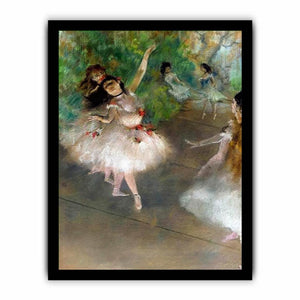
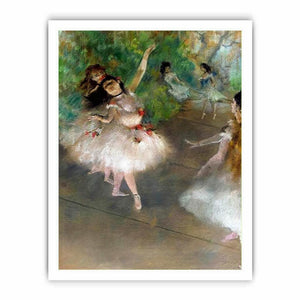
Dancers stands as one of Edgar Degas’s most concentrated and conceptually revealing explorations of movement, repetition, and the lived reality of artistic discipline. Rather than presenting ballet as spectacle or illusion, Degas situates the viewer within the ongoing process of dance—where bodies are trained, corrected, and reshaped through routine rather than performance. The painting belongs to Degas’s sustained engagement with dancers across several decades, a subject through which he examined modern life not as fleeting impression, but as structured labour governed by institution, hierarchy, and endurance.
Degas approached the world of ballet from a position distinct from his contemporaries. While often grouped with the Impressionists, he rejected their emphasis on spontaneity and outdoor light, favouring instead interior spaces shaped by control and repetition. The rehearsal room, the studio, and the backstage corridor offered Degas an environment where movement could be studied analytically, stripped of theatrical glamour. In Dancers, he continues this investigation, focusing not on the moment of applause, but on the continuum of effort that precedes it.
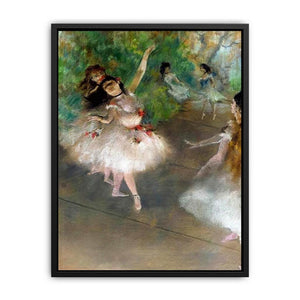
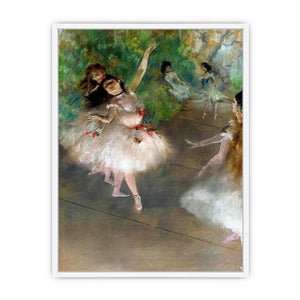
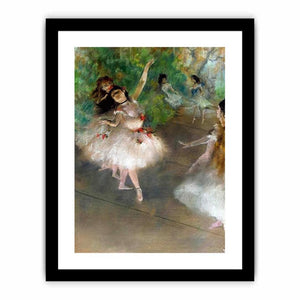
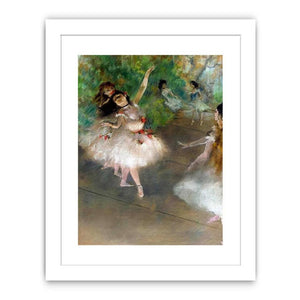
The composition is deliberately fragmented and asymmetrical. Figures enter and exit the pictorial field without ceremony, some partially cropped, others turned away or caught mid-adjustment. There is no central protagonist, no privileged pose. Degas distributes attention across the surface, allowing the viewer’s eye to move restlessly, mirroring the irregular rhythms of rehearsal. This compositional openness denies narrative closure and reinforces the sense that the scene is ongoing, uncontained by the canvas.
Perspective is oblique and unsettled. Degas frequently adopts elevated or angled viewpoints, and here the spatial logic resists comfort. Floors tilt, walls compress, and depth is suggested through overlapping bodies rather than architectural clarity. The viewer is placed within the space, not as a welcomed guest, but as an observer who has arrived unannounced. This perspective reinforces Degas’s commitment to observation over idealisation. We are not invited to admire; we are compelled to notice.
Light functions as a practical instrument rather than a dramatic device. It illuminates bodies evenly, revealing posture, strain, and imbalance without flattering them. Degas avoids theatrical contrasts or spotlight effects. Light clarifies the mechanics of movement—how weight shifts, how limbs respond to instruction—rather than transforming dancers into icons of grace. In this environment, illumination serves discipline, not illusion.
Colour is restrained and structural. Soft whites and pale hues of costumes are set against muted interiors—browns, greys, and subdued greens—that anchor the scene in material reality. Degas often uses colour to unify figures rather than distinguish individuals, reinforcing the sense that dancers function within a collective system. Colour does not celebrate; it organises. Its subtle modulation guides the eye without disrupting the painting’s tonal coherence.
Degas’s handling of paint is varied and intentional. Some passages are rendered with precision, others with loose, suggestive strokes that allow forms to emerge through implication. Edges dissolve, figures overlap, and the painting resists finish in the academic sense. This approach reflects Degas’s belief that truth lies not in polished surfaces, but in perceptual accuracy. Movement is not frozen into clarity; it is allowed to remain unstable, incomplete, and alive.
Psychologically, Dancers is marked by detachment rather than intimacy. Degas does not individualise his figures through facial expression or narrative gesture. Their identities remain secondary to posture, alignment, and repetition. This anonymity is not dismissive; it is analytical. The dancers are not characters in a story, but participants in a system that demands uniformity and endurance. Degas observes this condition without overt judgement, allowing the viewer to recognise both the beauty and the cost embedded within disciplined movement.
Symbolically, the painting resists allegory. Ballet is not presented as transcendence or fantasy, but as work—physical, repetitive, and governed by authority. The absence of overt symbolism is itself significant. Degas insists that modern life can be understood through ordinary processes rather than heroic narratives. Dancers becomes a study of how institutions shape bodies, habits, and perception, extending its relevance far beyond the ballet studio.
Emotionally, the work conveys quiet tension rather than joy or drama. There is concentration, fatigue, and persistence, but no visible climax. The dancers appear absorbed in their tasks, neither performing for an audience nor interacting in overtly expressive ways. This inward focus creates a mood of controlled intensity, where effort is continuous and reward deferred. The painting invites sustained looking rather than immediate emotional response.
Within Degas’s artistic evolution, Dancers represents a mature synthesis of his interests in movement, modern institutions, and unconventional composition. It demonstrates his departure from narrative clarity and classical balance in favour of fragmentation and observation. While sharing his contemporaries’ interest in modern subjects, Degas pursued a more analytical path, one that prioritised structure over sensation. This painting exemplifies that commitment with clarity and restraint.
Culturally, Dancers occupies a significant position in the history of modern art. It reframes the image of dance by exposing the systems and labour that sustain it. Degas challenges the romanticisation of artistic performance, revealing instead the disciplined processes that produce grace. In doing so, he aligns art with work and process, anticipating later modernist concerns with repetition, routine, and institutional life.
In contemporary interiors, Dancers integrates with exceptional versatility and intellectual presence. In living rooms, it introduces movement and cultural depth without decorative excess. In studies and offices, it communicates discipline, focus, and aesthetic intelligence. In galleries and luxury residences across the United States, United Kingdom, Canada, Australia, and Europe, the painting complements modern, minimalist, and eclectic décor with ease. Its restrained palette and dynamic composition allow it to animate space while maintaining refinement.
The enduring relevance of Dancers lies in its honesty. Degas does not invite admiration of illusion; he invites recognition of process. The painting endures because it acknowledges a universal truth: that beauty is constructed through repetition, discipline, and sustained effort rather than inspiration alone. In Dancers, Edgar Degas offers not a spectacle, but an examination—one that continues to resonate wherever movement, labour, and quiet perseverance shape human experience.
Buy museum qulaity 400- 450 canvas prints, framed prints, and 100% oil paintings of Dancers by Edgar Degas at Alpha Art Gallery, where world-famous masterpieces are recreated with museum-quality detail, refined craftsmanship, and premium materials.
FAQS
What does Dancers by Edgar Degas depict?
It depicts ballet dancers engaged in rehearsal or preparation, focusing on movement and process rather than performance.
Why does Degas avoid dramatic poses and clear narratives?
He was interested in discipline, repetition, and the realities of labour rather than theatrical display.
How does Degas convey movement in this painting?
Through asymmetrical composition, cropped figures, and varied postures that suggest ongoing activity.
Are the dancers meant to be individual portraits?
No, Degas downplays individuality to emphasise collective rhythm and physical discipline.
What role does perspective play in Dancers?
The angled viewpoint places the viewer inside the working environment rather than as a distant spectator.
Is Dancers a celebration of ballet?
It is an examination rather than a celebration, presenting ballet as structured labour.
Is Dancers suitable for contemporary interiors?
Yes, its refined palette and dynamic composition integrate well into modern and traditional spaces.
Why does Dancers remain relevant today?
Its focus on process, discipline, and unseen effort continues to resonate across artistic and professional fields.