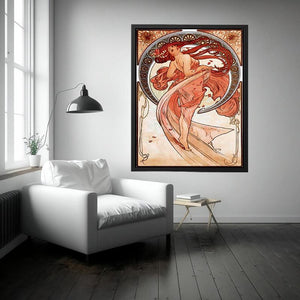
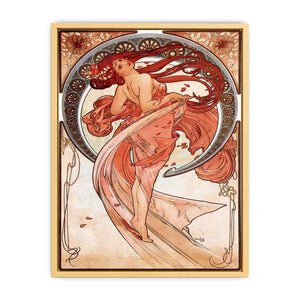
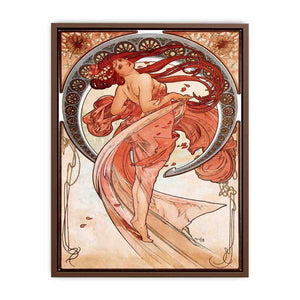
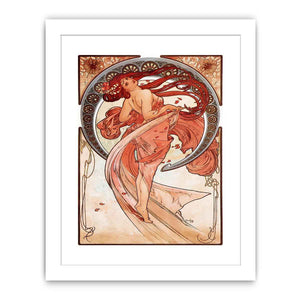
Dance Painting by Alphonse Mucha
Dance stands as one of the most eloquent expressions of Alphonse Mucha’s vision of movement, harmony, and idealised beauty, a work in which the human figure becomes a living embodiment of rhythm and grace. Created during the height of the Art Nouveau movement, Dance reflects Mucha’s belief that art should elevate daily life through beauty, symbolism, and spiritual resonance. Rather than depicting dance as a theatrical performance or narrative event, Mucha transforms it into an abstracted state of being—a visual metaphor for vitality, balance, and the natural flow of existence.
Alphonse Mucha emerged at the turn of the twentieth century as one of the defining artistic voices of his era. Working primarily in Paris, he became synonymous with Art Nouveau’s organic forms, sinuous lines, and idealised female figures. Mucha rejected the harshness of industrial modernity, seeking instead a visual language rooted in nature, tradition, and universal ideals. Dance belongs firmly within this philosophy. It is not concerned with realism or anecdote, but with expressing an eternal quality of motion that transcends time and place.
The composition is centred on a female figure whose body moves with fluid inevitability. Her posture suggests motion without strain, as though dance arises organically from her being rather than through effort. Limbs curve and extend in harmonious arcs, creating a continuous rhythm that guides the viewer’s eye across the surface. There is no abrupt gesture or dramatic tension. Instead, movement unfolds gently, reinforcing the sense that dance is a natural expression of life rather than a spectacle performed for an audience.
Mucha’s mastery of line is fundamental to the painting’s impact. Contours flow seamlessly, enclosing form without rigidity. These lines do not merely describe the figure; they animate it. The sinuous outline becomes a visual equivalent of music, carrying rhythm and cadence across the composition. This linear elegance is characteristic of Mucha’s mature style, in which line functions as both structure and expression.
Colour is employed with restraint and sensitivity. Soft, harmonious tones dominate the palette, enhancing the painting’s sense of grace and serenity. Rather than sharp contrasts, Mucha favours gentle transitions that support unity. Colour serves to reinforce mood rather than command attention. It envelops the figure, creating an atmosphere in which movement feels suspended and timeless.
Decorative elements play a significant role in the painting’s symbolic language. Flowing garments, stylised floral motifs, and ornamental backgrounds frame the figure without overwhelming her. These elements do not function as mere embellishment. They extend the sense of motion outward, blurring the boundary between figure and environment. Dance thus becomes a total composition in which human movement, natural form, and decorative rhythm coexist seamlessly.
Symbolically, Dance represents more than physical motion. It embodies harmony between body and spirit, individual expression and universal order. In Mucha’s work, the female figure often symbolises ideals rather than specific identities, and here she becomes an allegory of rhythm itself. Dance is not bound to a particular culture or tradition; it stands for the universal human impulse to express emotion through movement. The painting suggests that dance is a language older than words, capable of communicating joy, freedom, and balance without explanation.
Emotionally, the painting conveys calm vitality rather than exuberance. There is energy, but it is controlled and refined. Viewers often respond to Dance with a sense of quiet uplift, as though witnessing a moment of perfect equilibrium. The absence of strain or conflict reinforces the painting’s idealism. Mucha presents a world in which movement is harmonious, beauty is natural, and expression flows without resistance.
Within Mucha’s body of work, Dance exemplifies his commitment to integrating fine art and decorative art into a unified vision. He believed that beauty should not be confined to elite spaces, but woven into the fabric of everyday life. Dance reflects this ideal through its accessibility and clarity. Its message is immediate yet enduring, inviting repeated engagement without exhaustion.
Culturally, the painting represents the spirit of Art Nouveau at its most refined. It reflects a moment when artists sought to counterbalance industrial modernity with organic form and spiritual meaning. Dance stands as a reminder of a period that valued craftsmanship, symbolism, and the unity of art and life. Its influence can be traced through later developments in graphic design, illustration, and decorative arts, where rhythm and line remain central concerns.
In contemporary interiors, Dance offers exceptional adaptability and elegance. In living rooms, it introduces a sense of movement and refinement without visual heaviness. In bedrooms and private spaces, it reinforces tranquillity and grace. In studies, offices, and galleries, it communicates cultural sophistication and artistic sensitivity. Within luxury residences and curated interiors across the United States, United Kingdom, Canada, Australia, and Europe, the painting integrates seamlessly with modern, minimalist, and eclectic décor. Its flowing lines soften architectural rigidity, while its symbolic depth adds intellectual presence.
The enduring relevance of Dance lies in its affirmation of harmony as an ideal. Mucha presents movement not as chaos, but as order made visible. In a world often defined by speed and fragmentation, the painting offers a vision of balance, reminding viewers that expression can be both dynamic and serene. Dance endures because it speaks to a universal desire—for beauty that moves, for movement that heals, and for art that unites the physical and the spiritual into a single, graceful whole.
Buy museum qulaity 400- 450 canvas prints, framed prints, and 100% oil paintings of Dance by Alphonse Mucha at Alpha Art Gallery, where world-famous masterpieces are recreated with museum-quality detail, refined craftsmanship, and premium materials.
FAQS
What does Dance by Alphonse Mucha represent?
It represents harmony, rhythm, and the natural expression of movement as a universal human language.
Is Dance a depiction of a specific dance tradition?
No, it is an abstract and symbolic representation of movement rather than a specific cultural dance form.
Why are flowing lines so important in this painting?
They convey rhythm and motion, transforming line into a visual equivalent of music and movement.
How does Dance reflect Art Nouveau principles?
Through organic forms, decorative integration, idealised figures, and the unity of art and life.
What emotional tone does the painting convey?
It conveys calm vitality, grace, and balance rather than dramatic or theatrical energy.
Is Dance meant to be symbolic rather than realistic?
Yes, it prioritises symbolic expression and idealised beauty over realistic depiction.
Is Dance suitable for contemporary interiors?
Yes, its flowing lines and refined palette make it adaptable to modern, minimalist, and elegant spaces.
Why does Dance remain relevant today?
Its celebration of harmony, movement, and beauty continues to resonate in a world seeking balance and expressive freedom.