Dance At The Moulin De La Galette Painting by Pierre-Auguste Renoir
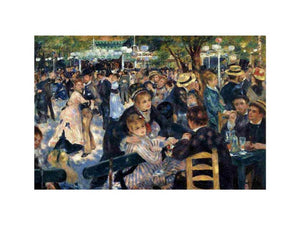
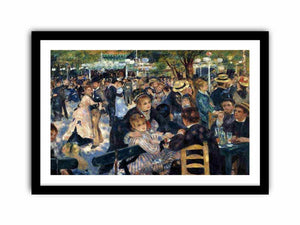
Dance At The Moulin De La Galette stands as one of the most luminous and socially expansive visions of modern life produced in the nineteenth century, a painting in which Pierre-Auguste Renoir transformed an ordinary Sunday gathering into a meditation on movement, light, and collective joy. Painted in 1876, at the height of the Impressionist experiment, the work captures a fleeting moment of leisure in the open-air dance gardens of Montmartre, yet it transcends reportage to become a profound statement about presence, sociability, and the modern experience of time.
Renoir created this painting during a period when Impressionism was still contested and uncertain. The movement’s insistence on contemporary subject matter, visible brushwork, and outdoor light challenged academic expectations of finish and hierarchy. Renoir, however, approached Impressionism with a distinct sensibility. Unlike artists who focused primarily on landscape, he believed the human figure to be central to painting’s emotional power. Dance At The Moulin De La Galette exemplifies this belief, presenting modern life not as spectacle alone, but as lived interaction shaped by warmth, proximity, and shared rhythm.
The scene depicts a popular dance garden where working-class Parisians gathered on Sundays to socialise, drink, and dance. Renoir does not isolate a single event or protagonist. Instead, he offers a densely populated composition in which figures overlap, converse, and move in loosely coordinated patterns. This multiplicity is essential to the painting’s meaning. Modern life here is not solitary or heroic; it is communal, dynamic, and unresolved. The painting resists narrative closure, favouring immersion over explanation.
Compositionally, the work is complex yet fluid. Renoir arranges figures in clusters that create depth without rigid structure. The foreground dancers draw the viewer inward, while the middle ground and background dissolve into a tapestry of faces, hats, dresses, and motion. Perspective is suggested rather than enforced, allowing space to breathe and shift. The eye wanders naturally across the canvas, mirroring the experience of moving through a crowd. This compositional openness reinforces the sense that the scene is ongoing rather than fixed.
Light is the painting’s unifying force. Filtered sunlight streams through the trees above, breaking into patches that dance across faces, clothing, and ground. These dappled effects are not merely descriptive. They animate the surface, creating rhythm and movement independent of the figures themselves. Light becomes an active participant in the scene, shaping mood and perception. Renoir’s refusal to stabilise light into a single source reflects his understanding of vision as fluid and time-bound.
Colour is handled with extraordinary sensitivity. Soft blues, warm pinks, creamy whites, and muted browns interact gently, creating harmony without monotony. Renoir avoids harsh contrast, allowing tones to merge and vibrate subtly against one another. Skin, fabric, and foliage are united through shared chromatic relationships, reinforcing the sense of collective presence. Colour here is social rather than symbolic; it binds individuals into a shared atmosphere.
The brushwork is loose yet deliberate. Renoir applies paint with visible strokes that suggest movement without sacrificing coherence. Faces are hinted at rather than fully defined, encouraging perception of expression rather than portrait likeness. Fabrics shimmer, and gestures are conveyed through economy rather than detail. This painterly approach supports the painting’s central theme: life as experienced, not dissected. The surface remains alive, refusing the stillness of academic finish.
Emotionally, Dance At The Moulin De La Galette conveys pleasure without idealisation. There is laughter and ease, but also distraction and fleetingness. No single figure commands the viewer’s empathy for long. Instead, attention shifts continuously, reflecting the ephemeral nature of social encounters. Renoir does not romanticise the crowd into abstraction, nor does he critique it. He observes with affection and acceptance, allowing complexity to remain intact.
Within Renoir’s career, the painting represents a defining synthesis. It unites his devotion to the figure with Impressionist explorations of light and atmosphere, demonstrating his ability to manage complexity without rigidity. Unlike later works that emphasised individual intimacy, this painting embraces collective experience. It shows Renoir at his most socially ambitious, willing to engage the full breadth of modern urban life.
Culturally, Dance At The Moulin De La Galette has come to symbolise the spirit of Impressionism itself. It captures a moment when art turned decisively toward the present, finding beauty not in myth or history, but in everyday pleasure. The painting affirms leisure as a legitimate subject of serious art, recognising it as a vital component of social identity and modern existence.
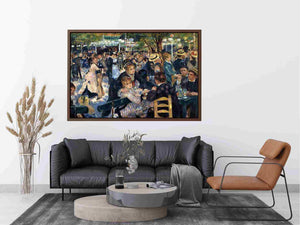
In contemporary interiors, Dance At The Moulin De La Galette retains remarkable vitality and adaptability. In living rooms, it introduces movement, warmth, and narrative richness without visual heaviness. In dining and social spaces, it resonates naturally with themes of gathering and conviviality. In studies and offices, it offers a reminder of balance between work and life. Within galleries and luxury residences across the United States, United Kingdom, Canada, Australia, and Europe, the painting integrates seamlessly with modern, traditional, and eclectic décor. Its layered composition rewards repeated viewing, while its harmonious palette complements a wide range of interior styles.
The enduring relevance of Dance At The Moulin De La Galette lies in its affirmation of shared experience. Renoir presents modern life not as alienating or mechanical, but as human, imperfect, and vibrant. The painting reminds viewers that meaning often arises not from singular moments of grandeur, but from participation—from being among others, under changing light, within time itself. In capturing this truth with generosity and restraint, Renoir created a work that continues to speak with clarity and warmth across generations.
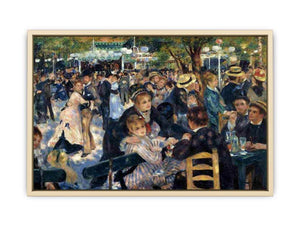
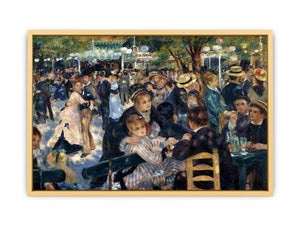
Buy museum qulaity 400- 450 canvas prints, framed prints, and 100% oil paintings of Dance At The Moulin De La Galette by Pierre Auguste Renoir at Alpha Art Gallery, where world-famous masterpieces are recreated with museum-quality detail, refined craftsmanship, and premium materials.
FAQS
What does Dance At The Moulin De La Galette by Pierre-Auguste Renoir depict?
It depicts a lively Sunday gathering at an open-air dance garden in Montmartre, showing people socialising, dancing, and enjoying leisure time.
Why is this painting considered a masterpiece of Impressionism?
It unites modern subject matter, visible brushwork, and complex light effects while maintaining emotional warmth and compositional balance.
How does Renoir use light in the painting?
He uses dappled sunlight filtering through trees to create movement, rhythm, and atmosphere across figures and space.
Is there a central subject in the composition?
No, the painting deliberately avoids a single focal point, emphasising collective experience over individual narrative.
What emotional tone does the painting convey?
It conveys pleasure, sociability, and fleeting joy without idealisation or sentimentality.
How does this work reflect modern urban life?
It presents leisure as a defining aspect of modern identity, capturing the rhythms and interactions of contemporary society.
Is Dance At The Moulin De La Galette suitable for contemporary interiors?
Yes, its harmonious colour, dynamic composition, and cultural significance make it adaptable to modern and classic spaces.
Why does the painting remain relevant today?
Its celebration of shared presence, movement, and everyday joy continues to resonate across cultures and generations.