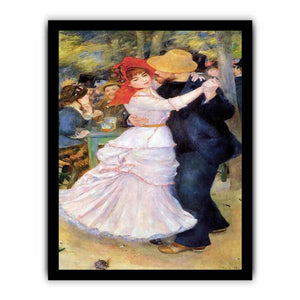
Dance at Bougival Painting by Pierre-Auguste Renoir
Dance at Bougival Painting by Pierre-Auguste Renoir is one of the most exuberant and psychologically assured images of modern life produced by Impressionism, a painting in which movement, intimacy, and social vitality are fused into a single, luminous experience. Painted in 1883, the work belongs to a brief but decisive moment in Renoir’s career when he sought to reconcile the immediacy of Impressionist perception with a renewed commitment to structure, volume, and classical balance. The result is a painting that feels spontaneous yet enduring—alive with motion, yet anchored by compositional intelligence.
The artist who achieved this synthesis, Pierre-Auguste Renoir, was increasingly concerned in the early 1880s with giving greater solidity to figures without abandoning light and color. Dance at Bougival emerges from this inquiry. Rather than depicting a fleeting crowd scene, Renoir focuses on a single dancing couple, bringing the viewer into close proximity with their shared rhythm. The painting does not describe a place so much as it evokes a state of being—absorbed, physical, and present.
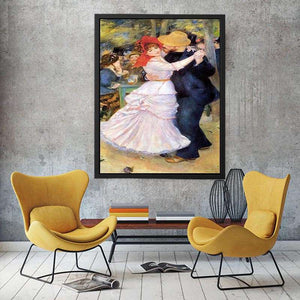
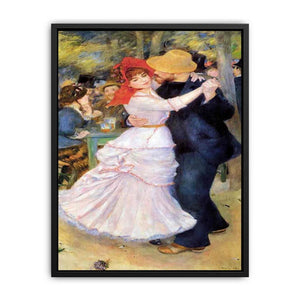
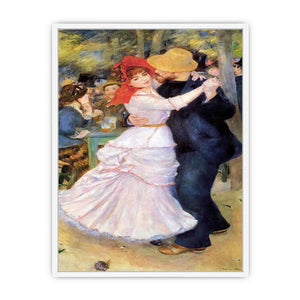
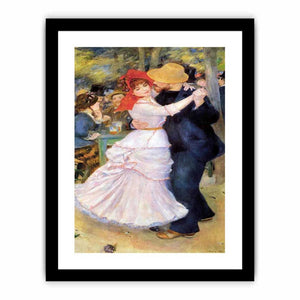
The subject shows a couple dancing outdoors in the Parisian suburb of Bougival, a popular destination for leisure along the Seine. The man, dressed in dark attire and straw hat, anchors the composition with grounded confidence. The woman, in a softly lit dress and fashionable hat, turns toward him with relaxed assurance. Their bodies form a compact, rotating unit, suggesting movement that is continuous rather than momentary. Renoir chooses not to depict the broader crowd in detail; background figures dissolve into suggestion, allowing the dance itself to command attention.
Compositionally, the painting is built around circular motion. The figures’ bodies curve inward, their arms and torsos creating a rhythmic loop that mirrors the act of dancing. This rotation is counterbalanced by the vertical stability of the male figure and the soft diagonal of the woman’s posture. The result is a composition that feels both dynamic and secure, capturing motion without sacrificing balance. Renoir’s control is evident: energy is released, but never chaotic.
Perspective reinforces intimacy. The viewer is placed close to the couple, almost within the dance’s orbit, yet not intrusively so. Renoir avoids theatrical staging or exaggerated distance. The scene unfolds at human scale, encouraging identification rather than spectacle. The painting feels experienced rather than observed, as though the viewer has stepped momentarily into the flow of the afternoon.
Light plays a crucial role in shaping mood. Renoir bathes the figures in warm daylight that softens edges and unifies form. Light does not spotlight or isolate; it envelops. Shadows are gentle, built through color rather than contrast, preserving the painting’s sense of ease. This luminous treatment transforms physical movement into emotional warmth, allowing the dance to feel effortless and shared.
The color palette is rich yet harmonized. Deep blues and blacks of the man’s clothing ground the composition, while the woman’s lighter dress introduces softness and luminosity. Accents of warm skin tones, straw hat yellows, and background greens create chromatic vibration without fragmentation. Renoir’s color is sensuous but disciplined, guiding the eye through the painting while maintaining unity. Color becomes the vehicle through which motion is felt.
Renoir’s technique balances fluid brushwork with renewed attention to form. The background is handled loosely, with visible strokes that suggest foliage, figures, and atmosphere without insisting on detail. By contrast, the dancers’ faces and bodies are modeled with greater solidity, reflecting Renoir’s desire to restore structure to Impressionist painting. This contrast directs focus and reinforces the central relationship without isolating it from its environment.
Symbolically, Dance at Bougival is understated yet resonant. Dance functions as a metaphor for social connection, physical harmony, and shared time. Renoir does not impose moral or narrative interpretation. The painting celebrates participation rather than observation, presence rather than performance. The couple is neither idealized nor dramatized; they are simply engaged, and that engagement becomes the subject.
Psychologically, the painting is defined by ease and mutual awareness. The dancers are attuned to one another, their expressions relaxed, their bodies responsive. There is no tension, no self-consciousness. Renoir captures a form of intimacy that is public yet personal, a balance that reflects modern urban leisure. The painting’s emotional intelligence lies in its refusal to exaggerate. It trusts simplicity.
Within Renoir’s broader oeuvre, Dance at Bougival belongs to a trio of dance paintings that explore movement and companionship from different angles. Among them, this work is perhaps the most grounded and immediate, emphasizing physical closeness over spectacle. It demonstrates Renoir’s evolving belief that modern life could be painted with both vitality and permanence, without sacrificing beauty or clarity.
Culturally, the painting reflects the optimism of late-nineteenth-century Parisian society, where leisure, sociability, and public pleasure were increasingly central to identity. Yet Renoir avoids superficial charm. He presents leisure as embodied experience—felt through weight, balance, and shared motion. The painting affirms that modernity can be humane and joyful without irony.
In contemporary interiors across the United States, the United Kingdom, Canada, Australia, and Europe, Dance at Bougival integrates with exceptional warmth and presence. In living rooms, it introduces movement and conviviality. In studies and offices, it offers energy tempered by composure. In galleries and luxury residences, it anchors space with Impressionist authority, harmonizing effortlessly with traditional, modern, minimalist, and eclectic décor through its balanced composition and radiant color.
The painting remains meaningful today because it celebrates connection without excess and movement without haste. In a world often defined by acceleration, Renoir’s dancers remind us that rhythm can be shared, and that joy can be both physical and composed. Dance at Bougival does not depict an event. It sustains a feeling.
Dance at Bougival Painting by Pierre-Auguste Renoir endures as one of the most life-affirming expressions of Impressionism. Through luminous color, circular composition, and psychological ease, Renoir transformed an afternoon dance into a timeless meditation on movement, intimacy, and modern pleasure.
Buy museum qulaity 400- 450 canvas prints, framed prints, and 100% oil paintings of Dance at Bougival by Pierre-Auguste Renoir at Alpha Art Gallery, where world-famous masterpieces are recreated with museum-quality detail, refined craftsmanship, and premium materials.
FAQS
What does Dance at Bougival depict?
It depicts a couple dancing outdoors in Bougival, capturing a moment of shared rhythm and leisure.
Why is this painting important in Renoir’s career?
It reflects a mature phase where Renoir balanced Impressionist light with stronger structure and form.
How does Renoir convey movement in the painting?
Through circular composition, responsive poses, and fluid brushwork that suggest continuous motion.
What role does light play in the scene?
Warm, diffused daylight envelops the figures, creating unity and emotional warmth.
Is the background intentionally less detailed?
Yes, looser handling keeps focus on the dancers while maintaining an open-air atmosphere.
Does the painting tell a specific story?
No, it emphasizes presence and feeling rather than narrative.
Why does the painting feel intimate despite being a public scene?
Close perspective and the dancers’ mutual focus create a sense of private connection within public space.
Where does this artwork work best in interiors?
It is ideal for living rooms, studies, offices, galleries, and spaces seeking warmth, movement, and refined joy.