Conversion of St. Paul Painting by Caravaggio
Conversion of St. Paul stands as one of the most arresting and inwardly dramatic interpretations of spiritual transformation in Western art, a painting in which Caravaggio reduces revelation to a moment of physical collapse and psychological awakening. Executed around 1600–1601 during his early Roman maturity, the work redefines conversion not as public spectacle but as an intimate rupture—an event that occurs within the body as much as the soul. In Caravaggio’s hands, divine intervention is neither distant nor ornamental; it is immediate, disorienting, and irrevocably personal.
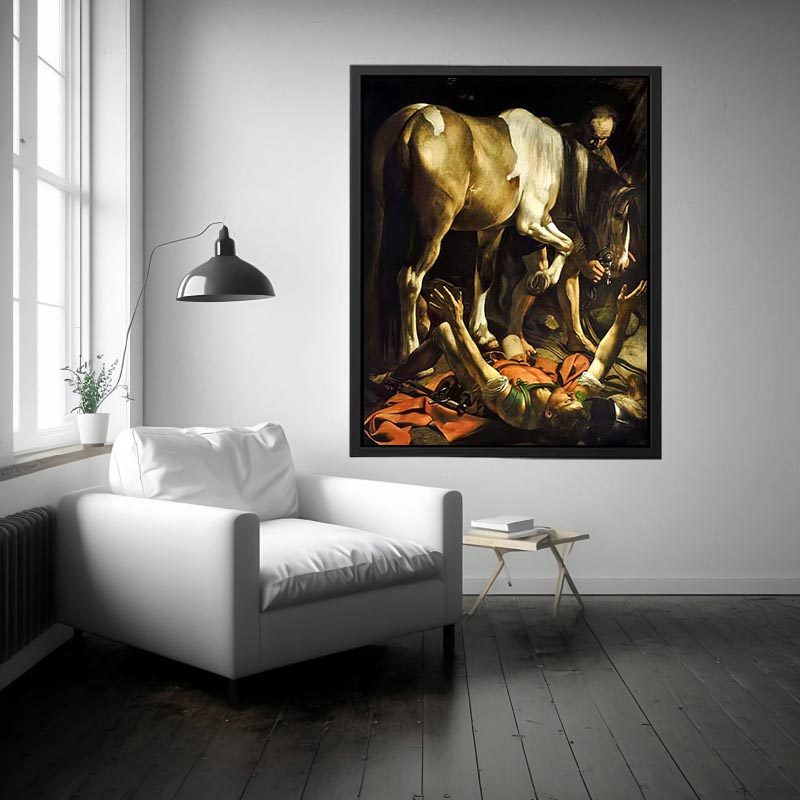
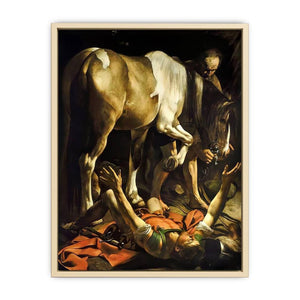
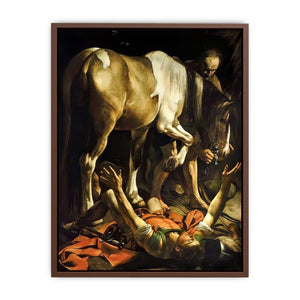
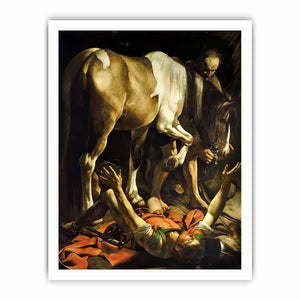
Caravaggio approached the biblical account of Saul’s conversion on the road to Damascus with characteristic audacity. Rather than illustrating the narrative expansively—with celestial visions, throngs of figures, or sweeping landscapes—he compresses the scene to its essential human core. Paul is shown fallen from his horse, sprawled on the ground, arms open, eyes closed or blinded, suspended between resistance and surrender. The drama unfolds not in the heavens but at ground level, where the body meets gravity and certainty dissolves into vulnerability.
The composition is radical in its economy. The canvas is dominated by the massive presence of the horse, whose muscular flank and lowered head occupy much of the pictorial space. This animal, rendered with calm indifference, becomes an unexpected counterpoint to the human drama below. Paul’s body, smaller and exposed, lies beneath the animal’s weight, emphasizing the disproportion between worldly power and spiritual reckoning. The groom or attendant, absorbed in controlling the horse, appears unaware of the miracle unfolding, reinforcing Caravaggio’s insistence that transformation can occur unnoticed by the world.
Perspective is deliberately intimate and destabilizing. The viewer is placed close to the fallen figure, within the shallow space of the scene, denied any panoramic distance that might aestheticize the event. There is no architectural grandeur, no descriptive landscape to contextualize the action. The setting is reduced to darkness and ground, a non-place that strips the moment of historical specificity and renders it universal. Conversion becomes a condition rather than an episode.
Light functions as the painting’s primary expressive agent. Emerging from an unseen source, it falls with decisive clarity upon Paul’s body, isolating him from the surrounding darkness. This light does not illuminate a vision; it illuminates a state. Paul’s armor gleams softly, his flesh registers warmth and weight, and his open hands receive light as if receiving meaning itself. Caravaggio’s chiaroscuro is not merely dramatic; it is diagnostic, revealing the moment when resistance gives way to submission. Darkness, dense and enveloping, presses in from all sides, intensifying the sense that illumination is hard-won and singular.
Colour is restrained and corporeal. Earthy browns, muted reds, and soft metallic tones dominate the palette, grounding the scene in physical reality. There is no chromatic exaltation, no symbolic color coding to announce holiness. Instead, colour serves to affirm presence: the solidity of the horse, the vulnerability of flesh, the weight of armor. This insistence on material truth anchors the spiritual event in the tangible world, a hallmark of Caravaggio’s revolutionary naturalism.
Caravaggio’s handling of paint reinforces the painting’s immediacy. Forms emerge through light rather than outline, their edges dissolving into shadow. The horse’s hide, the groom’s garments, and Paul’s armor are rendered with tactile precision, yet never distract from the central act of surrender. Paul’s face, partially obscured, resists theatrical expression. His conversion is not depicted as ecstasy but as yielding—a relinquishment of control enacted through the body.
Symbolically, Conversion of St. Paul reorients the meaning of power. Saul, once defined by authority and certainty, is rendered helpless, disarmed, and prone. The horse—often associated with status, mobility, and command—stands over him, unmoved. The absence of Christ’s visible figure intensifies the painting’s psychological depth: the divine is present as force rather than form, as impact rather than image. Faith here is not mediated by sight; it is imposed through experience.
Emotionally, the painting is austere and profound. There is no outward celebration, no crowd to witness the event. The moment is solitary, internal, and disquieting. Viewers are invited not to admire the miracle, but to feel its weight. Conversion is shown as interruption—a sudden reorientation that collapses identity before reconstructing it. This emotional restraint lends the work its enduring power, allowing it to resonate across belief systems and historical contexts.
Within Caravaggio’s career, Conversion of St. Paul exemplifies his commitment to psychological truth and his refusal to idealize sacred narrative. Alongside works such as Calling of St. Matthew and Doubting Thomas, it forms part of a coherent vision in which spiritual meaning is inseparable from human experience. Caravaggio does not decorate faith; he interrogates it, insisting that revelation must contend with flesh, fear, and uncertainty.
Culturally, the painting reflects the Counter-Reformation’s call for immediacy and emotional engagement, yet it exceeds doctrinal aims through its radical minimalism. By stripping the narrative to its essentials, Caravaggio created an image that transcends confessional boundaries. The painting speaks to anyone who has experienced a moment of forced reorientation—when certainty collapses and a new understanding demands space.
In contemporary interiors, Conversion of St. Paul commands presence through gravity rather than scale. In living rooms, it serves as a focal point that invites sustained contemplation and conversation. In studies and offices, it communicates seriousness, humility, and intellectual depth. In galleries and refined residences across the United States, United Kingdom, Canada, Australia, and Europe, the painting integrates seamlessly with traditional, modern, and minimalist settings. Its restrained palette and dramatic light anchor space with authority, offering meaning rather than ornament.
The enduring relevance of Conversion of St. Paul lies in its uncompromising portrayal of change. Caravaggio presents transformation as something that happens to us rather than for us—an event that disarms before it enlightens. The painting reminds viewers that revelation is rarely gentle, that understanding often begins in darkness, and that surrender can be the first act of clarity. In rendering this moment with unmatched psychological precision, Caravaggio created one of the most profound visual meditations on transformation in the history of art.
Buy museum qulaity 400- 450 canvas prints, framed prints, and 100% oil paintings of Conversion of St. Paul by Caravaggio at Alpha Art Gallery, where world-famous masterpieces are recreated with museum-quality detail, refined craftsmanship, and premium materials.
FAQS
What moment does Conversion of St. Paul by Caravaggio depict?
It depicts the moment Saul falls to the ground on the road to Damascus, experiencing a sudden spiritual transformation.
Why is Christ not visibly shown in the painting?
Caravaggio emphasizes inner experience over external vision, presenting divine presence as force rather than form.
What role does the horse play in the composition?
The horse symbolizes worldly power and indifference, towering over Paul’s vulnerability without awareness of the miracle.
How does light function in the painting?
Light isolates Paul’s moment of surrender, acting as the visual equivalent of divine intervention.
Why is Paul shown on the ground rather than upright?
His collapse signifies the breakdown of certainty and authority that precedes transformation.
Is the painting emotionally dramatic or restrained?
It is deeply restrained, conveying transformation through stillness and vulnerability rather than spectacle.
How does this work reflect Caravaggio’s style?
It exemplifies his dramatic chiaroscuro, naturalism, and focus on psychological truth.
Is Conversion of St. Paul suitable for contemporary interiors?
Yes, its narrative depth and restrained palette make it ideal for spaces that value reflection and cultural significance.