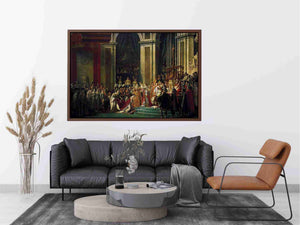
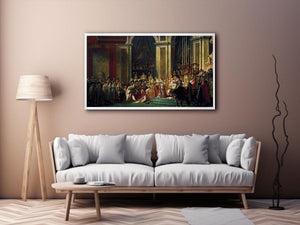
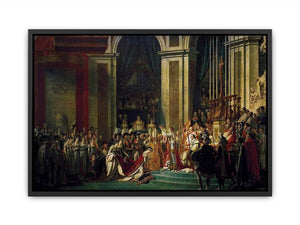
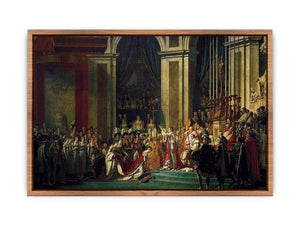
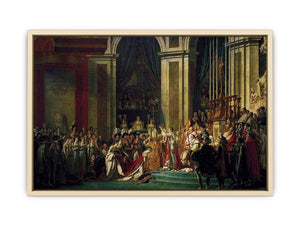
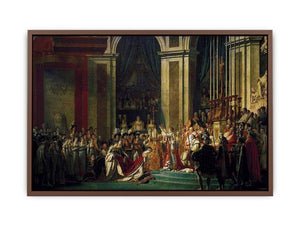
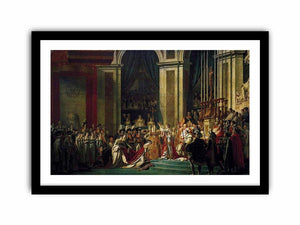
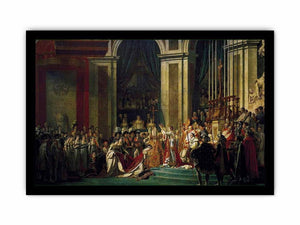
Consecration of the Emperor Napoleon I and Coronation of the Empress Josephine 1805–07 Painting by Jacques-Louis David
Consecration of the Emperor Napoleon I and Coronation of the Empress Josephine 1805–07 Painting by Jacques-Louis David stands as one of the most monumental and politically charged works in the history of Western art, a painting in which ceremony, power, ideology, and image-making converge with extraordinary precision. Executed between 1805 and 1807, the canvas does not merely document an event. It constructs a vision of authority designed to endure. Through scale, composition, and calculated symbolism, David transforms a single imperial ritual into a definitive statement about sovereignty, legitimacy, and the reconfiguration of power in post-revolutionary Europe.
At the center of this enterprise stands Jacques-Louis David, the leading artistic authority of Revolutionary and Napoleonic France. David was not a neutral observer. He was an active participant in the political life of his era, a former revolutionary who understood the potency of images in shaping public consciousness. By the time of Napoleon’s coronation, David had become the official visual architect of the new empire. This painting represents the apex of that role, where art operates as both historical record and ideological instrument.
The historical event depicted took place on 2 December 1804 in Notre-Dame Cathedral in Paris. In a deliberate break from tradition, Napoleon crowned himself emperor rather than receiving the crown from the Pope, asserting that his authority derived not from divine sanction alone but from his own will and achievements. David, however, makes a critical choice. Rather than depicting the self-coronation, he shows Napoleon crowning Josephine. This compositional decision shifts the narrative from defiance to magnanimity, from rupture to continuity, allowing the ceremony to appear solemn, orderly, and legitimate rather than radical.
Compositionally, the painting is vast and meticulously organized. The scene unfolds within the architectural grandeur of Notre-Dame, rendered with classical clarity and symmetry. Napoleon stands at the center, elevated and commanding, his posture upright and controlled. Josephine kneels before him, her position reinforcing both hierarchy and harmony. Around them, a dense assembly of figures—clergy, dignitaries, family members, and officials—forms a carefully choreographed tableau. Every figure is placed with intention, contributing to a visual hierarchy that mirrors imperial order.
Perspective reinforces Napoleon’s dominance without resorting to distortion. The viewer’s eye is drawn inexorably toward the emperor, guided by lines of architecture, arrangement of figures, and directional gazes. David uses scale masterfully: Napoleon’s presence is magnified not through exaggerated size, but through compositional centrality and visual authority. The painting feels balanced and controlled, conveying stability rather than chaos, permanence rather than upheaval.
Light plays a crucial role in shaping meaning. Illumination is even and ceremonial, bathing the central figures in clarity while allowing peripheral details to recede gently. There is no dramatic chiaroscuro, no emotional turbulence. Light here functions as legitimization. It reveals, sanctifies, and stabilizes. David avoids theatrical lighting because the message requires calm inevitability, not passion.
The color palette is rich, authoritative, and symbolic. Deep reds, imperial golds, luminous whites, and dark velvets dominate the canvas. These colors reference both ancient Roman authority and contemporary regalia, visually linking Napoleon’s empire to classical antiquity and monarchical tradition. Textiles, crowns, and ceremonial objects are rendered with astonishing detail, emphasizing material splendor without tipping into excess. Color becomes a language of power, wealth, and continuity.
David’s technique is precise and disciplined, characteristic of the Neoclassical ideal. Forms are clearly delineated, surfaces polished, and gestures controlled. There is no visible improvisation. Every element is resolved with deliberation. This technical rigor reinforces the painting’s ideological purpose: the empire is orderly, rational, and enduring. Painterly restraint serves political clarity.
Symbolically, the painting is dense yet controlled. The presence of Pope Pius VII, seated and blessing the ceremony, is particularly significant. Though historically marginalized during the event, he is granted dignified inclusion in the painting. This visual concession signals reconciliation between church and state, even as Napoleon remains the active agent of power. Josephine’s coronation, meanwhile, presents the empire as familial and dynastic, softening the image of military authority with ritualized grace.
Psychologically, the painting conveys composure rather than emotion. Napoleon’s expression is focused and contained. There is no triumph, no fervor. This restraint is strategic. David presents authority as naturalized, unquestioned, and self-assured. The absence of visible conflict reinforces the idea that the empire has resolved the turbulence of revolution and ushered in a new era of order.
Within David’s oeuvre, this painting represents the culmination of his transformation from revolutionary artist to imperial chronicler. Earlier works such as The Oath of the Horatii dramatized civic virtue and sacrifice. Here, virtue is replaced by legitimacy, sacrifice by ceremony. Yet the underlying Neoclassical discipline remains. David applies the moral seriousness of classical history painting to contemporary power, elevating modern politics to the level of epic history.
Culturally, the painting functions as one of the most successful examples of state-sponsored image-making. It demonstrates how art can shape collective memory, smoothing over contradictions and re-framing contested moments into coherent narratives. The painting does not lie outright; it edits. In doing so, it reveals the mechanics of visual power with remarkable clarity. It remains a foundational reference for understanding how modern regimes use art to legitimize authority.
In contemporary interiors across the United States, the United Kingdom, Canada, Australia, and Europe, Consecration of the Emperor Napoleon I and Coronation of the Empress Josephine commands exceptional gravitas. In offices, libraries, and studies, it conveys leadership, historical awareness, and intellectual authority. In galleries and luxury residences, it anchors space with monumental presence, harmonizing with traditional, neoclassical, and eclectic interiors while offering striking contrast in modern minimalist settings through its disciplined structure and rich tonality.
The painting remains meaningful today because it exposes the relationship between power and representation. In an era still shaped by image politics, David’s masterpiece serves as both artifact and lesson. It reminds the viewer that authority is not only exercised—it is staged, framed, and remembered through images. The painting does not merely commemorate empire. It explains how empires wish to be seen.
Consecration of the Emperor Napoleon I and Coronation of the Empress Josephine 1805–07 Painting by Jacques-Louis David endures as one of the most ambitious and intellectually formidable works of political art ever created. Through monumental scale, compositional discipline, and symbolic control, David transformed a ceremonial moment into a timeless assertion of imperial legitimacy. The painting does not ask for belief. It constructs it.
Buy museum qulaity 400- 450 canvas prints, framed prints, and 100% oil paintings of Consecration of the Emperor Napoleon I and Coronation of the Empress Josephine by Jacques-Louis David at Alpha Art Gallery, where world-famous masterpieces are recreated with museum-quality detail, refined craftsmanship, and premium materials.
FAQs
What historical event does this painting depict?
It depicts Napoleon crowning Empress Josephine during his imperial coronation ceremony at Notre-Dame in 1804.
Why is Napoleon shown crowning Josephine instead of himself?
David chose this moment to emphasize magnanimity, legitimacy, and dynastic continuity rather than political defiance.
Is this painting historically accurate?
It is accurate in many details but deliberately adjusted to serve political symbolism and imperial narrative.
What role does the Pope play in the painting?
Pope Pius VII is shown blessing the ceremony, reinforcing reconciliation between church and empire.
Why is this painting considered propaganda?
It constructs an idealized vision of authority, order, and legitimacy aligned with Napoleonic ideology.
How does this work reflect Neoclassical principles?
Through clarity of form, disciplined composition, moral seriousness, and reference to classical authority.
Why does the painting remain relevant today?
It reveals how images shape political legitimacy and collective memory.
Where does this artwork work best in interiors?
It is ideal for offices, libraries, studies, galleries, and spaces emphasizing leadership and history.