Composition VIII Painting by Wassily Kandinsky
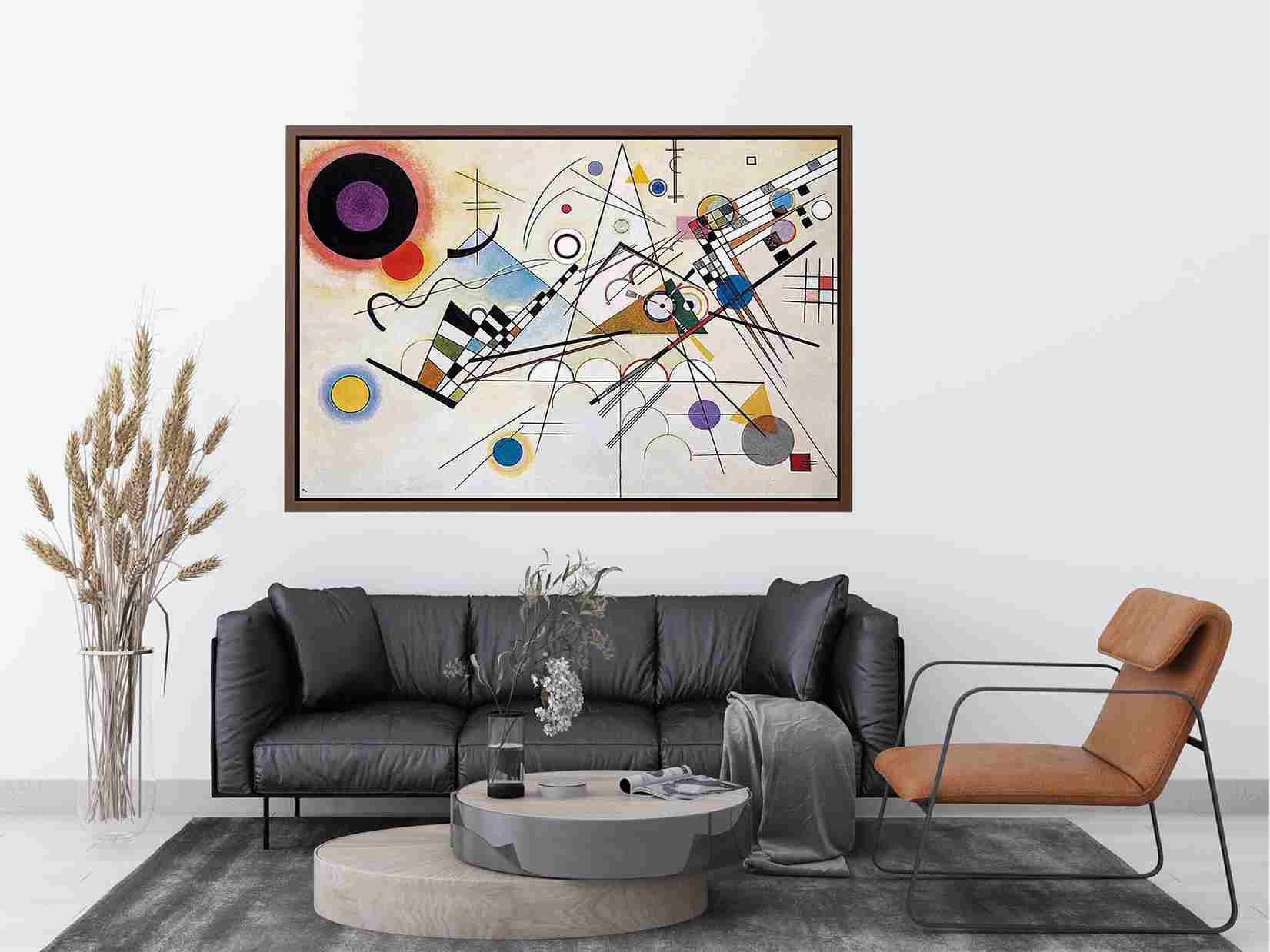
Composition VIII stands as one of the most intellectually distilled and structurally resolved works of Wassily Kandinsky’s career, a painting in which abstraction achieves full autonomy through clarity, balance, and conceptual precision. Created in 1923, shortly after Kandinsky joined the Bauhaus, the work represents a decisive moment in the evolution of modern art, where emotion, geometry, and philosophical intent converge without reliance on representation. Composition VIII is not an expression of chaos or spontaneity; it is a painting governed by internal laws, offering a vision of order born from abstraction itself.
By the early 1920s, Kandinsky had already traversed the turbulent emotional landscapes of early abstraction, where colour and form erupted with expressive urgency. Composition VIII belongs to a later phase, shaped by his immersion in Bauhaus pedagogy, where art, architecture, mathematics, and music intersected. In this environment, Kandinsky refined his belief that painting could operate as a universal language, one capable of conveying meaning through relationships rather than symbols. Composition VIII embodies this conviction with exceptional clarity.
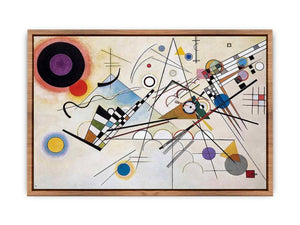
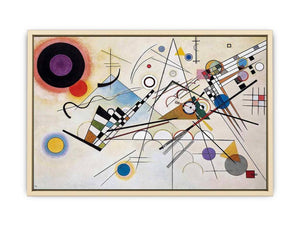
The composition is constructed from an array of geometric forms—circles, arcs, straight lines, triangles, grids, and diagonals—distributed across the surface with deliberate equilibrium. There is no illusion of natural space, no foreground or background in the traditional sense. Instead, space is generated through interaction. Shapes advance, recede, intersect, and repel one another through scale, colour, and placement. The viewer does not enter a depicted world; they encounter a system.
Circles play a dominant role in Composition VIII, functioning as centres of gravity within the painting’s visual field. For Kandinsky, the circle held particular significance, representing unity, continuity, and spiritual wholeness. Yet these circles are not isolated or static. They interact with sharp diagonals and linear elements that introduce tension and movement. The result is a dynamic balance between stability and disruption, harmony and resistance.
Line operates as a decisive force throughout the composition. Straight lines cut across the canvas with precision, establishing direction and rhythm. Diagonal lines inject energy, suggesting motion and instability, while curved lines soften transitions and redirect the eye. Kandinsky treats line as an active agent rather than a boundary. It is through line that the painting breathes, unfolding temporally as the viewer’s gaze moves from one interaction to another.
Colour in Composition VIII is restrained yet purposeful. Unlike the saturated intensity of Kandinsky’s earlier works, the palette here is cooler and more measured. Soft blues, muted reds, pale yellows, blacks, and neutral tones coexist without dominance. Colour does not overwhelm form; it articulates it. Each hue is calibrated to support spatial relationships and visual tension, reinforcing Kandinsky’s belief that colour possesses inherent psychological properties that operate independently of depiction.
Light is not represented as a natural phenomenon but as an outcome of contrast and clarity. Bright areas emerge through juxtaposition rather than illumination. The absence of chiaroscuro reinforces the painting’s autonomy from the visible world. Nothing in Composition VIII refers to a specific place, time, or object. The painting exists entirely within its own logic, governed by proportion and relation.
Texture is deliberately subdued. Kandinsky avoids expressive brushwork that might distract from structural clarity. Surfaces are smooth and controlled, allowing forms to read with immediacy. Where variation appears, it serves to modulate emphasis rather than assert materiality. This restraint reflects Kandinsky’s belief that abstraction should communicate through organisation rather than gesture.
Symbolically, Composition VIII resists fixed interpretation. Kandinsky rejected literal symbolism, arguing that abstraction could communicate directly to the inner life without translation. Yet the painting’s disciplined structure suggests a worldview shaped by balance, inquiry, and synthesis. The coexistence of order and tension mirrors broader intellectual currents of the early twentieth century, when artists sought new systems of meaning amid social and cultural transformation.
Emotionally, Composition VIII is alert rather than emotive. It does not seek to overwhelm or soothe. Instead, it engages the viewer intellectually, encouraging active perception. The experience of the painting unfolds gradually, revealing complexity through sustained attention. This demand on the viewer is central to its power. Kandinsky does not offer resolution; he offers participation.
Within Kandinsky’s artistic development, Composition VIII represents a culmination of his theoretical and visual investigations. It synthesises his spiritual aspirations with Bauhaus rationalism, demonstrating that abstraction could achieve both emotional resonance and formal discipline. The painting stands as a declaration that modern art need not choose between feeling and structure. It can embody both simultaneously.
The cultural importance of Composition VIII is immense. It occupies a central position in the history of abstraction, influencing generations of artists, designers, and architects. Its principles continue to resonate in contemporary visual culture, where geometry, balance, and relational thinking remain foundational. Viewers across the United States, the United Kingdom, Canada, Australia, and Europe continue to find relevance in its clarity and intellectual ambition.
In interior spaces, Composition VIII functions as a source of visual intelligence and energy. In living rooms, it introduces dynamism without narrative distraction. In studies and offices, it reinforces values of clarity, analysis, and creative thought. In galleries and luxury residences, it signals deep engagement with one of the defining achievements of twentieth-century art.
The painting integrates seamlessly into traditional, modern, minimalist, and eclectic interiors. Traditional spaces benefit from its contrast, which invigorates classical surroundings. Modern interiors resonate with its architectural logic and spatial clarity. Minimalist environments find richness in its structured complexity, while eclectic spaces draw cohesion from its balanced relationships.
The enduring significance of Composition VIII lies in its insistence that meaning can arise from pure relationship. Kandinsky demonstrates that abstraction is not absence, but presence—an active field where perception, thought, and sensation converge. The painting remains meaningful because it challenges the viewer to engage not with what is depicted, but with how seeing itself operates.
To live with Composition VIII is to engage daily with one of modern art’s most articulate visual systems. Through its disciplined geometry, measured colour, and philosophical depth, the painting continues to affirm Kandinsky’s belief that art can function as a universal language—one that speaks not through representation, but through the organised energy of form itself.
Buy museum qulaity 400- 450 canvas prints, framed prints, and 100% oil paintings of Composition VIII by Wassily Kandinsky at Alpha Art Gallery, where world-famous masterpieces are recreated with museum-quality detail, refined craftsmanship, and premium materials.
FAQS
What is the main idea behind Composition VIII?
The painting explores how geometric forms and colour relationships can create meaning without representing the visible world.
Why is Composition VIII considered a Bauhaus-era masterpiece?
It reflects Kandinsky’s synthesis of abstraction, mathematics, and visual theory developed during his time at the Bauhaus.
What role do circles play in the painting?
Circles function as stabilising elements, representing unity and balance within the composition’s dynamic structure.
Is Composition VIII meant to symbolise specific objects or ideas?
No. Kandinsky intended the work to communicate directly through visual relationships rather than fixed symbolism.
Is Composition VIII suitable for contemporary interiors?
Yes. Its clarity, balance, and intellectual presence integrate seamlessly into modern, minimalist, and eclectic spaces.
What emotional response does the painting evoke?
It encourages alertness, curiosity, and sustained engagement rather than emotional narrative.
Does this artwork have lasting cultural value?
As a cornerstone of abstract art, it holds enduring historical, theoretical, and artistic significance.
Where is the best place to display Composition VIII?
It is especially effective in living rooms, studies, offices, and gallery environments that value intellectual depth and visual clarity.