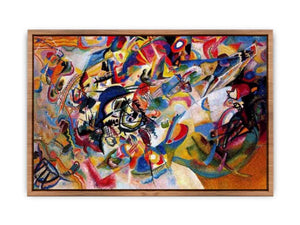
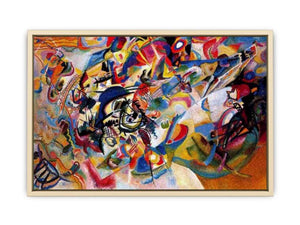
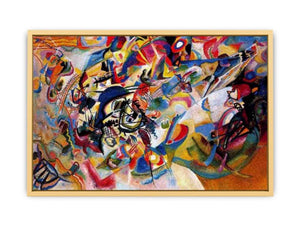
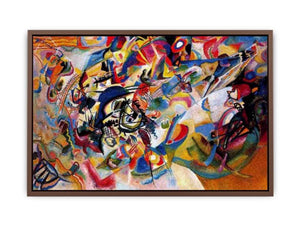
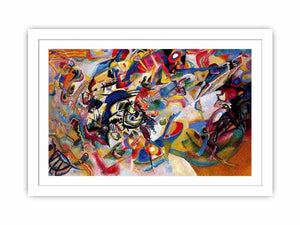
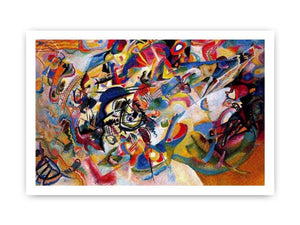
Composition VII Painting by Wassily Kandinsky
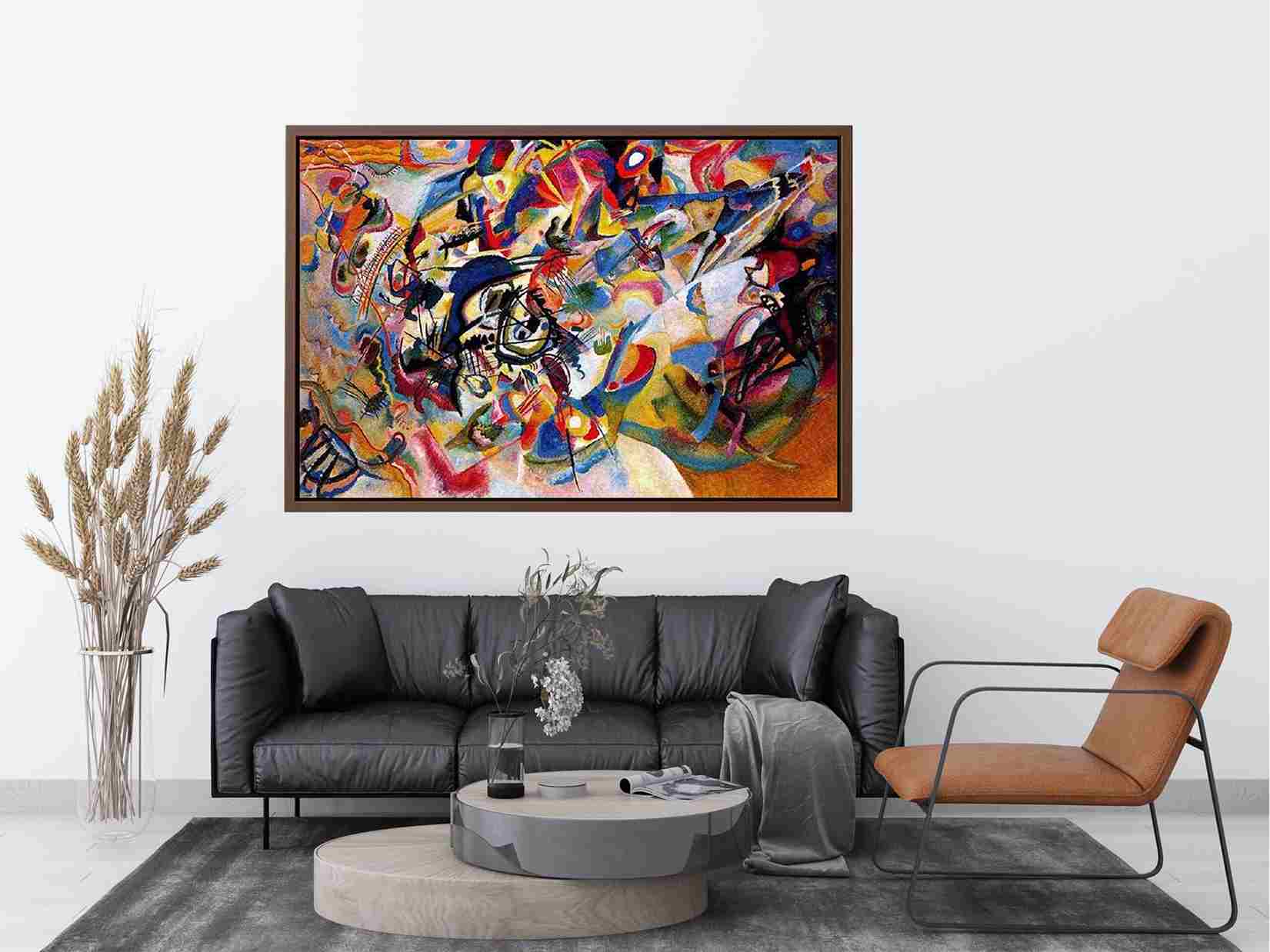
Composition VII stands as the most ambitious and emotionally charged work of Wassily Kandinsky’s early abstract period, widely regarded as the culmination of his pre-war artistic vision. Painted in 1913, at a moment of extraordinary intellectual intensity and cultural unease, the painting represents Kandinsky’s fullest attempt to create a purely abstract language capable of expressing inner necessity, spiritual upheaval, and transformation without recourse to representation. Composition VII is not an image to be read or decoded; it is an experience to be entered, a complex orchestration of colour, line, and motion that unfolds like a symphony rather than a narrative.
By 1913, Kandinsky had already moved decisively beyond figurative art. His earlier abstractions demonstrated growing confidence in colour and form as independent agents, but Composition VII marks a decisive escalation in scale, density, and ambition. It was created following extensive preparatory studies and theoretical reflection, reflecting Kandinsky’s belief that abstraction required discipline equal to, if not greater than, representational art. Far from improvisation, the painting is the result of sustained intellectual and emotional labour.
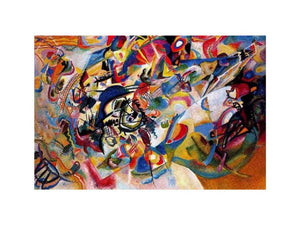
The composition is vast and immersive, filled with interlocking arcs, diagonals, whorls, and chromatic surges that resist any single point of focus. There is no stable ground, no horizon, no spatial hierarchy. Instead, the viewer encounters a continuous field of motion in which forms collide, dissolve, and re-emerge. Kandinsky deliberately denies compositional rest, compelling the eye to move incessantly across the surface. This perpetual motion is not chaotic; it is governed by rhythm, repetition, and counterpoint, much like a complex musical structure.
Colour functions as the primary carrier of emotional force. Kandinsky employs an expansive palette of blues, reds, yellows, whites, greens, and blacks, layered and juxtaposed with extraordinary intensity. Colours clash, merge, and reverberate, generating a sense of upheaval and transformation. Blue introduces depth and spiritual gravity, red asserts urgency and vitality, yellow flashes with sharp, almost piercing energy, while white punctuates the composition with moments of release. These colours do not symbolise objects or ideas in a literal sense; they operate directly on perception, eliciting response through vibration and contrast.
Line is equally vital, acting as both connective tissue and disruptive force. Sweeping curves suggest expansive movement and cyclical return, while sharp diagonals cut across the canvas with destabilising force. Kandinsky treats line not as contour but as energy, capable of accelerating, arresting, or redirecting visual flow. The interaction between curved and angular lines creates a dynamic tension that drives the composition forward without resolution.
Spatial depth in Composition VII is psychological rather than optical. Kandinsky abandons traditional perspective entirely, constructing space through overlapping forms and chromatic recession. Certain areas appear to advance aggressively toward the viewer, while others recede into visual density. This constant fluctuation undermines spatial certainty, reinforcing the painting’s sense of instability and transformation. The viewer does not occupy a fixed vantage point; perception itself becomes fluid.
Texture is layered and expressive, yet controlled. Kandinsky allows brushwork to remain visible, contributing to the painting’s intensity without descending into disorder. The surface bears evidence of revision and reworking, underscoring the painting’s status as a site of struggle and resolution. This physicality reinforces the idea that abstraction, for Kandinsky, was not decorative but existential.
Symbolically, Composition VII has often been associated with themes of apocalypse, resurrection, and spiritual rebirth—ideas that preoccupied Kandinsky at the time. However, he deliberately resisted explicit symbolism, believing that abstract form could convey these experiences more powerfully than figurative imagery. The painting does not depict destruction or renewal; it enacts them. Meaning arises through immersion, not recognition.
Emotionally, Composition VII is overwhelming by design. It demands sustained engagement, confronting the viewer with intensity rather than offering comfort or clarity. There is turbulence, urgency, and release, but no narrative arc to guide interpretation. Kandinsky intended this effect. He believed that true spiritual art should bypass intellect and speak directly to the inner life, provoking response rather than explanation.
Within Kandinsky’s artistic development, Composition VII represents both a peak and a turning point. Shortly after its completion, the outbreak of the First World War disrupted European cultural life and forced Kandinsky to reassess his artistic direction. His later work would become more structured and geometric, reflecting a shift toward order and analytical clarity. Composition VII thus stands as the final, most expansive expression of his early, emotionally driven abstraction.
The cultural importance of Composition VII cannot be overstated. It is widely recognised as one of the foundational masterpieces of abstract art, influencing generations of painters, composers, and thinkers who sought to break free from representational constraints. Its relevance endures across the United States, the United Kingdom, Canada, Australia, and Europe because it addresses universal experiences of upheaval, transformation, and inner intensity without anchoring them to a specific time or place.
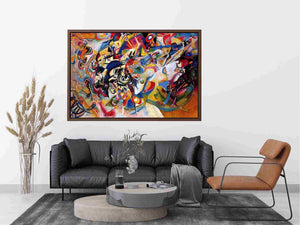
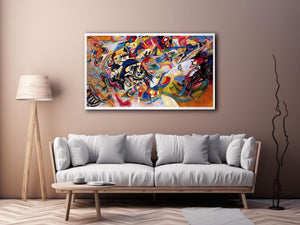
In interior spaces, Composition VII introduces extraordinary energy and intellectual depth. In living rooms, it becomes a commanding focal presence that invites contemplation and conversation. In studies and offices, it reinforces creativity, emotional intelligence, and engagement with complex ideas. In galleries and luxury residences, it signals a serious and informed relationship with one of the most consequential works of modern art.
The painting integrates powerfully into modern, minimalist, and eclectic interiors, where its complexity can breathe against clean architectural lines. In traditional settings, it functions as a provocative counterpoint, introducing dynamism and contemporary relevance. Its scale and density demand space and attention, making it particularly suited to environments that value visual and intellectual engagement.
The enduring power of Composition VII lies in its refusal to simplify experience. Kandinsky does not offer order, narrative, or reassurance. He offers transformation as a lived condition—messy, intense, and unresolved. The painting remains vital because it speaks to moments of profound change, when existing structures dissolve and new possibilities emerge without guarantee.
To live with Composition VII is to engage daily with one of the most radical and ambitious statements in the history of painting. Through its immersive composition, chromatic force, and philosophical daring, the work continues to affirm Kandinsky’s belief that art can operate as a direct conduit to inner experience. It stands as a testament to abstraction not as reduction, but as expansion—an art form capable of containing the full intensity of human consciousness.
Buy museum qulaity 400- 450 canvas prints, framed prints, and 100% oil paintings of Composition VII by Wassily Kandinsky at Alpha Art Gallery, where world-famous masterpieces are recreated with museum-quality detail, refined craftsmanship, and premium materials.
FAQS
What makes Composition VII one of Kandinsky’s most important works?
It represents the culmination of his early abstract period, uniting colour, line, and movement into a fully immersive, non-representational language.
Is Composition VII meant to depict specific events or symbols?
No. Kandinsky rejected literal symbolism, intending the painting to communicate directly through sensation and emotional resonance.
Why does the painting feel so intense and complex?
Its density, scale, and constant motion are deliberate, designed to immerse the viewer in a state of transformation rather than clarity.
How does Composition VII differ from Kandinsky’s later Bauhaus works?
Later works are more geometric and structured, while Composition VII prioritises emotional force and organic movement.
Is Composition VII suitable for contemporary interiors?
Yes, particularly in modern, minimalist, or gallery-style spaces that allow its scale and complexity to be fully experienced.
What emotional response does the painting evoke?
It often evokes intensity, awe, and introspection rather than calm or decorative pleasure.
Does this artwork have lasting cultural significance?
As one of the foundational masterpieces of abstract art, it holds enduring historical, artistic, and philosophical importance.
Where is the best place to display Composition VII?
It is most effective in living rooms, studies, offices, and gallery environments with sufficient space for sustained viewing.