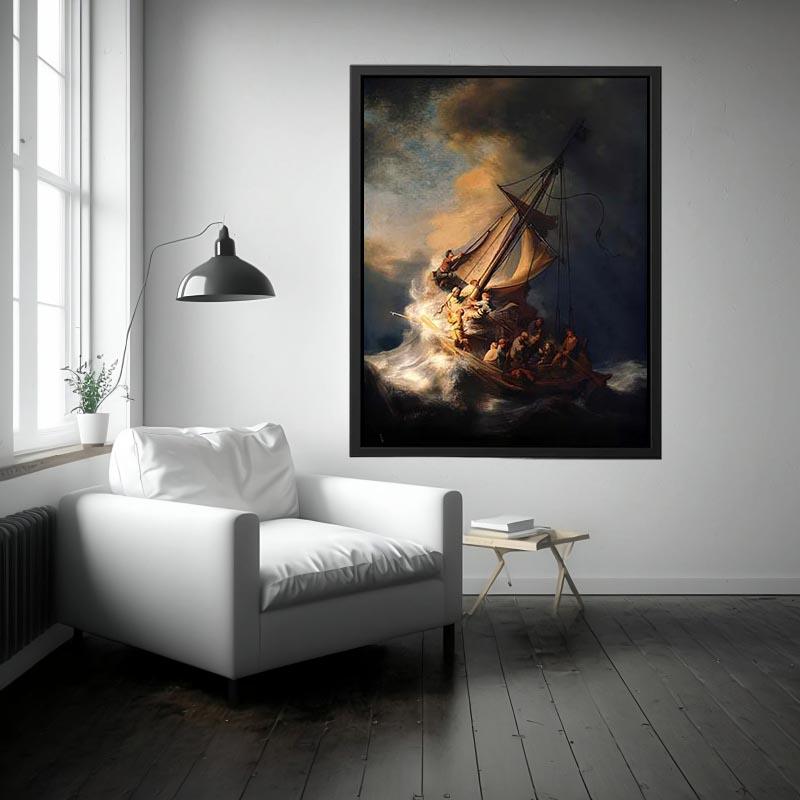
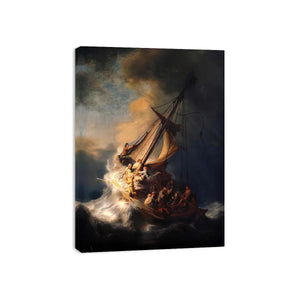
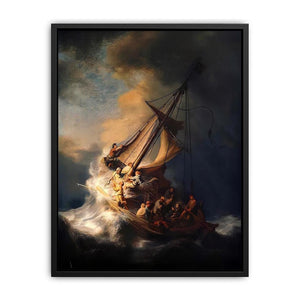
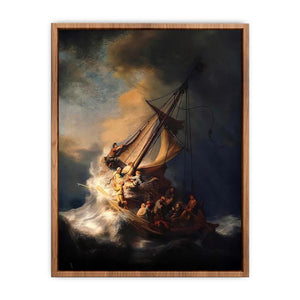
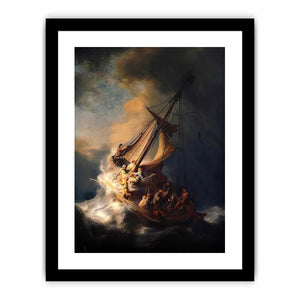
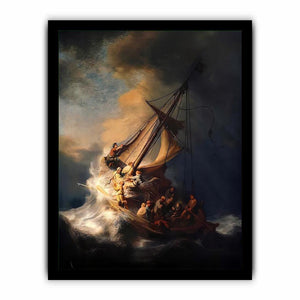
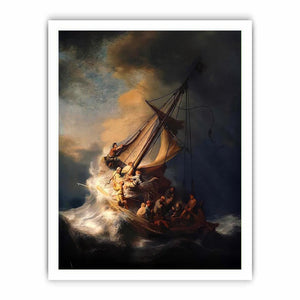
The Storm on the Sea of Galilee, more accurately titled Christ in the Storm on the Sea of Galilee, is Rembrandt van Rijn's dramatic 1633 painting of Christ and his disciples battling a violent storm. It is Rembrandt's only known seascape and one of his most celebrated biblical works. The original was stolen from the Isabella Stewart Gardner Museum in Boston in 1990 and remains missing. Alpha Art Gallery offers this masterpiece as a museum-quality canvas print, fine art print, framed print, or 100% hand-painted oil painting reproduction.
About The Storm on the Sea of Galilee by Rembrandt
Painted in 1633, Christ in the Storm on the Sea of Galilee transforms a biblical miracle into an intensely physical and psychological drama. A small fishing boat is thrown violently across rough water as Christ's disciples struggle with the wind, waves, ropes and damaged sail. Some figures work desperately to control the vessel, others react in fear, and Christ remains within the crowded boat as the crisis unfolds around him.
The painting is based on the biblical account of Christ calming the storm on the Sea of Galilee. Rembrandt does not present the event as a distant or serene religious image. Instead, he places the viewer close to the action, making the boat, the terrified figures and the force of the storm feel immediate. This powerful combination of sacred narrative and human emotion is one reason the painting remains so memorable.
Rembrandt's Only Known Seascape
The Storm on the Sea of Galilee holds a distinctive place among Rembrandt's paintings because it is his only known painted seascape. The work was created during an important early period in the artist's career, shortly after he had moved from Leiden to Amsterdam and was establishing himself as a major painter of portraits and historical subjects.
The painting demonstrates Rembrandt's ability to organize a complicated narrative around a single moment of extreme tension. The tilted boat creates a strong diagonal movement, while the large sail, dark sky and crashing water intensify the sense of danger. Individual reactions are carefully differentiated, allowing the viewer to move from one figure to another and experience the crisis through many expressions of fear, effort and uncertainty.
A Biblical Drama of Fear, Faith and Deliverance
The subject is commonly understood through the Gospel story in which Christ and his disciples encounter a dangerous storm on the Sea of Galilee. The disciples' struggle against nature provides the painting with its immediate drama, while Christ's presence gives the scene its religious significance.
The contrast between human panic and Christ's calm has often made the work a powerful image of faith in the face of danger. The painting can be appreciated both as a Christian narrative and as an extraordinary study of people confronted by forces beyond their control. Its emotional impact comes from Rembrandt's refusal to reduce the figures to simple symbols: each person appears caught in a different physical or emotional response to the storm.
One especially famous detail is the figure looking directly outward toward the viewer. He is widely identified as a self-portrait of Rembrandt, an appearance that creates an unusual connection between the artist, the biblical story and the person standing before the painting.
Composition, Light and Movement
Rembrandt builds the composition around instability. The boat rises sharply against the waves, the sail pulls across the upper part of the scene, and the figures are crowded into a space where every movement appears necessary for survival. Ropes, masts, sails and bodies create intersecting lines that guide the eye through the drama.
Light is equally important. Bright areas catch the waves, sail and figures while much of the composition is enveloped by darker passages. This contrast helps direct attention through the painting and strengthens its theatrical intensity. The changing relationship between darkness and illumination also contributes to the work's emotional atmosphere.
For wall art, this visual energy makes the painting especially effective at a substantial size. The composition rewards close viewing because the individual expressions and actions become easier to appreciate, while its dramatic overall silhouette gives it strong presence from across a room.
Rembrandt, Baroque Drama and the Dutch Golden Age
Rembrandt van Rijn is one of the defining artists of the Dutch Golden Age. Although he is especially famous for portraits, self-portraits and biblical scenes, his work also reveals an exceptional ability to tell stories through gesture, expression, light and composition.
The Storm on the Sea of Galilee reflects the dramatic visual language associated with Baroque art: movement, emotional intensity, strong contrasts and a sense that the viewer is witnessing an event in progress. Yet the painting is also deeply individual. Rather than presenting an orderly tableau, Rembrandt creates a crowded and unstable scene in which the viewer is almost drawn onto the boat.
Its mixture of religious subject matter, maritime danger and psychological observation makes it stand apart even within Rembrandt's own body of work. Visitors exploring other celebrated masterpieces from art history can see how unusual this painting's combination of narrative scale and emotional immediacy is.
The Original Painting and the 1990 Theft
The historical original was painted in oil on canvas in 1633 and measures approximately 160 × 128 cm. It belonged to the Isabella Stewart Gardner Museum in Boston and was displayed there until March 1990, when it was stolen during the notorious theft of 13 works from the museum.
The painting was cut from its frame during the theft. It has not been recovered, and its whereabouts remain unknown. For this reason, it is important to distinguish between the historic original and the reproduction offered by Alpha Art Gallery: this product is a reproduction inspired by Rembrandt's painting and is not the original work or affiliated with, authorized by or endorsed by the Isabella Stewart Gardner Museum.
Choose the Right The Storm on the Sea of Galilee Reproduction
Alpha Art Gallery offers several ways to bring the visual drama of Rembrandt's masterpiece into your home or professional space. Each format creates a different presentation experience.
Museum-Quality Canvas Print
A canvas version is a strong choice for this painting because the composition depends so heavily on visual scale, movement and atmosphere. Alpha Art Gallery uses 400–450 GSM museum-quality canvas, providing a substantial textured presentation that works particularly well for statement wall art. Multiple sizes are available, making a canvas print a natural option for a living room, study, library or other space where the artwork can become a focal point.
Museum-Quality Fine Art Print
A fine art print offers a detailed and refined presentation for buyers who prefer a traditional printed artwork format. It can be a particularly appealing choice when you want to appreciate the composition, expressions and contrasts within Rembrandt's scene in a classic wall-art presentation.
Museum-Quality Framed Print
A framed print gives The Storm on the Sea of Galilee a finished, formal appearance. The painting's seventeenth-century subject and dramatic composition can work especially well in a study, library, traditional living room or reception area. Available frame choices allow buyers to select a presentation that suits the surrounding interior.
100% Hand-Painted Oil Painting Reproduction
For buyers who want a more tactile interpretation of the image, Alpha Art Gallery also offers a 100% hand-painted oil painting reproduction. Each reproduction is individually painted by professional artists using oil on canvas. Real brushwork, painted texture and visual depth create a handmade character, with subtle variations inherent in individually painted artwork. Explore related oil painting reproductions when physical brushwork is an important part of the presentation you want.
Which Format Suits This Painting?
| Format |
Presentation |
Best suited to |
| Canvas Print |
Textured, visually substantial wall presentation |
Statement walls and larger-scale displays |
| Fine Art Print |
Detailed, traditional printed artwork presentation |
Buyers who prefer a classic print format |
| Framed Print |
Finished and formal wall presentation |
Studies, libraries and interiors with a more traditional character |
| Hand-Painted Oil Reproduction |
Individually painted brushwork and texture |
Buyers who value the physical character of a handmade painting |
How to Display The Storm on the Sea of Galilee as Wall Art
This is a vertically oriented painting with considerable visual intensity. It works particularly well where viewers have enough distance to absorb the overall drama while still being able to approach and examine the figures.
In a living room, a larger canvas or hand-painted reproduction can create a commanding focal point above a substantial piece of furniture or on a dedicated statement wall. In a study or library, a framed print can emphasize the painting's historical and intellectual character. The biblical subject and Old Master atmosphere can also suit a traditional dining room, professional office or reception space.
Because the composition is busy and dramatic, the artwork often benefits from surrounding space rather than being crowded by many competing decorative elements. A larger size will emphasize the storm's scale and the individual figures, while a more modest format can work as part of a carefully selected collection of religious or Dutch Golden Age art.
Choosing a Size
When choosing the size of your The Storm on the Sea of Galilee wall art, consider both viewing distance and the role you want the artwork to play. A larger format allows the boat, waves and human expressions to become a major visual feature. A smaller size can be effective where the painting is intended for closer, more contemplative viewing.
Canvas and hand-painted oil reproductions are especially compelling when the composition is given enough scale to express its dramatic movement. A framed print may be ideal when the surrounding room calls for a more contained and formal presentation. If you need artwork tailored to a particular wall or interior project, Alpha Art Gallery also offers custom artwork and commissions.
Why Buy from Alpha Art Gallery?
Alpha Art Gallery gives buyers a choice between 400–450 GSM museum-quality canvas prints, museum-quality fine art prints, museum-quality framed prints and 100% hand-painted oil painting reproductions. Hand-painted versions are created individually by professional artists using oil on canvas, while multiple sizes and frame options are available where applicable.
Orders are securely packaged and include free worldwide shipping. With production facilities in the USA, Australia, the United Kingdom and Canada, Alpha Art Gallery also supports regional production capabilities alongside worldwide delivery.
Whether you are drawn to Rembrandt's biblical storytelling, the painting's extraordinary maritime drama or its place in the history of the 1990 Gardner Museum theft, you can choose the reproduction format that best suits how you want this remarkable image to live in your space.
Frequently Asked Questions
What is The Storm on the Sea of Galilee?
The Storm on the Sea of Galilee, commonly titled Christ in the Storm on the Sea of Galilee, is a 1633 oil-on-canvas painting by Rembrandt van Rijn. It depicts Christ and his disciples in a fishing boat during a violent storm and is Rembrandt's only known painted seascape.
Who painted The Storm on the Sea of Galilee?
The painting was created by Rembrandt van Rijn, one of the most important artists of the Dutch Golden Age. He painted the work in 1633, during an important early stage of his career in Amsterdam.
When was The Storm on the Sea of Galilee painted?
Rembrandt painted Christ in the Storm on the Sea of Galilee in 1633. The date is documented on the painting and by the Isabella Stewart Gardner Museum.
Why is The Storm on the Sea of Galilee famous?
The painting is famous for its dramatic biblical subject, powerful depiction of a storm, intense expressions and dynamic composition. It is also unique within Rembrandt's painted oeuvre as his only known seascape and became even more widely known after its theft from the Isabella Stewart Gardner Museum in 1990.
What does The Storm on the Sea of Galilee depict?
The painting depicts Christ and his disciples struggling aboard a boat during a violent storm on the Sea of Galilee. The scene is based on the Gospel account in which Christ calms the storm.
What does The Storm on the Sea of Galilee mean?
The painting is commonly interpreted through themes of fear, faith, human vulnerability and divine deliverance. The terrified reactions of the disciples contrast with Christ's presence in the boat, although the precise meaning of every individual figure and detail should not be reduced to a single interpretation.
What art style is The Storm on the Sea of Galilee?
The painting belongs to the Dutch Golden Age and is strongly associated with Baroque art. Its dramatic movement, emotional intensity, contrasts of light and darkness, and immersive storytelling are characteristic of Baroque visual expression.
Where is the original The Storm on the Sea of Galilee?
The original was formerly held and displayed by the Isabella Stewart Gardner Museum in Boston. It was stolen from the museum in March 1990 and has not been recovered, so its current whereabouts remain unknown.
Can I buy The Storm on the Sea of Galilee as a canvas print?
Yes. Alpha Art Gallery offers the painting as a museum-quality canvas print made using 400–450 GSM canvas. Multiple sizes are available, making it suitable for anything from a more intimate display to a substantial statement wall.
Is The Storm on the Sea of Galilee available as a framed print?
Yes. Alpha Art Gallery offers a museum-quality framed print option, with frame choices available where applicable. This format can be particularly suitable for buyers who want a finished presentation for a traditional, formal or historically inspired interior.
Can I order a hand-painted oil reproduction of The Storm on the Sea of Galilee?
Yes. Alpha Art Gallery offers a 100% hand-painted oil painting reproduction individually created by professional artists using oil on canvas. This option is designed for buyers who value real brushwork, painted texture and the handmade character of an individually painted artwork.
Is the Alpha Art Gallery reproduction the original Rembrandt painting?
No. The product offered by Alpha Art Gallery is a reproduction of Rembrandt's historic artwork. It is not the original 1633 painting, which was stolen from the Isabella Stewart Gardner Museum in 1990 and remains missing.
Does Alpha Art Gallery ship The Storm on the Sea of Galilee reproductions worldwide?
Yes. Alpha Art Gallery provides worldwide delivery and free worldwide shipping on all orders. Orders are securely packaged for shipment.
Bring the drama of Rembrandt's only known seascape to your wall and choose the format, size and presentation that best suits your space.