Christ in the House of Martha and Mary Painting by Henryk Hector Siemiradzki
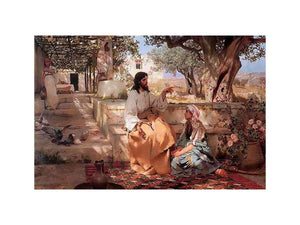
Christ in the House of Martha and Mary stands as one of Henryk Hector Siemiradzki’s most intellectually refined and psychologically balanced religious compositions, a painting in which classical harmony, moral philosophy, and human attentiveness converge with exceptional composure. Executed by an artist renowned for his synthesis of academic classicism and spiritual narrative, the work transforms a familiar biblical episode into a meditation on inner life, priority, and the nature of devotion. Rather than dramatizing miracle or confrontation, Siemiradzki renders a moment of quiet instruction, allowing meaning to emerge through posture, space, and light.
Henryk Hector Siemiradzki was among the most accomplished academic painters of the nineteenth century, celebrated across Europe for his mastery of large-scale historical and religious scenes. Educated in St. Petersburg and Rome, he brought to his work a classical sensibility shaped by antiquity, archaeology, and Renaissance balance. Yet his paintings are never cold exercises in form. In Christ in the House of Martha and Mary, Siemiradzki applies his technical authority to a deeply human subject, exploring the tension between action and contemplation without judgment or excess.
The painting is grounded in the Gospel episode in which Martha, occupied with service, contrasts with Mary, who sits at Christ’s feet in attentive listening. Siemiradzki approaches this narrative not as a moral rebuke, but as a nuanced exploration of different modes of devotion. His Christ is not severe or admonishing. Instead, he appears calm, measured, and inclusive, acknowledging both service and contemplation as meaningful expressions of faith, while gently affirming the primacy of inward attention.
The composition is carefully orchestrated to reflect this balance. Christ occupies a central yet unforced position, neither elevated theatrically nor submerged within the scene. His presence anchors the composition through calm authority rather than dominance. Mary is positioned close to him, her posture receptive and composed, while Martha’s placement conveys movement and responsibility. The spatial relationships between the figures articulate the painting’s ethical structure without resorting to overt symbolism.
Perspective is intimate and stable. Siemiradzki situates the viewer within the domestic interior, close enough to sense conversation and stillness, yet removed enough to maintain reverence. The space is ordered and classical, its proportions lending dignity to the scene. Architectural elements frame the figures with restraint, reinforcing harmony rather than hierarchy. The setting feels lived-in but idealised, bridging everyday life and timeless moral reflection.
Light is central to the painting’s expressive clarity. Siemiradzki employs a warm, natural illumination that settles gently across faces, garments, and interior surfaces. There is no dramatic chiaroscuro, no divine radiance separating Christ from others. Instead, light unifies the figures, reinforcing the idea that spiritual truth unfolds within ordinary human environments. Subtle highlights guide the viewer’s attention without imposing narrative force.
Colour is restrained and balanced with classical discipline. Siemiradzki favours warm earth tones, softened whites, muted blues, and harmonious flesh tones that reinforce calm and coherence. The palette avoids emotional excess, allowing relationships and gestures to carry meaning. Colour functions structurally, supporting spatial depth and emotional equilibrium rather than spectacle.
Siemiradzki’s handling of texture demonstrates academic mastery tempered by sensitivity. Fabrics fall with convincing weight and softness, skin is rendered with luminous restraint, and architectural surfaces convey solidity without distraction. Brushwork remains controlled and largely invisible, reinforcing the painting’s timeless quality. Technique here serves contemplation, not display.
The figures’ expressions and gestures are the painting’s psychological core. Christ’s demeanor is composed and attentive, his gesture measured rather than emphatic. Mary’s posture conveys stillness and inward focus, her attention undivided. Martha’s movement suggests diligence and care, not frustration or rebuke. Siemiradzki resists caricature, presenting each figure with dignity and empathy. The painting becomes an exploration of human difference rather than moral opposition.
Symbolically, Christ in the House of Martha and Mary operates through relationship rather than iconography. There are no overt symbols, no didactic props. Meaning arises from proximity, posture, and gaze. The painting suggests that spiritual life is not defined solely by action or contemplation, but by orientation—by where attention ultimately rests. This subtlety elevates the work beyond illustration into philosophical reflection.
Emotionally, the painting conveys serenity, attentiveness, and moral clarity without tension. There is no conflict, no raised voice, no dramatic turning point. Instead, Siemiradzki invites the viewer into a space of quiet discernment. The emotional register is reflective rather than instructive, encouraging prolonged engagement rather than immediate interpretation.
Within Siemiradzki’s broader oeuvre, this painting exemplifies his ability to humanise grand religious themes. While he is often associated with monumental historical canvases, Christ in the House of Martha and Mary demonstrates his sensitivity to interior life and ethical nuance. It confirms his belief that spiritual truth is often revealed in stillness rather than action.
The painting’s relevance today remains strong across the United States, the United Kingdom, Canada, Australia, and Europe. Contemporary viewers continue to recognise its central question: how to balance responsibility with reflection, action with presence. In a modern world defined by urgency and distraction, Siemiradzki’s painting offers a vision of attentive listening as a vital human practice.
In interior settings, Christ in the House of Martha and Mary introduces calm authority and contemplative depth. In living rooms, it fosters reflection and conversation. In studies and offices, it reinforces focus, discernment, and ethical balance. In galleries and luxury residences, it signals refined engagement with nineteenth-century academic painting that privileges thought as much as form.
The painting integrates seamlessly into traditional, modern, minimalist, and eclectic décor. Traditional interiors resonate with its classical composition and biblical subject. Modern spaces benefit from its psychological clarity and restrained palette. Minimalist environments amplify its stillness, while eclectic interiors draw cohesion from its balanced harmony and timeless theme.
The enduring importance of Christ in the House of Martha and Mary lies in its refusal to reduce faith to action alone or contemplation alone. Siemiradzki presents devotion as a spectrum of attention, guided by presence and understanding. The painting endures because it recognises that the most transformative moments often occur not through labour or instruction, but through listening.
To live with Christ in the House of Martha and Mary is to engage daily with a work that honours balance, attentiveness, and moral clarity. Through its classical restraint, psychological insight, and spiritual depth, the painting continues to affirm Henryk Hector Siemiradzki’s position as one of the most thoughtful and humane religious painters of the nineteenth century. It stands as a testament to his belief that art, when guided by harmony and reflection, can illuminate enduring human truths.
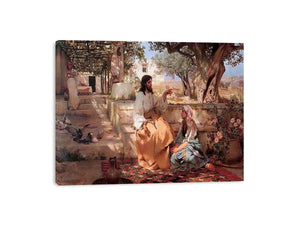
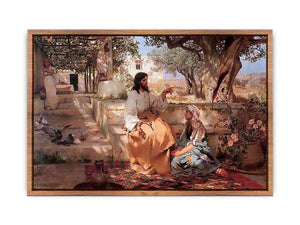
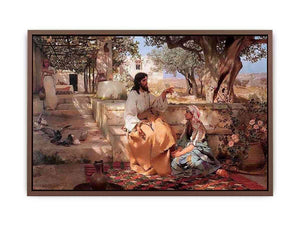
Buy museum qulaity 400- 450 canvas prints, framed prints, and 100% oil paintings of Christ in the House of Martha and Mary by Henryk Hector Siemiradzki at Alpha Art Gallery, where world-famous masterpieces are recreated with museum-quality detail, refined craftsmanship, and premium materials.
FAQS
What biblical story does Christ in the House of Martha and Mary depict?
It depicts Christ visiting the sisters Martha and Mary, illustrating the contrast between service and attentive listening.
What is the central theme of the painting?
The balance between action and contemplation, and the importance of inward attention.
How does Siemiradzki portray Christ in this work?
Christ is shown as calm, inclusive, and instructive without severity or dramatization.
Is the painting moralistic in tone?
No. It is reflective rather than judgmental, presenting different forms of devotion with empathy.
Is Christ in the House of Martha and Mary suitable for contemporary interiors?
Yes. Its calm palette and thoughtful composition integrate beautifully into modern and traditional spaces.
What emotional tone does the painting convey?
It conveys serenity, attentiveness, and moral clarity rather than tension or drama.
Does this artwork have lasting spiritual and artistic value?
As a refined example of nineteenth-century academic religious painting, it holds enduring cultural and spiritual significance.
Where is the best place to display this painting?
It is especially well suited to living rooms, studies, galleries, and contemplative spaces focused on reflection and balance.