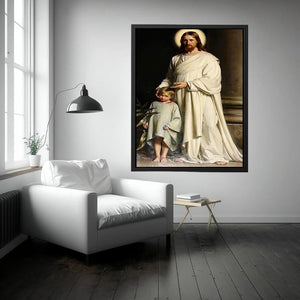
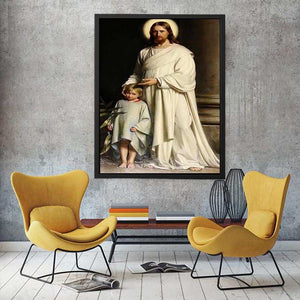
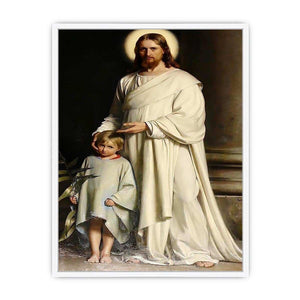
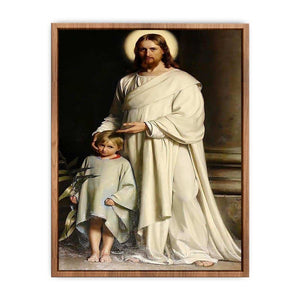
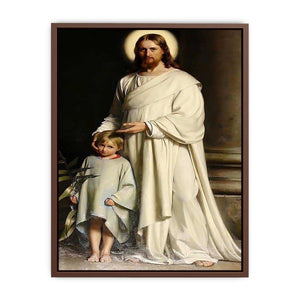
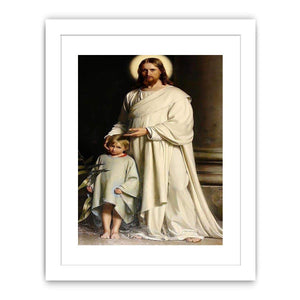
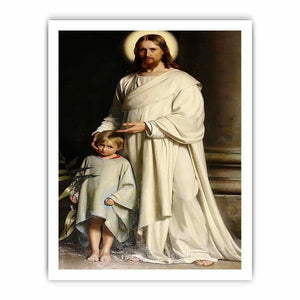
Christ and a Boy Painting by Carl Heinrich Bloch
Christ and a Boy stands as one of Carl Heinrich Bloch’s most intimate and spiritually humane compositions, a painting in which sacred presence is expressed not through miracle or grandeur, but through closeness, attention, and moral tenderness. Bloch approaches the figure of Christ not as a distant theological symbol, but as a living moral force encountered within the simplicity of everyday human experience. The result is a work of profound quiet power, where spiritual meaning emerges through compassion rather than spectacle.
Carl Heinrich Bloch occupies a distinctive position in nineteenth-century religious painting. Trained within the academic tradition yet guided by a deeply personal faith, Bloch sought to make biblical narratives emotionally accessible and ethically resonant. His works are characterised by clarity of storytelling, sincerity of feeling, and an unwavering belief that sacred themes must speak to the human heart. In Christ and a Boy, Bloch distils this philosophy into its purest form, presenting a moment that feels both timeless and immediate.
The subject depicts Christ in gentle interaction with a young boy, a scene not drawn from a single dramatic biblical episode, but from the broader moral spirit of Christ’s teachings. Bloch does not depict instruction through words or gestures of authority. Instead, Christ’s presence itself becomes the lesson. The boy’s posture and expression suggest trust, openness, and quiet attentiveness, while Christ’s demeanor conveys patience, understanding, and moral clarity. The exchange is inward rather than declarative.
Compositionally, the painting is deliberately intimate. Bloch positions the figures close together, eliminating unnecessary spatial distance and narrative distraction. The focus rests entirely on the relationship between Christ and the child. Background elements are subdued and secondary, ensuring that emotional exchange remains central. This compositional restraint reinforces the painting’s ethical message: that spiritual truth is transmitted through presence and relationship rather than proclamation.
Perspective places the viewer at eye level, creating a sense of shared space rather than hierarchical observation. We are not positioned above the scene in judgement or reverence, nor below it in submission. Instead, Bloch invites us into a moment of moral witnessing. This perspective enhances the painting’s immediacy, allowing the viewer to feel included in the encounter rather than separated from it.
Light is handled with great sensitivity. Bloch employs a soft, enveloping illumination that gently highlights faces and gestures without dramatic contrast. Light here functions as moral atmosphere rather than theatrical device. It suggests warmth, safety, and clarity, reinforcing the emotional tone of trust and reassurance. The illumination draws attention to expression rather than action, guiding the viewer toward inward reflection.
Colour is restrained and harmonious. Bloch favours warm earth tones, softened whites, and muted accents that support the painting’s calm seriousness. There is no chromatic excess or decorative flourish. Colour serves emotional unity, ensuring that nothing distracts from the human exchange at the centre of the composition. The palette reinforces the painting’s timeless quality, allowing it to transcend specific historical context.
Bloch’s handling of paint is controlled and respectful. Brushwork is smooth and unobtrusive, allowing forms to resolve clearly without calling attention to technique. Textures are suggested with care, preserving realism while maintaining simplicity. This technical restraint aligns with the painting’s moral intent, ensuring that craft serves meaning rather than display.
Emotionally, Christ and a Boy conveys reassurance, moral guidance, and unconditional acceptance. There is no sentimentality or exaggerated tenderness. Instead, Bloch presents compassion as steady and grounded. Christ’s expression suggests attentiveness rather than indulgence, while the boy’s presence conveys openness rather than dependency. The emotional balance between the two figures gives the painting its enduring strength.
Symbolically, the painting reflects core Christian values of humility, care for the young, and the moral responsibility of guidance without coercion. The boy may be understood as a figure of innocence or learning, while Christ represents moral clarity and spiritual steadiness. Yet Bloch avoids allegory in favour of lived encounter. The painting’s symbolism is inseparable from its realism, allowing meaning to emerge naturally through interaction.
Within Bloch’s broader body of work, Christ and a Boy exemplifies his commitment to portraying Christ as approachable and ethically present. While he is known for large-scale biblical scenes and dramatic narratives, this painting reveals his sensitivity to small moments of moral truth. It demonstrates his belief that faith is sustained not only through revelation and sacrifice, but through everyday acts of care and understanding.
The painting’s relevance today remains profound across the United States, the United Kingdom, Canada, Australia, and Europe. Contemporary viewers continue to respond to images that emphasise compassion, guidance, and moral presence in an increasingly complex world. Christ and a Boy speaks across cultures and denominations, offering a vision of faith grounded in human connection.
In interior settings, Christ and a Boy introduces calm, ethical depth, and spiritual reassurance. In living rooms, it becomes a contemplative focal point that encourages reflection. In studies and private spaces, it supports moral introspection and quiet presence. In galleries and luxury residences, it signals an appreciation for religious art that prioritises humanity over grandeur.
The painting integrates seamlessly into traditional, modern, minimalist, and eclectic décor. Traditional interiors resonate with its devotional sincerity. Modern spaces benefit from its emotional clarity and restraint. Minimalist environments heighten its intimacy and focus, while eclectic interiors draw cohesion from its warm palette and universal theme.
The enduring importance of Christ and a Boy lies in its affirmation that spiritual authority need not be distant or severe. Bloch presents faith as something encountered through kindness, patience, and moral attention. The painting endures because it recognises that guidance, at its most powerful, is offered quietly and received freely.
To live with Christ and a Boy is to engage daily with a work that honours compassion as a moral force. Through its intimate composition, gentle light, and emotional intelligence, the painting affirms Carl Heinrich Bloch’s ability to translate sacred belief into human experience. It stands as a testament to his conviction that the deepest spiritual truths are revealed not through spectacle, but through presence.
Buy museum qulaity 400- 450 canvas prints, framed prints, and 100% oil paintings of Christ and a Boy by Carl Heinrich Bloch at Alpha Art Gallery, where world-famous masterpieces are recreated with museum-quality detail, refined craftsmanship, and premium materials.
FAQS
What does Christ and a Boy by Carl Heinrich Bloch depict?
It depicts an intimate moment of moral guidance and compassion between Christ and a young boy.
What emotional tone defines this painting?
It conveys reassurance, trust, and quiet moral authority rather than drama or spectacle.
Is this scene based on a specific biblical event?
It is inspired by the spirit of Christ’s teachings rather than a single dramatic episode.
How does Bloch portray Christ in this work?
Christ is portrayed as approachable, attentive, and morally present rather than distant or authoritative.
What role does light play in the painting?
Light creates warmth and clarity, reinforcing trust and emotional intimacy.
Is Christ and a Boy suitable for contemporary interiors?
Yes. Its restraint, warmth, and universal message integrate beautifully into modern and traditional spaces.
Does the painting have lasting spiritual significance?
As a deeply humane interpretation of Christian compassion, it holds enduring moral and religious relevance.
Where is the best place to display Christ and a Boy?
It is especially well suited to living rooms, studies, galleries, and spaces intended for reflection, faith, and ethical contemplation.