


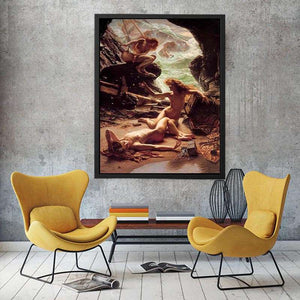
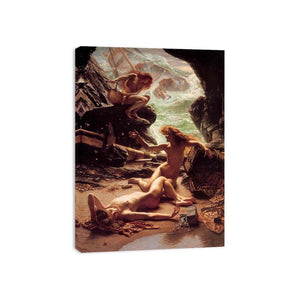


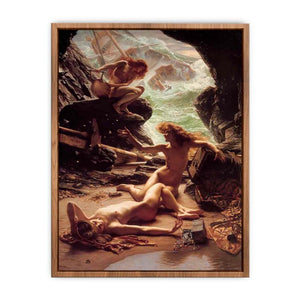

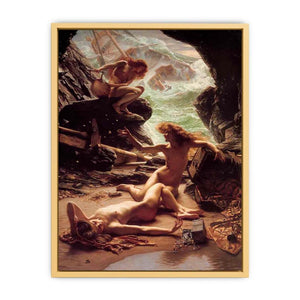


Cave of the Storm Nymphs 1903
Go kalles this summer with this vintage navy and white striped v-neck t-shirt from the Nike. Perfect for pairing with denim and white kicks for a stylish kalles vibe.

Cave of the Storm Nymphs 1903
Cave of the Storm Nymphs 1903 Painting by Sir Edward John Poynter
Cave of the Storm Nymphs stands as one of Sir Edward John Poynter’s most atmospheric and psychologically charged mythological works, a painting in which classical subject matter is transformed through late Victorian restraint, technical mastery, and a heightened sensitivity to elemental power. Painted in 1903, the work belongs to the final phase of Poynter’s career, when his academic discipline was increasingly infused with mood, introspection, and a subtle modernity of feeling. Rather than presenting mythology as narrative spectacle, Poynter approaches it as an exploration of nature’s latent forces and the human response to them.
By the turn of the twentieth century, Sir Edward John Poynter had long been established as one of Britain’s most authoritative painters. His training in the classical tradition, his deep engagement with archaeology and historical accuracy, and his leadership within the artistic institutions of his time had shaped a reputation for intellectual seriousness and compositional control. Yet Cave of the Storm Nymphs reveals an artist less concerned with didactic clarity than with atmosphere and sensation. The painting is not about myth retold; it is about myth felt.
The subject draws upon classical lore surrounding nymphs—female spirits associated with natural forces—yet Poynter avoids overt storytelling. The storm nymphs are not shown as characters engaged in action, but as presences within a cavernous space, suspended between stillness and impending movement. The cave itself becomes as important as the figures it shelters, serving as a liminal space between interior calm and exterior violence. This ambiguity is central to the painting’s power.
Compositionally, the work is carefully balanced yet deliberately enclosed. The nymphs are arranged within the shadowed interior of the cave, their bodies forming a rhythmic sequence that guides the viewer’s eye across the canvas. There is no open horizon, no expansive vista. Instead, Poynter compresses space, creating a sense of containment and anticipation. The figures appear poised, listening, waiting, their attention subtly directed outward toward an unseen storm.
The human forms are rendered with classical idealism tempered by naturalism. Poynter’s understanding of anatomy is precise, yet never ostentatious. The nymphs possess physical weight and presence, their bodies relaxed but alert. They are neither eroticised nor remote; they inhabit their environment with quiet authority. Drapery, where present, clings and folds in response to gravity and air, reinforcing the sense that the natural world is active even in moments of pause.
Light plays a decisive role in shaping the painting’s emotional register. Illumination filters into the cave selectively, catching on skin, stone, and fabric while leaving much of the space in shadow. This interplay between light and darkness suggests both shelter and vulnerability. The cave offers protection, yet it also confines. The light does not dispel shadow; it coexists with it, reinforcing the idea that calm and danger are inseparable aspects of nature.
Colour is restrained and atmospheric. Poynter employs a palette of muted earth tones, cool greys, soft flesh hues, and subtle highlights that emerge gradually rather than assert themselves. There are no bright accents or decorative excesses. The colours feel as though they have been absorbed by the cave itself, lending the painting a tonal unity that heightens its sense of realism and mood. This restraint aligns the work with the sensibilities of the early twentieth century, where emotional depth increasingly took precedence over surface brilliance.
Texture is handled with exceptional sensitivity. The roughness of rock, the smoothness of skin, and the softness of fabric are differentiated through nuanced brushwork that remains controlled and measured. Poynter’s surface does not call attention to itself; instead, it supports immersion. The viewer is drawn into the space not by spectacle, but by coherence.
Symbolically, Cave of the Storm Nymphs operates as a meditation on latent power. Storms, in classical thought, are manifestations of forces beyond human control—capricious, transformative, and necessary. By situating the nymphs within a cave, Poynter suggests a moment before release, a gathering of energy held in suspension. The nymphs are not passive victims of nature; they are embodiments of it, attuned to its rhythms and capable of unleashing its force.
Emotionally, the painting conveys tension without violence. There is no visible storm, no dramatic gesture, no overt expression of fear or excitement. Instead, there is anticipation. The figures seem aware of what is coming, their stillness charged with expectation. This emotional restraint distinguishes the work from more theatrical mythological paintings. Poynter trusts suggestion over declaration, allowing mood to accumulate slowly.
Within the context of Poynter’s broader oeuvre, Cave of the Storm Nymphs represents a subtle departure from the clarity and narrative precision of his earlier classical scenes. While his commitment to academic principles remains evident, here those principles are placed in service of atmosphere rather than instruction. The painting reflects an artist responding to changing tastes at the dawn of the modern era, where ambiguity and interiority were gaining prominence.
The cultural relevance of the work remains strong. In a contemporary world increasingly conscious of humanity’s relationship with nature, Cave of the Storm Nymphs resonates as an image of elemental power held in balance. Viewers across the United States, the United Kingdom, Canada, Australia, and Europe continue to respond to its quiet intensity and its refusal to sentimentalise nature. The painting acknowledges beauty without denying danger, serenity without ignoring force.
In interior spaces, Cave of the Storm Nymphs introduces depth and gravitas. In living rooms, it creates an atmosphere of contemplative calm enriched by underlying tension. In studies and offices, it reinforces themes of focus, restraint, and awareness of forces beyond immediate control. In galleries and luxury residences, it communicates refined discernment and an appreciation for works that reward sustained engagement.
The painting integrates seamlessly into traditional, modern, minimalist, and eclectic décor. Traditional interiors resonate with its classical subject and disciplined execution. Modern spaces benefit from its subdued palette and psychological depth, which complement clean lines and restrained furnishings. Minimalist environments find contrast and richness in its tonal complexity, while eclectic spaces draw cohesion from its unified atmosphere.
The enduring importance of Cave of the Storm Nymphs lies in its capacity to suggest rather than assert. Poynter does not explain the storm or dramatise its arrival. He presents a moment of poised awareness, reminding the viewer that some forces are best understood through attentiveness rather than control. This perspective feels increasingly relevant in an age defined by uncertainty and change.
To live with Cave of the Storm Nymphs is to engage daily with a work that honours restraint, anticipation, and the quiet power of nature. Through its measured composition, atmospheric depth, and symbolic resonance, Sir Edward John Poynter created a painting that transcends its mythological origins. It stands as a testament to the enduring capacity of classical themes to address modern sensibilities, offering a vision of beauty shaped by awareness rather than excess.
Buy museum qulaity 400- 450 canvas prints, framed prints, and 100% oil paintings of Cave of the Storm Nymphs by Sir Edward John Poynter at Alpha Art Gallery, where world-famous masterpieces are recreated with museum-quality detail, refined craftsmanship, and premium materials.
FAQS
What is the central theme of Cave of the Storm Nymphs?
The painting explores latent natural power and anticipation, presenting mythological figures as embodiments of elemental forces held in balance.
How does this work differ from traditional mythological paintings?
Rather than narrating a specific event, it focuses on mood, atmosphere, and psychological tension through restraint and suggestion.
Why is the cave setting important?
The cave symbolises shelter, containment, and the threshold between calm and upheaval, reinforcing the painting’s sense of suspended energy.
Is Cave of the Storm Nymphs suitable for contemporary interiors?
Yes. Its subdued palette and atmospheric depth integrate seamlessly into modern, minimalist, and traditional spaces.
What emotional atmosphere does the painting create?
It conveys calm infused with anticipation, encouraging reflective engagement rather than dramatic response.
Does this artwork hold long-term artistic value?
As a mature work by Sir Edward John Poynter, it holds enduring cultural and artistic significance within late Victorian classicism.
Where is the best place to display this painting?
It is especially effective in living rooms, studies, offices, and gallery environments where quiet intensity can be appreciated.
Why does Cave of the Storm Nymphs remain meaningful today?
Its meditation on nature’s restrained power and human attentiveness continues to resonate in a modern world shaped by uncertainty.
| 1. Select Type |
Canvas Print, Unframed Paper Print, Hand-Painted Oil Painting, Framed Paper Print |
|---|---|
| 2. Select Finish Option |
Rolled Canvas, Rolled- No Frame, Streched Canvas, Black Floating Frame, White Floating Frame, Brown Floating Frame, Black Frame with Matt, White Frame with Matt, Black Frame No Matt, White Frame No Matt, Streched, Natural Floating Frame, Champagne Floating Frame, Gold Floating Frame |
| 3. Select Size |
60cm X 90cm [24" x 36"], 76cm X 114cm [30" x 45"], 90cm X 120cm [36" x 48"], 100cm X 150cm [40" x 60"], 16.54 x 11.69"(A3), 23.39 x 16.54"(A2), 33.11 x 23.39"(A1), 46.81 x 31.11"(A0), 54" X 36", 50cm X 60cm [16" x 24"], 121cm X 182cm [48" x 72"], 135cm X 200cm [54" x 79"], 165cm x 205cm [65" x 81"], 183cm x 228cm [72" x 90"], 22cm X 30cm [9" x 12"], 30cm x 45Cm [12" x 18"], 45cm x60cm [16" x 24'], 75cm X 100cm [30" x 40"], 121cm x 193cm [48" x 76"], 45cm x 60cm [16" x 24'], 20cm x 25Cm [8" x 10"], 35cm x 50Cm [14" x 20"], 45cm x 60 cm [18" x 24"], 35cm x 53Cm [14" x 21"], 66cm X 101cm[26" x 40"], 76cm x 116cm [30"x 46"], 50cm X 60cm 16" x 24"] |