Capri Painting by John Singer Sargent
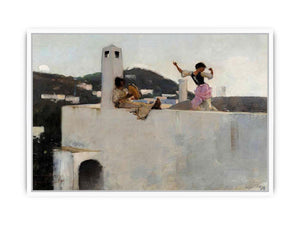
Capri Painting by John Singer Sargent is a work of radiant immediacy and perceptual freedom, capturing the Mediterranean world not as a picturesque destination but as a lived experience shaped by light, heat, movement, and momentary stillness. Painted during Sargent’s travels in Italy, the work reflects his deep engagement with place as sensation rather than subject. Capri is not presented as a landmark or a scenic overview. Instead, it appears as an atmosphere—intimate, luminous, and transient—revealed through the artist’s extraordinary sensitivity to light and human presence.
At the time of this painting, John Singer Sargent was at the height of his powers, moving fluidly between formal portraiture and an increasingly experimental body of travel works. These paintings, often created away from commissions, allowed Sargent to abandon social performance in favor of pure observation. Capri belongs to this vital strand of his career. It reveals an artist liberated by place, responding instinctively to the rhythms of Mediterranean life and the visual challenges posed by intense sunlight and deep shadow.
Capri held particular significance for artists of the late nineteenth century. The island represented a convergence of classical memory, southern light, and cultural openness, attracting painters, writers, and intellectuals seeking alternatives to northern formality. Sargent does not mythologize Capri as an idyllic escape, nor does he frame it through historical nostalgia. Instead, he engages with it directly, treating the island as a site of immediate perception. What matters is not where Capri stands in history, but how it feels in the present moment.
Compositionally, the painting is informal and fluid. Sargent avoids rigid framing or centralized focus, allowing the scene to unfold organically. Figures, architecture, and landscape coexist without hierarchy, unified by light rather than structure. The composition suggests a fragment—a glimpse rather than a statement—reinforcing the sense that the viewer is encountering a moment already in motion. This openness aligns with Sargent’s broader interest in capturing life as it is experienced, not as it is arranged.
Perspective places the viewer within the scene, close enough to feel the warmth and brightness, yet not so close as to intrude. The viewpoint feels observational rather than directive, as though Sargent has paused briefly to record what passes before him. This balance between immersion and detachment is central to the painting’s sophistication. The viewer is invited to share the experience without being instructed how to interpret it.
Light is the defining force of Capri. Mediterranean sunlight floods the scene with intensity, creating sharp contrasts between illuminated surfaces and deep shadow. White walls, stone, and fabric reflect light aggressively, while shaded areas collapse into cool darkness. Sargent handles this contrast with extraordinary control, allowing brightness to dominate without flattening form. Light becomes both subject and structure, shaping space more decisively than line.
The color palette is restrained but vibrant. Warm whites, sunlit ochres, soft blues, and muted earth tones dominate, punctuated by deeper accents that anchor the composition. These colors are not decorative; they are responsive. They register the physical conditions of the environment—the glare, the heat, the reflective surfaces. Color in this painting is inseparable from light, reinforcing the sensation of place rather than describing it.
Sargent’s technique is characteristically confident and economical. Brushwork is loose where possible and precise where necessary. Surfaces are suggested rather than detailed, allowing the painting to breathe. Edges dissolve in light, while key forms remain legible through tonal contrast. This painterly freedom gives the work its immediacy. Nothing appears labored, yet everything feels intentional.
Psychologically, the painting conveys ease without indulgence. Figures, if present, are absorbed in their own existence, neither performing nor posing. There is no narrative tension, no implied drama. Instead, Sargent captures a shared state of presence—people and place coexisting within the same luminous field. The emotional tone is one of quiet attentiveness, suggesting rest without idleness and leisure without excess.
Within Sargent’s broader oeuvre, Capri exemplifies his travel paintings at their most distilled. Unlike his society portraits, which negotiate identity, status, and performance, this work is free of social obligation. It aligns closely with his watercolors and informal oils produced during travel, where perception takes precedence over representation. These works reveal Sargent not as a chronicler of elites, but as a modern painter deeply attuned to sensation and environment.
Culturally, the painting reflects a late nineteenth-century shift toward experiential modernity. Travel was no longer solely about documentation or conquest, but about perception, movement, and personal encounter. Sargent’s Capri embodies this shift. The island is not consumed visually; it is encountered. The painting resists ownership, offering instead a fleeting participation in place.
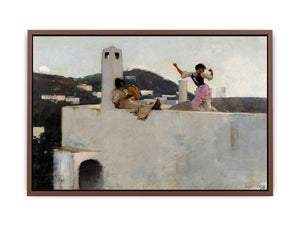
In contemporary interiors across the United States, the United Kingdom, Canada, Australia, and Europe, Capri integrates with remarkable versatility and vitality. In living rooms, it introduces light, warmth, and spatial openness. In studies and offices, it conveys cultural fluency, independence, and perceptual intelligence. In galleries and refined private residences, it anchors interiors with Mediterranean luminosity, harmonizing seamlessly with traditional, modern, minimalist, and eclectic décor.
The painting remains meaningful today because it honors direct experience in an increasingly mediated world. In an age saturated with images of travel and place, Sargent’s Capri stands apart for its refusal to sensationalize. It does not advertise location. It records sensation. The result feels timeless rather than touristic.
Capri Painting by John Singer Sargent endures as a masterful expression of light, presence, and painterly freedom. Through compositional openness, luminous restraint, and extraordinary technical assurance, Sargent transformed a moment on a Mediterranean island into a lasting meditation on how place is felt rather than defined. The painting does not describe Capri. It inhabits it.
Buy museum qulaity 400- 450 canvas prints, framed prints, and 100% oil paintings of Capri by John Singer Sargent at Alpha Art Gallery, where world-famous masterpieces are recreated with museum-quality detail, refined craftsmanship, and premium materials.
FAQs
What does Capri depict in this painting?
It depicts an impression of life and environment on the island of Capri, focusing on light and atmosphere rather than landmarks.
Is Capri a landscape or a genre scene?
It functions as both, blending environment and human presence without narrative emphasis.
Why does the painting feel so immediate?
Sargent’s loose brushwork and focus on light create the sensation of a moment captured in passing.
How does light shape the composition?
Mediterranean sunlight defines space, form, and color more strongly than line or detail.
How does this work fit into Sargent’s career?
It belongs to his travel paintings, where he explored perception freely outside formal portraiture.
Why is this painting considered modern?
Its emphasis on sensation, informality, and cropped perception anticipates modern approaches to painting.
Why does Capri remain relevant today?
Its focus on direct experience resonates in a visually saturated, image-driven world.
Where does this artwork work best in interiors?
It is ideal for living rooms, studies, offices, galleries, and light-filled residential spaces.