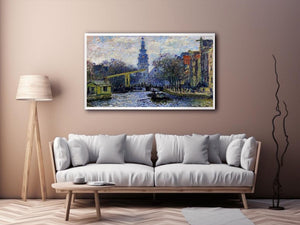
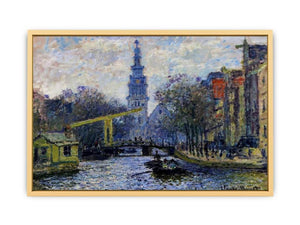
Canal in Amsterdam Painting by Claude Monet
Canal in Amsterdam stands as one of Claude Monet’s most measured and intellectually revealing encounters with the urban landscape, a painting in which architecture, water, and atmosphere are bound together through a disciplined study of light and reflection. Created during Monet’s visit to the Netherlands in 1871, the work belongs to a moment of transition, both historically and artistically. Europe was emerging from political upheaval, and Monet himself was refining an Impressionist language capable of absorbing not only natural scenery but also the structured environments of modern cities. In this painting, Amsterdam is not presented as a spectacle or a monument; it is approached as a lived space, experienced through quiet observation and perceptual clarity.
The Dutch canal offered Monet a subject unlike the French rivers he knew so well. Where the Seine often unfolded through organic curves and shifting banks, Amsterdam’s canals imposed order through straight lines, regular facades, and carefully engineered watercourses. For Monet, this environment presented a challenge rather than a constraint. The canal’s geometry became an opportunity to test how light, colour, and reflection could soften structure without denying it. Canal in Amsterdam emerges from this encounter as a work that balances solidity and fluidity with remarkable restraint.
The composition is horizontally oriented and carefully stabilised. The canal occupies the central axis of the painting, extending into the distance and establishing a calm, measured rhythm. Buildings line the water’s edge, their facades forming a sequence of verticals that counterbalance the canal’s horizontal flow. Monet avoids dramatic angles or theatrical framing. Instead, he presents the scene frontally, allowing the viewer to register the canal as a continuous spatial experience rather than a picturesque view.
Perspective is clear but understated. Depth is created through diminishing scale and tonal modulation rather than sharp linear recession. As the canal recedes, architectural forms soften, their details absorbed into atmosphere. Reflections on the water mirror this process, fragmenting vertical structures into shimmering bands of colour. The eye moves easily along the canal’s length, guided by repetition and rhythm rather than by a single focal point. Space unfolds with quiet assurance.
Light plays a central role in mediating between architecture and water. Rather than casting strong shadows or dramatic highlights, light diffuses across the scene, flattening contrasts and unifying forms. Monet captures a moment when illumination is even and subdued, allowing colour relationships to take precedence over contour. The canal’s surface reflects sky and buildings with subtle variation, transforming solidity into movement without dissolving it entirely. Light here is not a spotlight; it is an atmosphere.
Colour is employed with characteristic sensitivity. Greys, muted blues, and soft browns dominate the palette, reflecting the restrained tonality of the urban environment. Monet avoids vivid accents, choosing instead to work within a narrow chromatic range that rewards close attention. Within this restraint, subtle shifts occur: cooler tones suggest depth and distance, while warmer notes anchor the foreground. Colour functions relationally, establishing coherence rather than contrast.
Monet’s brushwork is controlled yet visibly present. Individual strokes articulate the canal’s surface with gentle horizontals, allowing reflections to ripple and break without becoming chaotic. Architectural forms are suggested through broader, more deliberate marks that preserve structure while avoiding rigidity. The surface retains a sense of immediacy, recording the act of looking without sacrificing compositional stability. The painting feels observed rather than constructed.
Symbolically, Canal in Amsterdam resists allegory. The canal does not stand for commerce, progress, or history in any explicit way. Monet does not frame the city as emblematic or narrative. Instead, meaning arises through perception itself. The painting proposes that urban environments, no less than fields or rivers, can be sites of quiet contemplation when approached attentively. Architecture becomes part of the visual rhythm rather than an assertion of permanence.
Emotionally, the work conveys calm concentration. There is no sense of bustle or activity, despite the canal’s role within a functioning city. Boats and figures, if present at all, remain secondary to the overall atmosphere. The mood is reflective rather than energetic, encouraging slow looking. Viewers often experience the painting as composed and stabilising, its restraint offering visual clarity without detachment.
Within Monet’s artistic evolution, Canal in Amsterdam occupies an important place. Painted during a period of displacement and travel, it demonstrates his growing confidence in applying Impressionist principles beyond familiar landscapes. The work shows Monet engaging with urban order without reverting to academic precision. He allows perception—light on water, colour in reflection—to mediate between the built environment and painterly freedom. This balance would remain central to his later work.
Culturally, the painting reflects a broader nineteenth-century rethinking of the city as a subject for serious art. Urban scenes had often been treated either as backdrops for narrative or as demonstrations of architectural prowess. Monet’s approach is different. He treats the city as an environment experienced through time and atmosphere, aligning urban representation with modern perception rather than historical documentation. Canal in Amsterdam thus participates in the emergence of a modern urban sensibility grounded in observation.
In contemporary interiors, Canal in Amsterdam integrates with exceptional refinement and versatility. In living rooms, it introduces depth and calm through its balanced composition and restrained palette. In studies and offices, it supports focus and reflective thought, offering visual order without rigidity. In galleries and luxury residences across the United States, United Kingdom, Canada, Australia, and Europe, the painting complements modern, minimalist, and classic décor alike. Its tonal subtlety harmonises with neutral interiors, while its architectural rhythm lends quiet authority.
The enduring relevance of Canal in Amsterdam lies in its affirmation that structure and sensation need not be opposed. Monet demonstrates that even the most ordered environments can be rendered through perceptual openness, and that modern cities possess their own quiet atmospheres when seen without haste. The painting endures not because it records a specific canal or moment, but because it models a way of seeing—one attentive to reflection, rhythm, and the subtle intelligence of light. In doing so, Monet expands the scope of Impressionism and affirms the city as a place of contemplative vision.
Buy museum qulaity 400- 450 canvas prints, framed prints, and 100% oil paintings of Canal in Amsterdam by Claude Monet at Alpha Art Gallery, where world-famous masterpieces are recreated with museum-quality detail, refined craftsmanship, and premium materials.
FAQS
What does Canal in Amsterdam by Claude Monet depict?
It depicts a quiet Amsterdam canal with surrounding buildings, focusing on reflection, light, and urban atmosphere.
Why did Monet paint scenes in Amsterdam?
He was interested in how light and water interacted within structured urban environments unlike those in France.
Is this painting considered Impressionist?
Yes, it reflects Impressionist principles of perceptual observation, visible brushwork, and atmospheric unity.
How does Monet treat architecture in this work?
Buildings are softened through light and reflection, integrated into the overall rhythm rather than rigidly defined.
What role does water play in the composition?
Water acts as a reflective surface that mediates between architecture and atmosphere.
Is the painting narrative or symbolic?
It is observational, with meaning arising from perception rather than story or allegory.
Is Canal in Amsterdam suitable for contemporary interiors?
Yes, its restrained palette and balanced structure suit modern, minimalist, and classic spaces.
Why does Canal in Amsterdam remain relevant today?
Its calm portrayal of urban space and focus on perceptual clarity continue to resonate with modern viewers.