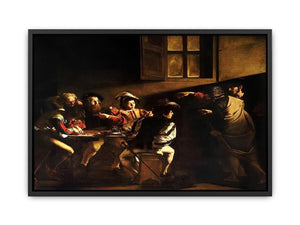
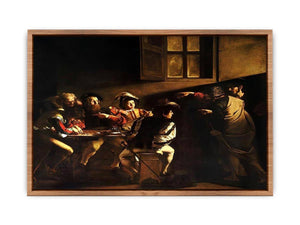
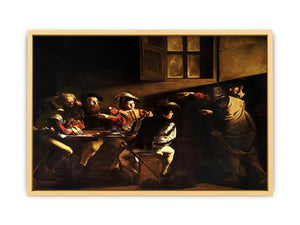
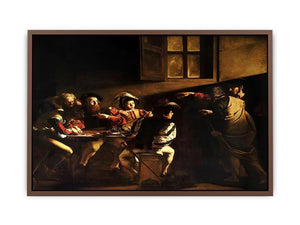
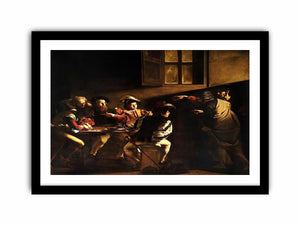
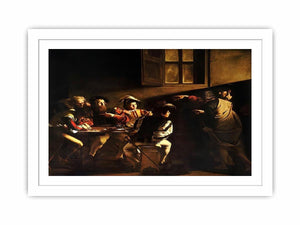
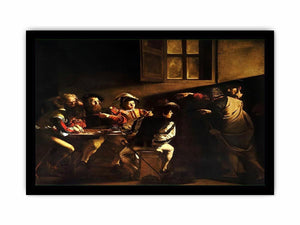
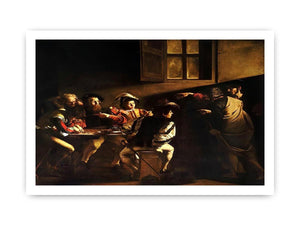
Calling of St. Matthew (Vocazione di san Matteo) Painting by Caravaggio
Calling of St. Matthew stands as one of the most radical and psychologically compelling interpretations of sacred narrative in the history of Western art, a painting in which Caravaggio redefined how divine action could be seen, felt, and understood. Executed around 1599–1600, the work belongs to the artist’s transformative Roman period, when his dramatic naturalism and revolutionary use of light irrevocably altered the visual language of religious painting. In this composition, the miraculous is neither distant nor theatrical. It unfolds quietly, almost invisibly, within the ordinary fabric of daily life, demanding attention not through spectacle, but through recognition.
Caravaggio created Calling of St. Matthew for the Contarelli Chapel in San Luigi dei Francesi in Rome, a commission that would secure his reputation as the most daring painter of his generation. At the turn of the seventeenth century, religious art was expected to instruct clearly and edify morally. Caravaggio fulfilled these aims while overturning convention. Instead of idealised saints or classical settings, he placed biblical figures in contemporary dress, within a dimly lit tavern-like interior that resembles the Rome of his own time. The sacred enters the world not from above, but from the side, through a beam of light and a nearly imperceptible gesture.
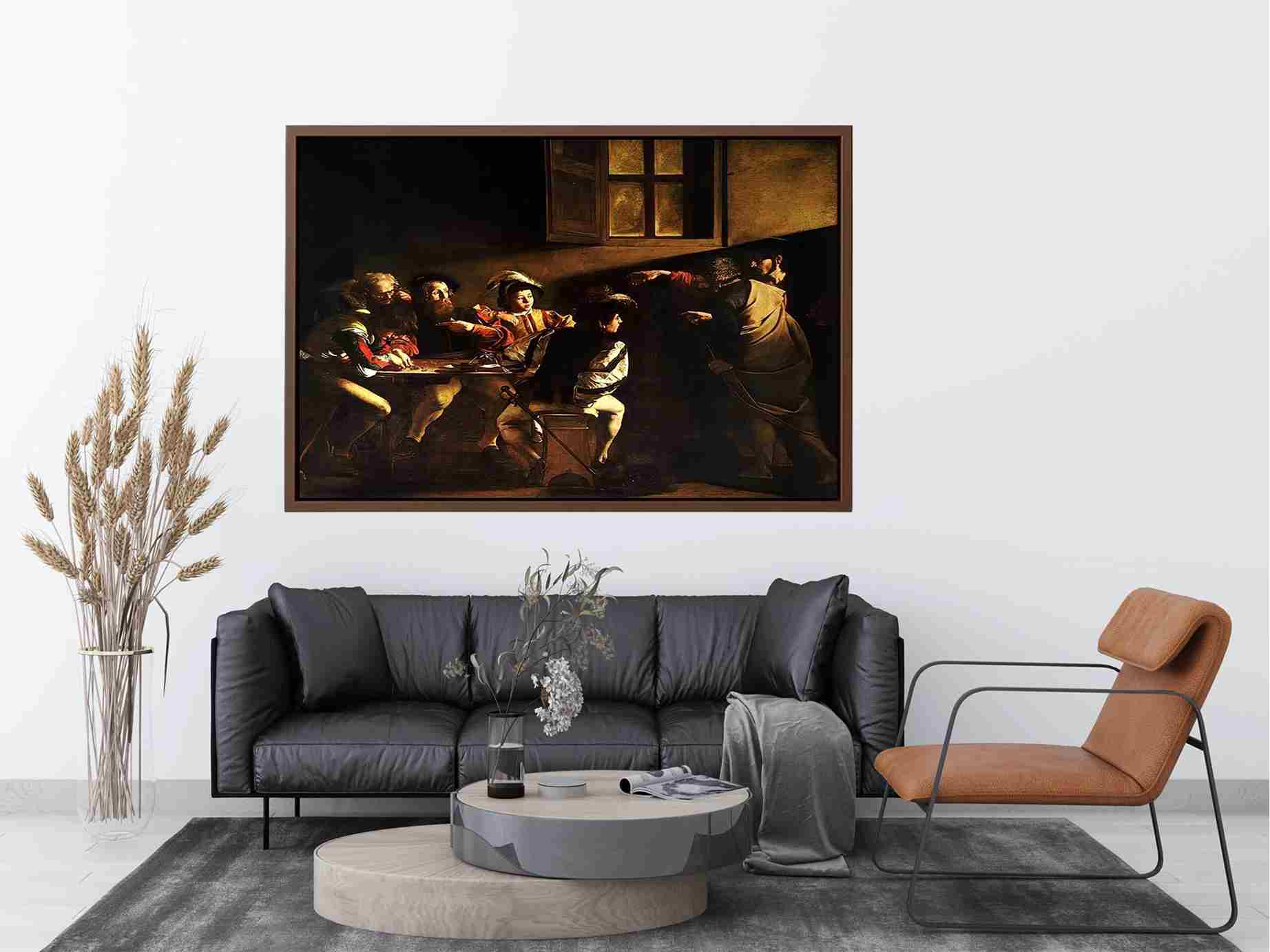
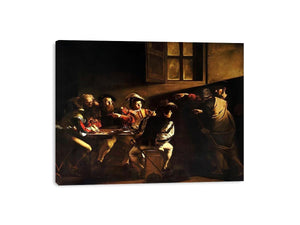
The composition centres on a group of men seated around a table, absorbed in the mundane activity of counting money. Their clothing is contemporary, their faces unidealised, their gestures casual. Into this scene step Christ and Saint Peter, partially obscured and almost secondary in scale. Christ extends his arm toward Matthew in a gesture unmistakably reminiscent of Adam’s creation in Michelangelo’s Sistine Chapel ceiling, yet stripped of grandeur and reduced to its essential meaning. The hand does not command; it calls.
Perspective plays a crucial role in the painting’s psychological power. The viewer is positioned within the same space as the figures, neither elevated nor distanced. The room is shallow and enclosed, intensifying the intimacy of the moment. There is no architectural grandeur to frame the event, no celestial backdrop to announce its significance. Instead, the divine intervention occurs within a confined, human environment, reinforcing Caravaggio’s conviction that spiritual transformation arises from lived reality.
Light is the painting’s true protagonist. A sharp beam cuts diagonally across the canvas, entering from the upper right and illuminating faces, hands, and coins with selective precision. This light does not simply model form; it carries meaning. It isolates Matthew at the precise instant of recognition, catching his face as he gestures toward himself in disbelief, as if asking whether the call could truly be meant for him. Darkness surrounds the scene, swallowing unnecessary detail and focusing attention on the threshold between ignorance and awareness. Light becomes grace made visible.
Colour is restrained and purposeful. Earthy browns, deep blacks, and muted reds dominate the palette, grounding the scene in material reality. There is no decorative excess, no chromatic symbolism to distract from the drama of perception. Flesh tones emerge from shadow with startling immediacy, emphasising the physicality of the figures. Caravaggio’s colour choices reinforce the painting’s moral seriousness, keeping the focus firmly on the act of calling rather than its outward trappings.
Caravaggio’s handling of paint intensifies the sense of presence. Figures are sculpted through light and shadow rather than outline, their forms emerging abruptly from darkness. Wrinkles, textures, and imperfections are rendered without idealisation. Matthew is not portrayed as a saint in waiting, but as a man caught mid-action, uncertain and resistant. This psychological realism transforms the biblical narrative into a universal human experience: the moment when life changes without warning.
Symbolically, Calling of St. Matthew operates on multiple levels. The coins on the table represent worldly attachment, occupation, and identity. Christ’s gesture interrupts this closed circuit of self-interest, introducing a different economy governed by calling rather than calculation. The presence of Saint Peter, positioned slightly in front of Christ, reinforces the continuity of the Church while also emphasising mediation between the divine and the human. Yet nothing in the painting forces interpretation. Meaning emerges through attention rather than instruction.
Emotionally, the painting is charged with tension and stillness. There is no overt reaction of joy or fear. The figures are suspended in a moment of hesitation, caught between past and future. Matthew’s expression conveys confusion more than revelation. This restraint deepens the work’s impact. Conversion is not portrayed as immediate certainty, but as an opening—fragile, disruptive, and deeply personal.
Within Caravaggio’s career, Calling of St. Matthew represents a decisive breakthrough. It demonstrates the full maturity of his chiaroscuro technique and his commitment to presenting sacred history as lived experience. The painting encapsulates his belief that truth in art emerges through confrontation with reality rather than escape from it. In doing so, it became a model for Baroque painting across Europe, influencing generations of artists who sought to make religious narrative immediate and persuasive.
Culturally, the work reflects the Counter-Reformation’s emphasis on accessibility and emotional engagement, yet Caravaggio’s interpretation remains singular in its subtlety. Rather than instructing through clarity alone, he invites the viewer into a moment of recognition. The painting asks not who Matthew is, but whether the viewer recognises themselves in the act of being called.
In contemporary interiors, Calling of St. Matthew carries extraordinary gravitas and relevance. In living rooms, it functions as a powerful focal point that invites sustained contemplation and conversation. In studies and offices, it communicates moral seriousness, intellectual depth, and cultural literacy. In galleries and refined residences across the United States, United Kingdom, Canada, Australia, and Europe, the painting integrates seamlessly into traditional, modern, and minimalist interiors alike. Its restrained palette and dramatic lighting anchor space with authority, while its narrative depth rewards long engagement.
The enduring relevance of Calling of St. Matthew lies in its understanding of transformation as quiet and disruptive rather than spectacular. Caravaggio presents grace not as thunder or vision, but as interruption—a moment when attention is redirected and life irrevocably altered. The painting reminds viewers that profound change often arrives without announcement, that meaning emerges in the midst of routine, and that the act of being called begins not with certainty, but with recognition. In capturing this moment with unmatched psychological clarity, Caravaggio created one of the most enduring and human images of spiritual awakening ever painted.
Buy museum qulaity 400- 450 canvas prints, framed prints, and 100% oil paintings of Calling of St. Matthew (Vocazione di san Matteo) by Caravaggio at Alpha Art Gallery, where world-famous masterpieces are recreated with museum-quality detail, refined craftsmanship, and premium materials.
FAQS
What moment does Calling of St. Matthew by Caravaggio depict?
It depicts the moment when Christ calls Matthew to follow him while Matthew is engaged in counting money.
Why are the figures dressed in contemporary clothing?
Caravaggio used modern dress to collapse historical distance and make the biblical event immediate and relatable.
How does light function symbolically in the painting?
Light represents divine grace, isolating the moment of recognition without overt supernatural imagery.
Why is Matthew shown pointing to himself?
The gesture expresses disbelief and hesitation, emphasising the human shock of being chosen.
What role does Saint Peter play in the composition?
He acts as a mediator, reinforcing the continuity of the Church while partially obscuring Christ’s presence.
Is the conversion shown as immediate?
No, the painting captures the moment of hesitation before acceptance, highlighting transformation as a process.
Why is this painting considered revolutionary?
It redefined religious art through dramatic realism, psychological depth, and innovative use of light.
Is Calling of St. Matthew suitable for contemporary interiors?
Yes, its restrained palette and profound narrative make it ideal for spaces that value cultural depth and reflection.