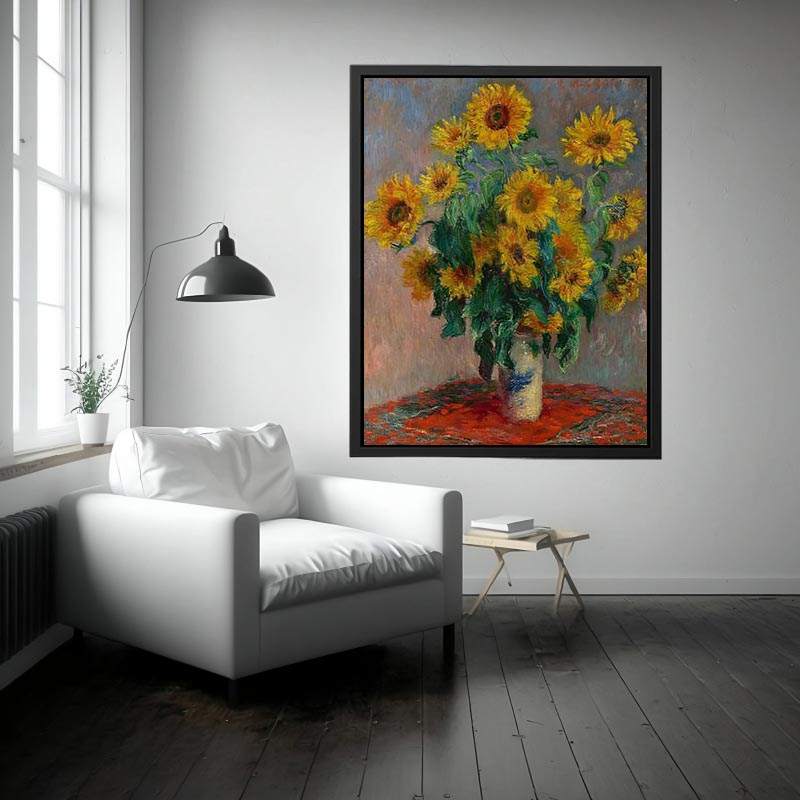
Bouquet of Sunflowers Painting by Claude Monet
Bouquet of Sunflowers occupies a distinctive position within Claude Monet’s artistic practice, revealing an aspect of his work that is often overshadowed by his landscapes and serial explorations of light. Painted during the 1880s, when Monet’s Impressionist language had reached maturity, the work demonstrates how his perceptual intelligence could be applied with equal depth to an interior still life. Rather than treating flowers as decorative objects or symbolic motifs, Monet approaches the bouquet as a living concentration of colour, light, and texture, translating organic vitality into painterly structure.
By this stage of his career, Monet was no longer concerned with proving the legitimacy of Impressionism. He had secured his artistic direction and was free to explore subjects according to their perceptual potential rather than their traditional status. Still life, historically associated with academic exercises or symbolic vanitas themes, offered Monet a controlled environment in which light and colour could be studied without the variables of weather or shifting landscape. Bouquet of Sunflowers emerges from this context as a work of observation rather than arrangement, focused on how colour asserts presence within a confined space.
The composition is deliberately intimate. The bouquet dominates the pictorial field, rising from its container with a sense of weight and expansion. Monet avoids symmetrical balance, allowing blossoms to cluster unevenly, some leaning forward, others receding into shadow. This irregularity reinforces the impression of natural growth rather than formal design. The surrounding space is understated, ensuring that attention remains concentrated on the flowers themselves without distraction or narrative framing.
Perspective is shallow and immediate. Monet brings the viewer close to the bouquet, collapsing depth so that the flowers occupy the foreground almost entirely. This proximity intensifies the sensory experience, encouraging attention to surface, colour, and variation rather than spatial recession. The background functions primarily as a tonal field, stabilising the composition without asserting independent presence. Space is felt through density and overlap rather than distance.
Light plays a central role in shaping the bouquet’s vitality. Rather than illuminating the flowers uniformly, light interacts with individual petals and leaves, producing subtle shifts in tone and saturation. Highlights emerge softly, without sharp contrast, allowing colour to remain dominant. Monet does not model the flowers through chiaroscuro; he allows light to reveal itself through chromatic nuance. The effect is one of warmth and immediacy, as though the bouquet is seen at a particular hour rather than under idealised conditions.
Colour is the painting’s defining force. The yellows of the sunflowers are not uniform, but richly modulated through ochres, golds, pale greens, and hints of orange. Monet resists pure colour, instead allowing each bloom to respond to its neighbours and to surrounding light. The greens of stems and leaves introduce counterpoints that anchor the composition and prevent chromatic excess. Background tones remain subdued, ensuring that the bouquet’s colour intensity is felt as presence rather than ornament.
Monet’s brushwork is open, tactile, and visibly present. Individual strokes articulate petals and foliage with energy and variation, conveying texture without descriptive precision. The flowers are not botanically detailed; they are experienced through the accumulation of painterly marks. This handling preserves the immediacy of perception, aligning the surface of the painting with the act of looking. The bouquet appears alive because it is never fully resolved into fixed form.
Symbolically, Bouquet of Sunflowers resists allegorical interpretation. While sunflowers have often carried symbolic associations of vitality or transience, Monet does not emphasise such meanings. The flowers function as visual phenomena rather than symbols. Their significance lies in their capacity to absorb and reflect light, to assert colour within space, and to sustain prolonged visual attention. Meaning arises through perception rather than interpretation.
Emotionally, the painting conveys warmth and concentration. There is a sense of contained abundance, a fullness that does not spill into excess. Viewers often experience the work as intimate and grounding, drawn into the density of colour and texture without being overwhelmed. The absence of narrative allows the painting to function as a space of quiet engagement rather than expressive declaration.
Within Monet’s artistic evolution, Bouquet of Sunflowers demonstrates how Impressionist principles could be extended beyond landscape and atmosphere into interior space. It shows Monet applying the same sensitivity to colour relationships and light modulation within a controlled setting. The painting confirms that Impressionism was not limited to outdoor motifs, but was fundamentally a way of seeing applicable to all subjects.
Culturally, the work participates in a broader modern reassessment of still life painting. By treating a bouquet not as symbolic arrangement but as a perceptual event, Monet helped shift still life away from narrative meaning toward visual experience. The painting aligns with modern sensibilities that value presence, immediacy, and materiality over allegory.
In contemporary interiors, Bouquet of Sunflowers integrates with exceptional versatility and warmth. In living rooms, it introduces colour and vitality without visual aggression. In dining spaces, it reinforces a sense of abundance and conviviality without illustration. In studies and offices, it offers focus and chromatic richness, balancing energy with restraint. Across interiors in the United States, United Kingdom, Canada, Australia, and Europe, the painting complements traditional, modern, minimalist, and eclectic décor alike. Its concentrated palette enlivens neutral spaces while maintaining compositional calm.
The enduring relevance of Bouquet of Sunflowers lies in its affirmation of attention as artistic substance. Monet demonstrates that even within a confined interior space, perception can unfold with depth and complexity. The painting endures not because of symbolic meaning or decorative appeal, but because it invites sustained looking—an encounter with colour, light, and form distilled into a moment of quiet intensity. In doing so, Monet reveals that the ordinary, when seen attentively, holds inexhaustible visual richness.
Buy museum qulaity 400- 450 canvas prints, framed prints, and 100% oil paintings of Bouquet of Sunflowers by Claude Monet at Alpha Art Gallery, where world-famous masterpieces are recreated with museum-quality detail, refined craftsmanship, and premium materials.
FAQS
What does Bouquet of Sunflowers by Claude Monet depict?
It depicts a dense arrangement of sunflowers treated as a study of colour, light, and texture rather than symbolic still life.
How does this painting differ from Monet’s landscapes?
It applies Impressionist principles to an interior setting, focusing on colour relationships within a confined space.
Are the sunflowers symbolic in this work?
No, Monet treats them primarily as visual phenomena rather than carriers of allegorical meaning.
How does Monet use colour in this painting?
He modulates yellows through subtle tonal variation, allowing colour to define form and presence.
What role does light play in the bouquet?
Light interacts gently with petals and leaves, shaping colour without dramatic contrast.
Is this painting considered Impressionist?
Yes, it reflects Impressionist values of visible brushwork, perceptual immediacy, and colour-based structure.
Is Bouquet of Sunflowers suitable for contemporary interiors?
Yes, its warmth and compositional balance make it adaptable to a wide range of interior styles.
Why does Bouquet of Sunflowers remain relevant today?
Its focus on presence, colour, and attentive perception continues to resonate with modern viewers.