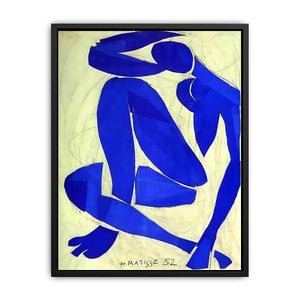
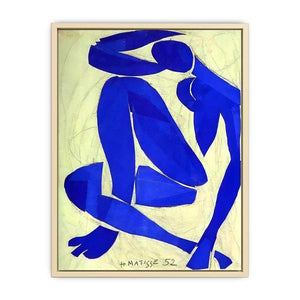
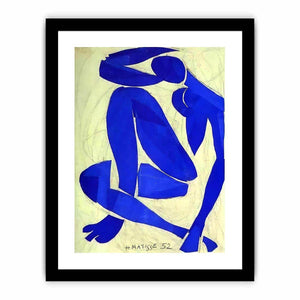
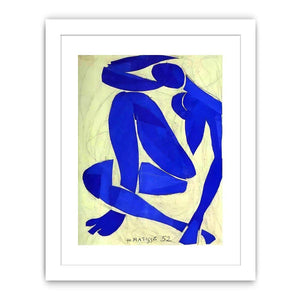
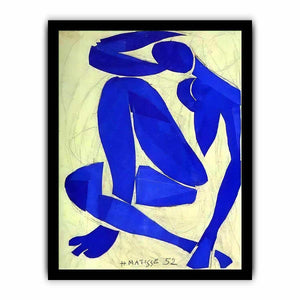
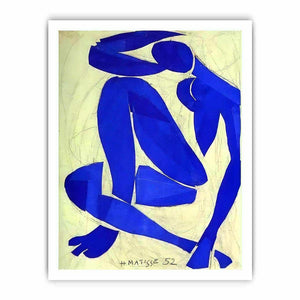
Blue Nude Painting by Henri Matisse
Blue Nude Painting by Henri Matisse stands as one of the most radical and intellectually charged affirmations of modern art’s break with naturalism, transforming the human body into a site of pure form, rhythm, and expressive color. Created in the early twentieth century during a period of intense experimentation, the work does not seek to represent a body as it appears in the world, but to reimagine it as an autonomous visual structure. In Blue Nude, Matisse abandons descriptive fidelity in favor of sculptural clarity, asserting that truth in art can emerge from distortion, simplification, and chromatic intensity rather than imitation.
Henri Matisse approached the nude not as an academic exercise, but as a foundational problem of modern painting: how to reconcile sensation, structure, and emotional resonance within a flattened pictorial field. Blue Nude belongs to a decisive moment in his artistic evolution, when he was absorbing influences from African sculpture, Cézanne’s structural logic, and his own Fauvist explorations of color. The painting reflects a deliberate rejection of Western ideals of idealized beauty, replacing them with a vision grounded in force, weight, and formal necessity.
The subject is a reclining female nude, her body twisted and compressed into a configuration that defies anatomical convention. Limbs are enlarged or abbreviated, contours exaggerated, and posture rendered deliberately awkward. Matisse does not soften these distortions. He emphasizes them, insisting that the body be understood as a dynamic arrangement of volumes rather than a naturalistic figure. The pose is not seductive or relaxed; it is tense, grounded, and self-contained.
Compositionally, Blue Nude is governed by mass and balance rather than linear grace. The figure occupies the pictorial space with undeniable presence, her body pressing against the boundaries of the canvas. There is no illusion of depth, no recession into space. Instead, the body exists as a compact, sculptural form within a shallow field. This compression intensifies the figure’s physicality, transforming the nude into a force rather than an object.
Perspective is intentionally flattened. Matisse eliminates conventional spatial cues, refusing to situate the figure within a believable environment. The background functions not as setting but as counterforce, supporting the figure’s weight and rhythm. This flattening aligns the painting with modernist principles, where the surface of the canvas is acknowledged as a primary reality rather than a window onto the world.
Color is the painting’s most commanding element. The intense blue that defines the body is not descriptive of flesh; it is symbolic, structural, and emotional. Blue here functions as a unifying force, binding the figure into a coherent whole while asserting its separation from naturalistic expectation. The color conveys coolness, density, and permanence, transforming the body into an abstracted presence that resists interpretation as mere physical form.
Light, in the traditional sense, is absent. There are no shadows cast by a visible source, no highlights that model volume through illumination. Instead, form is articulated through color contrasts and contour. This rejection of natural light underscores Matisse’s commitment to autonomy of form. The body is not revealed by light; it exists through color.
Matisse’s handling of line is decisive and economical. Contours are bold, enclosing the figure with clarity and authority. These lines do not describe surface detail; they define structure and rhythm. The body’s twists and compressions are articulated through continuous contour rather than internal modeling, reinforcing the painting’s sculptural logic.
Emotionally, Blue Nude is confrontational rather than inviting. The figure does not perform for the viewer. Her posture is closed, her presence self-contained. There is no attempt to elicit desire or empathy. Instead, the painting asserts independence. The emotional force arises from tension—between distortion and stability, abstraction and corporeality. Matisse invites the viewer to confront the body as form, not fantasy.
Psychologically, the painting represents a decisive rejection of the passive nude tradition. The figure is not an object of contemplation but a subject of structure. Her weight, compression, and solidity deny any sense of decorative ease. In this way, Blue Nude challenges entrenched assumptions about femininity, beauty, and the gaze, replacing them with a vision grounded in autonomy and formal power.
Symbolically, the blue body can be read as an assertion of art’s independence from nature. By divorcing color from description, Matisse affirms painting as a language with its own grammar. The nude becomes a vehicle for exploring how far representation can be transformed without losing coherence. Meaning emerges not from narrative or allegory, but from visual logic itself.
Within Matisse’s broader body of work, Blue Nude occupies a critical position as a turning point toward greater abstraction and structural clarity. It anticipates later developments in his art, where color and form would achieve even greater autonomy. The controversy the painting provoked upon its creation underscores its radical nature. What was once perceived as shocking distortion is now recognized as foundational modernism.
Culturally, Blue Nude reflects the broader upheavals of early twentieth-century art, when artists sought new visual languages capable of expressing modern consciousness. Matisse’s solution was not fragmentation or chaos, but disciplined reduction. The painting demonstrates that radical innovation can coexist with formal rigor, and that beauty can be redefined without being abandoned.
In contemporary interiors across the United States, the United Kingdom, Canada, Australia, and Europe, Blue Nude commands exceptional presence. In living rooms, it introduces boldness and intellectual confidence. In studies and offices, it reflects independent thinking and engagement with modernist ideas. In galleries and luxury residences, it signals connoisseurship and appreciation for works that reshaped the foundations of modern art.
The painting integrates powerfully into modern and minimalist interiors, where its saturated color and simplified form resonate with contemporary design. It also creates striking contrast in traditional spaces, asserting modernity through disciplined force rather than ornament. In eclectic environments, it functions as a visual anchor, unifying diverse elements through chromatic intensity.
The long-term artistic importance of Blue Nude lies in its uncompromising assertion that art need not mirror the visible world to convey truth. Matisse demonstrates that distortion can be a form of clarity, and that reduction can intensify meaning. The painting endures because it challenges viewers to reconsider what the human body can signify when freed from convention.
Today, Blue Nude remains profoundly relevant. In a world still negotiating representation, autonomy, and abstraction, its vision feels both historical and immediate. Through sculptural form, radical color, and disciplined composition, Henri Matisse created a painting that continues to assert the power of modern art to redefine perception itself.
Buy museum qulaity 400- 450 canvas prints, framed prints, and 100% oil paintings of Blue Nude by Henri Matisse at Alpha Art Gallery, where world-famous masterpieces are recreated with museum-quality detail, refined craftsmanship, and premium materials.
FAQS
What makes Blue Nude by Henri Matisse so radical?
The painting radically distorts the human body and uses non-naturalistic color to prioritize form and structure over realistic depiction.
Why is the figure painted entirely blue?
Blue functions as a structural and emotional force, unifying the body while rejecting descriptive flesh tones.
Is Blue Nude meant to be abstract or figurative?
It occupies a critical space between figuration and abstraction, using the body as a vehicle for formal exploration.
Why did the painting cause controversy when first shown?
Its aggressive distortion and rejection of traditional beauty challenged established expectations of the nude.
Where does this artwork work best in interior spaces?
It is ideal for modern living rooms, studies, offices, galleries, and architecturally bold interiors.
Is Blue Nude suitable for minimalist décor?
Yes, its simplified form and powerful color integrate exceptionally well into minimalist spaces.
Does Blue Nude have lasting artistic significance?
It is a landmark of modern art, essential to understanding Matisse’s influence on abstraction and form.