Birth of Venus (La Nascita di Venere) Painting by Sandro Botticelli (Alessandro Filipepi)
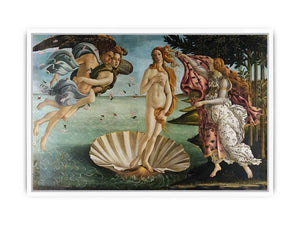
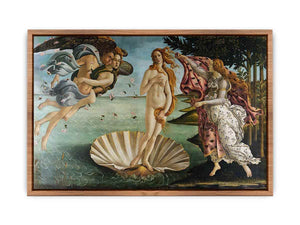
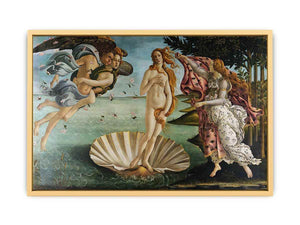
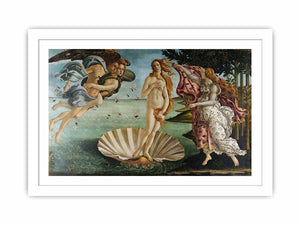
Birth of Venus (La Nascita di Venere) Painting by Sandro Botticelli (Alessandro Filipepi) stands as one of the most enduring and intellectually resonant images of Western art, a painting in which mythology, philosophy, poetry, and aesthetic idealism converge into a vision of beauty that transcends time. Created in the late fifteenth century during the height of the Italian Renaissance, the work does not merely illustrate a classical myth; it articulates a worldview in which beauty is understood as a bridge between the earthly and the divine, the sensual and the spiritual.
Sandro Botticelli, born Alessandro Filipepi, was among the most refined and philosophically attuned artists of Florence. Working under the intellectual atmosphere shaped by the Medici court, Botticelli absorbed the influence of humanist scholars who sought to reconcile classical antiquity with Christian thought. Birth of Venus emerges directly from this cultural synthesis, reflecting the Neoplatonic belief that physical beauty, when perceived rightly, elevates the soul toward higher truth.
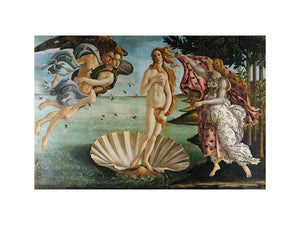
The subject derives from classical mythology, depicting Venus, the goddess of love and beauty, emerging fully formed from the sea upon a shell. Yet Botticelli’s interpretation departs decisively from ancient sculptural precedent. Venus is not portrayed as triumphant or sensual in a corporeal sense; instead, she appears ethereal, poised, and inwardly reflective. Her nudity is symbolic rather than erotic, signifying purity, ideal form, and divine origin rather than physical desire.
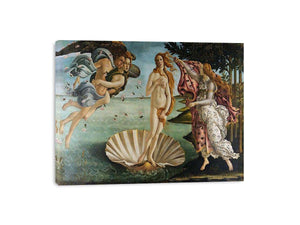
Compositionally, the painting is organized with deliberate symmetry and lyrical balance. Venus stands centrally upon the shell, her elongated form acting as the vertical axis around which all other elements are arranged. To the left, the wind god Zephyrus and his companion propel her toward shore, their intertwined figures forming a dynamic diagonal that introduces motion and breath. To the right, a female figure representing one of the Horae awaits with a cloak, completing the narrative arc from emergence to arrival. This balanced structure allows movement without disorder, narrative without distraction.
Perspective in the painting is intentionally shallow. Botticelli does not seek to create deep spatial illusion, but rather a stage-like plane upon which symbolic figures exist. The sea, sky, and shore are rendered with decorative clarity rather than atmospheric realism. This flattening of space reinforces the painting’s philosophical intent: the scene unfolds not in the physical world as experienced, but in an idealized realm shaped by intellect and imagination.
Line is one of Botticelli’s most powerful expressive tools, and it reaches exceptional refinement in Birth of Venus. The contours of Venus’s body are defined by flowing, continuous lines that emphasize grace over anatomy. These lines guide the eye with rhythmic elegance, creating a sense of visual music rather than corporeal weight. Botticelli’s line does not describe flesh as mass; it defines form as idea.
Color is employed with restraint and symbolic harmony. Soft blues and greens dominate the sea and sky, establishing calm and serenity. Venus’s pale flesh contrasts gently with her surroundings, enhancing her otherworldly presence. Accents of gold and warm tones appear sparingly, lending the scene a subtle radiance without opulence. Color here functions not as sensory indulgence, but as emotional and intellectual modulation.
Light in the painting is even and unlocalized. There is no single source casting dramatic shadows. Instead, illumination seems inherent to the figures themselves, particularly Venus, who appears to glow softly against the background. This choice further distances the scene from naturalism and aligns it with metaphysical presence. Venus is not lit by the world; she embodies light within it.
Botticelli’s treatment of the human figure reflects Renaissance ideals filtered through poetic abstraction. Venus’s proportions are intentionally elongated, her posture both modest and ceremonial. The classical contrapposto is softened, transformed into a stance of quiet containment. Her gesture, covering herself, is not one of shame but of inwardness, reinforcing her role as a spiritualized embodiment of beauty.
Emotionally, Birth of Venus conveys serenity, contemplation, and reverence rather than passion or drama. The figures do not interact through intense gaze or gesture. Instead, they exist in a shared rhythm, bound by purpose rather than emotion. This emotional restraint allows the painting to function as meditation rather than narrative spectacle.
Symbolically, the painting operates on multiple levels. On one level, it illustrates the classical myth of Venus’s birth. On another, it embodies Neoplatonic philosophy, where Venus represents divine love that elevates the soul toward truth. The sea signifies primordial matter, the shell purity and generation, the wind divine breath, and the awaiting figure moral order and civilization. Botticelli does not insist upon any single interpretation; instead, he weaves symbolism into visual harmony, allowing meaning to unfold gradually.
Within Botticelli’s artistic career, Birth of Venus represents a pinnacle of poetic invention. While he produced many religious works of profound sensitivity, this painting reveals his unique ability to translate abstract philosophy into visual form. It stands alongside Primavera as one of the clearest expressions of Florentine humanism rendered through art.
Culturally, Birth of Venus has become a defining image of the Renaissance itself. It encapsulates an era that sought to revive antiquity not as imitation, but as transformation. Botticelli’s Venus is not a pagan relic; she is a Renaissance ideal—classical in origin, Christian in moral tone, and humanist in aspiration.
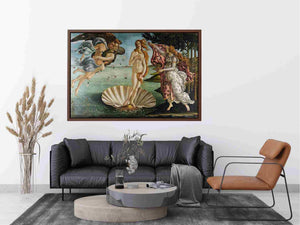
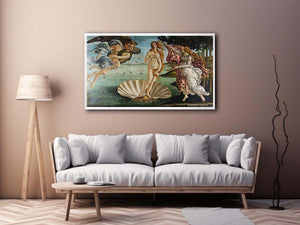
In contemporary interiors across the United States, the United Kingdom, Canada, Australia, and Europe, Birth of Venus retains extraordinary presence and adaptability. In living rooms, it introduces timeless elegance and cultural depth. In studies and libraries, it reflects intellectual curiosity and philosophical engagement. In galleries and luxury residences, it signals connoisseurship and reverence for one of the foundational works of Western art.
The painting integrates seamlessly into traditional interiors, where its classical harmony aligns with established aesthetics. It also functions powerfully in modern and minimalist spaces, where its linear clarity and symbolic restraint offer contrast and gravitas. In eclectic environments, it serves as a unifying cultural anchor, bridging antiquity and modernity through shared ideals of beauty and balance.
The long-term artistic importance of Birth of Venus lies in its redefinition of beauty as an intellectual and spiritual force. Botticelli demonstrates that art can elevate perception, guiding the viewer beyond surface appearance toward contemplation of ideal form and moral harmony. This vision continues to shape how beauty is understood and valued.
Today, Birth of Venus remains profoundly relevant. In a world often dominated by immediacy and spectacle, Botticelli’s painting invites stillness, reflection, and depth. Through lyrical line, symbolic clarity, and philosophical restraint, Sandro Botticelli (Alessandro Filipepi) created a work that continues to speak across centuries, affirming beauty as a timeless and transformative power.
Buy museum qulaity 400- 450 canvas prints, framed prints, and 100% oil paintings of Birth of Venus (La Nascita di Venere) by Sandro Botticelli (Alessandro Filipepi) at Alpha Art Gallery, where world-famous masterpieces are recreated with museum-quality detail, refined craftsmanship, and premium materials.
FAQS
What mythological story does Birth of Venus depict?
It depicts the classical myth of Venus emerging from the sea after her birth, symbolizing divine beauty.
Is the painting meant to be religious or pagan?
It blends classical mythology with Renaissance humanist and Neoplatonic philosophy rather than strict religious doctrine.
Why does Venus appear modest despite being nude?
Her pose reflects idealized purity and spiritual beauty rather than sensuality.
What artistic style does the painting represent?
It is a Renaissance work characterized by linear grace, symbolic composition, and philosophical depth.
Where does this artwork work best in interior spaces?
It is ideal for living rooms, studies, libraries, galleries, and refined luxury interiors.
Is Birth of Venus suitable for modern décor?
Yes, its clarity of form and timeless symbolism integrate beautifully into modern and minimalist spaces.
Does the painting have lasting cultural importance?
It is one of the most influential and recognizable masterpieces in Western art history, with enduring intellectual and aesthetic significance.