Battle of Trafalgar Painting by Louis Philippe Crepin
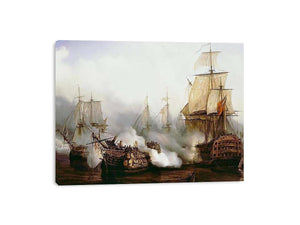
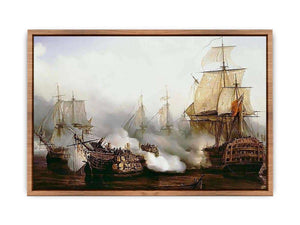
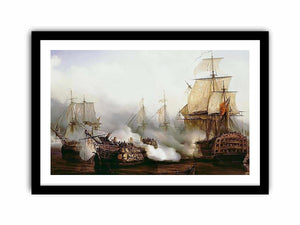
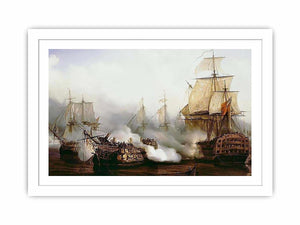
Battle of Trafalgar stands as one of Louis-Philippe Crépin’s most historically resonant and visually disciplined maritime paintings, a work in which naval warfare, national destiny, and the structured violence of the sea are rendered with sober clarity. Painted by an artist who combined firsthand maritime knowledge with academic precision, the composition does not romanticise combat through chaos or excess drama. Instead, Crépin presents the battle as an ordered yet catastrophic collision of fleets, technology, leadership, and fate. The painting functions not only as an image of war, but as a considered meditation on naval power at the decisive moment when Britain’s command of the seas was irrevocably secured.
Louis-Philippe Crépin occupies a unique position in early nineteenth-century marine painting. Unlike artists who approached naval subjects as distant spectacle, Crépin had direct experience of the sea and its realities. This practical understanding informs every aspect of Battle of Trafalgar. Ships are not decorative silhouettes; they are functional machines of war, rendered with structural accuracy and spatial logic. Rigging, hulls, masts, and sails are depicted as instruments under strain, bearing the full physical burden of combat.
The subject itself is one of the defining military engagements of modern European history. Fought on 21 October 1805, the Battle of Trafalgar ended Napoleon’s ambitions of naval supremacy and established Britain as the dominant maritime power for more than a century. Crépin does not isolate a single heroic moment or individual act. Instead, he presents the battle as a system in motion—multiple vessels locked in intersecting lines, smoke and water binding them into a single theatre of conflict. This approach reflects an understanding that Trafalgar was not won by spectacle alone, but by discipline, coordination, and command.
The composition is expansive and meticulously organised. Crépin arranges the fleets in a complex yet readable structure, guiding the viewer’s eye across the canvas through diagonal lines of ships and the rhythmic repetition of masts and sails. The sea becomes both stage and participant, its surface broken by cannon fire, drifting wreckage, and the wake of manoeuvring vessels. Despite the density of action, the painting maintains clarity. Each ship occupies a logical position, reinforcing the sense of strategic intent rather than random destruction.
Perspective plays a crucial role in sustaining this clarity. Crépin adopts a slightly elevated viewpoint that allows the viewer to comprehend the scale of the engagement without losing intimacy with individual ships. The vantage point does not glorify; it informs. The viewer becomes an observer of strategy and consequence rather than a participant swept into chaos. This measured perspective aligns with Crépin’s broader commitment to documentary seriousness.
Light is handled with disciplined realism. Crépin does not use illumination to dramatise victory or heroism. Instead, light diffuses across smoke, water, and canvas sail, creating a muted, atmospheric cohesion. The sky is heavy, the air thick with gunpowder. Light reveals form and motion without assigning moral emphasis. British and Franco-Spanish ships exist within the same visual conditions, reinforcing the painting’s historical impartiality.
Colour is restrained and functional. Crépin favours natural maritime tones—greys, blues, weathered wood, and the dull whites of canvas—punctuated by controlled flashes of red and ochre. These accents signal violence and urgency without overwhelming the composition. Colour serves orientation and structure rather than emotion, allowing the painting to maintain intellectual authority.
Crépin’s attention to material detail is exacting. Hulls show damage and wear, sails strain under wind and shot, rigging hangs torn and tangled. Cannon smoke is rendered with density rather than theatrical flourish, contributing to the painting’s sense of physical consequence. Brushwork remains controlled and deliberate, ensuring that complexity accumulates without visual confusion. Technique serves comprehension.
Emotionally, Battle of Trafalgar is notable for its restraint. There is no overt triumph, no sentimental loss, no romantic exaltation of sacrifice. The emotional register is sober and weighty. Victory is implicit, not celebrated. The painting communicates the cost of naval warfare through scale and inevitability rather than through individual suffering. Crépin presents war as an event of consequence rather than spectacle.
Symbolically, the painting functions as a statement about modern power. Trafalgar represents the moment when naval organisation, industrial capacity, and command structure determined global influence. Crépin’s emphasis on fleets rather than individuals reinforces this reading. Leadership is present, but diffused through formation and movement. Power emerges from coordination rather than personal heroics.
Within Crépin’s broader body of work, Battle of Trafalgar represents a mature synthesis of experience and academic discipline. While he painted numerous naval engagements, this work stands apart for its balance of scale, accuracy, and compositional intelligence. It confirms Crépin’s role not merely as a marine painter, but as a visual historian of naval modernity.
The painting’s relevance today remains strong across the United States, the United Kingdom, Canada, Australia, and Europe. Contemporary viewers recognise Trafalgar as a foundational moment in global history, shaping trade, empire, and geopolitical balance. Crépin’s painting offers a visual language that avoids nationalism in favour of structural understanding, making it enduringly relevant in a global context.
In interior settings, Battle of Trafalgar introduces authority, scale, and historical gravity. In living rooms, it functions as a commanding focal point rich in narrative depth. In studies and offices, it reinforces themes of leadership, strategy, and consequence. In galleries and luxury residences, it signals engagement with serious maritime history painting of the early nineteenth century.
The painting integrates seamlessly into traditional, modern, minimalist, and eclectic décor. Traditional interiors resonate with its historical subject and disciplined execution. Modern spaces benefit from its compositional clarity and atmospheric restraint. Minimalist environments amplify its structural power, while eclectic interiors draw cohesion from its balanced palette and historical weight.
The enduring importance of Battle of Trafalgar lies in its refusal to mythologise naval warfare. Crépin presents victory as the result of structure, endurance, and calculated risk rather than heroic spectacle. The painting endures because it recognises that history is shaped by systems as much as by individuals.
To live with Battle of Trafalgar is to engage daily with a work that commands attention without demanding emotion. Through its disciplined composition, maritime accuracy, and historical seriousness, the painting continues to affirm Louis-Philippe Crépin’s position as one of the most authoritative interpreters of naval conflict. It stands as a testament to his belief that art, when grounded in experience and restraint, can preserve the complexity of history with lasting clarity.
Buy museum qulaity 400- 450 canvas prints, framed prints, and 100% oil paintings of Battle of Trafalgar by Louis Philippe Crepin at Alpha Art Gallery, where world-famous masterpieces are recreated with museum-quality detail, refined craftsmanship, and premium materials.
FAQS
What historical event does Battle of Trafalgar depict?
It depicts the naval battle of 1805 in which the British fleet defeated the combined French and Spanish fleets, securing British naval dominance.
Why is this painting considered historically important?
It presents one of the most decisive naval engagements in modern history with accuracy, scale, and strategic clarity.
How does Louis-Philippe Crépin approach naval warfare in this work?
He emphasises structure, fleet movement, and material reality rather than romantic heroism.
Is the painting focused on a specific ship or commander?
No. It presents the battle as a collective event shaped by coordinated fleets rather than individual figures.
What emotional tone does the painting convey?
It conveys sobriety, consequence, and historical gravity rather than celebration or drama.
Is Battle of Trafalgar suitable for contemporary interiors?
Yes. Its disciplined palette and intellectual depth integrate well into modern and traditional spaces.
Does this artwork have lasting cultural and historical value?
As a major visual record of a pivotal naval victory, it holds enduring significance in European and global history.
Where is the best place to display Battle of Trafalgar?
It is especially well suited to studies, offices, galleries, and large living spaces that value history, leadership, and maritime heritage.