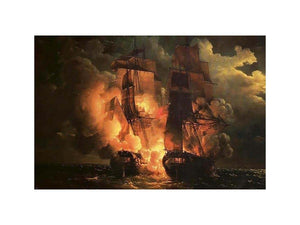
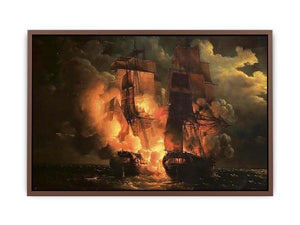
Battle Between the French Frigate Arethuse and the English Frigate Amelia Painting by Louis Philippe Crepin
Battle Between the French Frigate Arethuse and the English Frigate Amelia stands as one of Louis-Philippe Crépin’s most concentrated and intellectually rigorous depictions of naval combat, a painting in which tactical clarity, maritime realism, and restrained drama are brought into exacting balance. Unlike large fleet engagements that dissolve individual actions into massed spectacle, this work focuses on a single ship-to-ship encounter, allowing Crépin to examine naval warfare as a contest of seamanship, discipline, and endurance. The painting does not glorify violence; it records confrontation with the calm authority of an artist deeply familiar with the sea and its demands.
Louis-Philippe Crépin occupies a singular position in early nineteenth-century marine painting. A former sailor turned artist, he brought to his canvases an understanding of naval life grounded in experience rather than imagination. His paintings are distinguished by structural accuracy, atmospheric truth, and a refusal to romanticise maritime conflict. In Battle Between the French Frigate Arethuse and the English Frigate Amelia, these qualities converge. The work reads not as theatrical invention, but as a reasoned visual account of combat between equals, shaped by wind, hull, gun, and command.
The historical encounter itself was emblematic of the wider naval struggle between France and Britain during the Napoleonic era, when control of the seas depended as much on individual engagements as on grand strategy. Crépin chooses to represent neither victory nor defeat as absolute. Instead, he presents the clash as an unfolding process, a moment suspended between intent and outcome. This choice reinforces the painting’s seriousness. The viewer is not instructed how to feel; they are invited to observe.
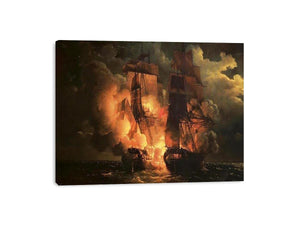
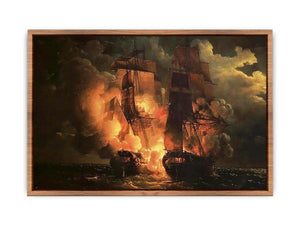
Compositionally, the painting is tightly organised yet dynamically charged. The two frigates dominate the pictorial field, their hulls angled toward one another in a configuration that suggests imminent collision as much as calculated manoeuvre. Crépin arranges the ships so that their opposing trajectories generate tension across the canvas. The sea is not a neutral ground; it is an active force, shaping movement and resistance. Waves press against hulls, wind strains sails, and the surface of the water fractures under cannon fire.
Perspective is carefully calibrated to preserve both immediacy and comprehension. Crépin adopts a vantage point that places the viewer close enough to sense the violence of the encounter, yet elevated enough to read the structural relationship between the ships. This balance allows the painting to communicate strategy rather than confusion. The viewer becomes an informed witness, capable of understanding how position, angle, and timing determine survival.
Light is handled with disciplined realism. Smoke from cannon fire diffuses illumination across the scene, softening contrast and unifying sky, sea, and vessel into a single atmospheric field. There is no heroic spotlighting, no moral illumination separating one side from the other. Light reveals damage and motion impartially. This neutrality is essential to Crépin’s historical integrity. Both ships exist under the same conditions, bound by the same physical laws.
Colour is restrained and functional. Crépin employs a maritime palette of greys, deep blues, weathered wood, and muted whites, punctuated by controlled flashes of ochre and red where violence breaks the surface. These accents register impact without overwhelming the composition. Colour serves orientation and structure rather than emotion, reinforcing the painting’s documentary authority.
The rendering of ships is exacting. Hulls are solid and weight-bearing, masts rise with geometric clarity, rigging tangles under strain, and sails tear or billow according to wind and damage. Crépin’s knowledge of naval architecture is evident in every line. These vessels are not symbols; they are working machines subjected to extraordinary stress. The accuracy of their depiction anchors the painting firmly in lived maritime reality.
Human presence is implied rather than foregrounded. Crépin does not isolate individual sailors or officers in moments of heroism. Instead, the crews are absorbed into the functioning of the ships themselves. This decision reinforces the idea that naval combat is collective and systemic. Victory or loss emerges from coordination and endurance rather than individual gesture.
Emotionally, Battle Between the French Frigate Arethuse and the English Frigate Amelia is defined by tension without excess. There is urgency, but not panic; violence, but not chaos. The painting conveys the gravity of combat through inevitability rather than spectacle. The viewer senses the cost of engagement without being directed toward triumph or tragedy.
Symbolically, the painting functions as a meditation on parity and contest. Neither frigate is diminished or exaggerated. Crépin presents the engagement as a test of equivalence, where outcome depends on discipline, conditions, and decision rather than inherent superiority. This refusal to moralise elevates the work beyond propaganda into historical reflection.
Within Crépin’s broader oeuvre, this painting exemplifies his strength in rendering single-engagement naval actions with clarity and seriousness. While he is often associated with grand fleet scenes, Battle Between the French Frigate Arethuse and the English Frigate Amelia demonstrates his ability to compress historical significance into a focused encounter. It reveals his belief that the essence of naval history is found not only in decisive victories, but in the sustained tension of individual confrontations.
The painting’s relevance today remains strong across the United States, the United Kingdom, Canada, Australia, and Europe. Contemporary viewers recognise in this work a disciplined vision of conflict that avoids sensationalism. In an era accustomed to exaggerated representations of warfare, Crépin’s measured approach offers an alternative grounded in realism and respect for complexity.
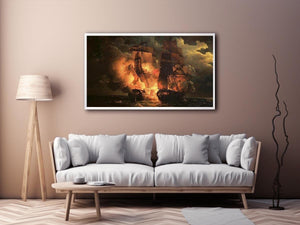
In interior settings, Battle Between the French Frigate Arethuse and the English Frigate Amelia introduces authority, motion, and historical depth. In living rooms, it becomes a commanding focal point rich in narrative energy. In studies and offices, it reinforces themes of strategy, endurance, and consequence. In galleries and luxury residences, it signals engagement with serious maritime history painting rooted in experience.
The painting integrates seamlessly into traditional, modern, minimalist, and eclectic décor. Traditional interiors resonate with its historical subject and academic discipline. Modern spaces benefit from its compositional clarity and atmospheric restraint. Minimalist environments amplify its structural power, while eclectic interiors draw cohesion from its balanced palette and kinetic tension.
The enduring importance of Battle Between the French Frigate Arethuse and the English Frigate Amelia lies in its refusal to simplify naval warfare into spectacle. Crépin presents combat as a disciplined collision of forces governed by skill, environment, and resolve. The painting endures because it treats history as process rather than pageant.
To live with Battle Between the French Frigate Arethuse and the English Frigate Amelia is to engage daily with a work that rewards careful looking. Through its maritime accuracy, compositional intelligence, and emotional restraint, the painting continues to affirm Louis-Philippe Crépin’s position as one of the most authoritative marine painters of his era. It stands as a testament to his belief that art, when grounded in experience and discipline, can preserve the reality of conflict with lasting clarity.
Buy museum qulaity 400- 450 canvas prints, framed prints, and 100% oil paintings of Battle Between the French Frigate Arethuse and the English Frigate Amelia by Louis Philippe Crepin at Alpha Art Gallery, where world-famous masterpieces are recreated with museum-quality detail, refined craftsmanship, and premium materials.
FAQS
What naval event does this painting depict?
It depicts a direct ship-to-ship engagement between the French frigate Arethuse and the English frigate Amelia during the Napoleonic era.
Why is this painting considered significant in maritime art?
It focuses on a single naval encounter rendered with technical accuracy, tactical clarity, and emotional restraint.
How does Louis-Philippe Crépin portray naval combat here?
He presents it as a disciplined, structural confrontation shaped by seamanship, wind, and positioning rather than spectacle.
Is the painting focused on victory or defeat?
No. It presents the engagement as an unfolding contest without moralising the outcome.
What emotional tone does the painting convey?
It conveys tension, gravity, and inevitability rather than triumph or melodrama.
Is this artwork suitable for contemporary interiors?
Yes. Its clarity, movement, and historical depth integrate well into modern and traditional spaces.
Does this painting have lasting historical value?
As a precise visual record of Napoleonic naval warfare by a former sailor, it holds enduring historical and artistic importance.
Where is the best place to display this painting?
It is especially well suited to studies, offices, galleries, and living spaces that value maritime history and strategic realism.