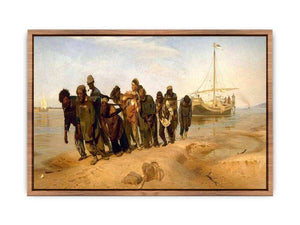
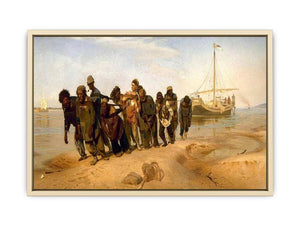
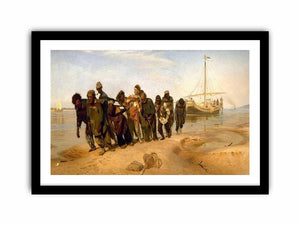
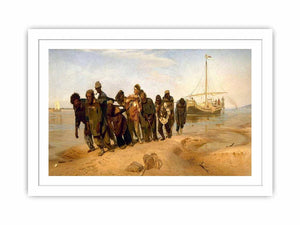
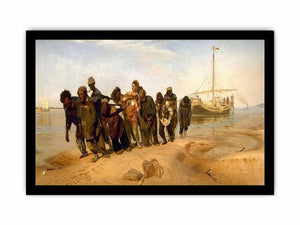
Barge Haulers on the Volga Painting by Ilya Efimovich Repin
Barge Haulers on the Volga Painting by Ilya Efimovich Repin is one of the most uncompromising and socially conscious masterpieces of nineteenth-century art, a work that transformed realist painting into a vehicle of moral inquiry and historical truth. Completed between 1870 and 1873, the painting confronts the viewer with the physical burden, psychological exhaustion, and silent dignity of laborers forced to haul a massive barge upstream along the Volga River. Repin does not sentimentalize suffering, nor does he dramatize it for effect. Instead, he presents labor as lived reality—inescapable, collective, and deeply human.
The artist behind this monumental work, Ilya Efimovich Repin, was emerging at the time as the most formidable voice of Russian Realism. Trained at the Imperial Academy of Arts yet increasingly aligned with the progressive ideals of the Peredvizhniki (the Itinerants), Repin rejected idealized academic subjects in favor of contemporary life and social truth. Barge Haulers on the Volga marked a turning point not only in his career but in Russian art itself, demonstrating that history painting could be forged from present conditions rather than distant myth.
The subject depicts a group of men known as burlaks—seasonal laborers who hauled heavy barges against the river’s current before the advent of mechanized transport. Repin observed such workers firsthand during his travels along the Volga, sketching from life and absorbing the rhythms of their movement, exhaustion, and hierarchy. This direct engagement gives the painting its extraordinary authenticity. The figures are not generalized symbols of poverty; they are individuals, each marked by age, strength, wear, and temperament.
Compositionally, the painting unfolds as a powerful horizontal procession. The figures are arranged in a slow, grinding line that cuts across the canvas, mirroring the relentless forward pull of their labor. Their bodies lean forward under strain, bound together by harnesses that enforce collective motion. Repin uses this linear structure to convey time itself—dragging, repetitive, and unyielding. There is no dramatic climax. The composition insists on endurance rather than release.
Perspective places the viewer at ground level, directly confronting the men rather than observing from a position of safety or superiority. This choice is ethically significant. Repin denies distance. One walks alongside the haulers visually, sharing their plane of existence. The river and sky recede into the background, expansive yet indifferent, reinforcing the imbalance between natural scale and human effort.
Light is naturalistic and unsentimental. Sunlight falls harshly across figures and landscape, revealing sweat, dust, and worn fabric without beautification. There is no heroic glow, no theatrical shadow. Illumination here functions as exposure. Repin allows nothing to be concealed, insisting that reality be seen clearly. The light does not redeem suffering; it reveals it.
The color palette is grounded and earthy. Browns, ochres, muted blues, and sun-bleached tones dominate the scene. These colors bind figures to the land itself, emphasizing their physical integration with environment and labor. Occasional accents—such as the brighter garment of a younger hauler—draw attention not as decoration, but as psychological punctuation within the collective mass. Color supports narrative and character rather than visual pleasure.
Repin’s technique is both disciplined and expressive. Brushwork is controlled yet alive, capable of rendering coarse fabric, weathered skin, and strained muscle with tactile immediacy. Each figure is modeled individually, with careful attention to posture and expression. Despite the group’s collective burden, Repin preserves individuality. Faces reveal resignation, resistance, numbness, and quiet defiance. This balance between unity and difference is central to the painting’s power.
Symbolically, Barge Haulers on the Volga functions as an indictment of social inertia. The men strain forward while the barge looms behind them, a mass of unseen weight representing economic systems that demand effort without reward. The river flows, society advances, yet progress is borne by bodies that remain unseen and unacknowledged. Repin does not depict overseers or owners. The absence of visible oppressors emphasizes the structural nature of exploitation.
Psychologically, the painting is devastating in its restraint. The men do not cry out. They endure. Their silence is more powerful than protest. Repin understood that the most profound injustices are often sustained not through spectacle, but through repetition. By depicting labor as ongoing rather than climactic, he reveals suffering as normalized condition rather than isolated event.
Within Repin’s broader oeuvre, this painting stands as a foundational statement of his artistic ethics. While he would later explore history, portraiture, and psychological drama, Barge Haulers on the Volga remains his most direct confrontation with social reality. It aligns him with European Realism while asserting a distinctly Russian moral gravity. The painting insists that art must witness, not escape.
Culturally, the work became an icon of Russian identity and conscience. It challenged romanticized visions of national life and forced recognition of the human cost underpinning economic and social structures. Even beyond its historical context, the painting has continued to resonate as a universal image of labor under strain. Its relevance extends far beyond nineteenth-century Russia.
In contemporary interiors across the United States, the United Kingdom, Canada, Australia, and Europe, Barge Haulers on the Volga carries immense intellectual and emotional weight. In studies, libraries, and offices, it conveys seriousness, ethical awareness, and historical depth. In galleries and luxury residences, it anchors space with gravitas, integrating powerfully into traditional, modern, minimalist, and eclectic interiors through its strong horizontal composition and restrained palette.
The painting remains meaningful today because it addresses conditions that persist in different forms across societies: unequal labor, unseen effort, and the endurance of those who sustain systems that rarely reward them. Barge Haulers on the Volga does not propose solutions. It demands recognition. In doing so, it fulfills one of art’s highest functions—to make visible what is most easily ignored.
Barge Haulers on the Volga Painting by Ilya Efimovich Repin endures as one of the most morally forceful works in the history of realist art. Through compositional rigor, psychological insight, and uncompromising truthfulness, Repin transformed ordinary labor into a timeless meditation on human endurance and social responsibility. The painting does not console. It bears witness.
Buy museum qulaity 400- 450 canvas prints, framed prints, and 100% oil paintings of Barge Haulers on the Volga by Ilya Efimovich Repin at Alpha Art Gallery, where world-famous masterpieces are recreated with museum-quality detail, refined craftsmanship, and premium materials.
FAQs
What does Barge Haulers on the Volga depict?
It depicts laborers hauling a heavy barge upstream along the Volga River, representing physical toil and endurance.
Is the painting based on real observation?
Yes, Repin studied burlaks directly and sketched from life along the Volga.
Why is the painting considered socially important?
It exposes labor exploitation and human suffering without romanticization.
How does Repin show individuality within the group?
Each figure has distinct posture, expression, and physical condition.
Is the painting political?
It is socially critical rather than overtly political, focusing on structural injustice.
Why does the painting feel so heavy and slow?
The horizontal composition and strained postures convey relentless effort and time.
Why does Barge Haulers on the Volga remain relevant today?
Its themes of labor, inequality, and endurance are universal and ongoing.
Where does this artwork work best in interiors?
It is ideal for studies, libraries, offices, galleries, and spaces devoted to history and reflection.