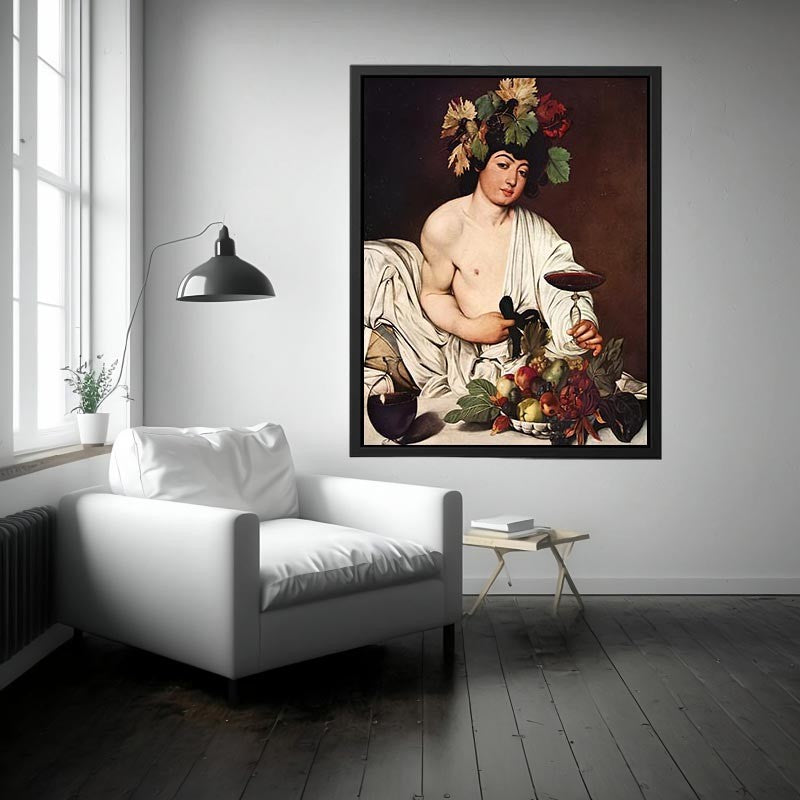
Bacchus Painting by Caravaggio
Bacchus stands as one of the most provocative and intellectually layered works of Caravaggio’s early Roman period, a painting in which classical mythology is reimagined through the lens of lived reality. Created around 1596–1597, the work reveals Caravaggio at a moment of decisive transformation, when he rejected idealised beauty in favour of uncompromising naturalism. Rather than presenting Bacchus as a distant god of antiquity, he offers a figure grounded in the physical world—youthful, sensual, imperfect, and disarmingly human. In doing so, Caravaggio collapses the boundary between myth and everyday life, inviting viewers into an intimate encounter with desire, pleasure, and transience.
When Caravaggio arrived in Rome, artistic convention still favoured polished elegance and intellectualised references to classical form. Bacchus challenged these expectations immediately. The god of wine, revelry, and excess is depicted not as an ideal statue come to life, but as a flesh-and-blood youth seated at a table, extending a goblet of wine toward the viewer. This gesture is central to the painting’s meaning. It is an invitation that is both seductive and ambiguous, offering pleasure while hinting at its consequences. The viewer is not merely observing Bacchus; they are being addressed directly, implicated in the exchange.
The composition is intimate and frontal. Bacchus occupies the foreground, his body turned slightly yet firmly anchored in the pictorial space. There is little background detail to distract from the figure itself. This shallow space brings the subject uncomfortably close, intensifying the psychological immediacy of the encounter. The table, laden with fruit and wine, functions as a threshold between the figure and the viewer, reinforcing the sense of invitation and decision.
Caravaggio’s treatment of the body is revolutionary in its honesty. The figure’s flesh is soft, almost vulnerable, marked by subtle imperfections rather than idealised musculature. The youthful face, flushed with warmth, carries an expression that is neither fully confident nor entirely innocent. There is a hint of fatigue beneath the surface charm, a suggestion that indulgence has its cost. This psychological ambiguity transforms the painting from a simple celebration of pleasure into a meditation on its fragility.
Light plays a decisive role in shaping this effect. Although Bacchus predates Caravaggio’s most dramatic chiaroscuro, light is already used with remarkable intelligence. It falls across skin, fabric, glass, and fruit, revealing texture with tactile clarity. The illumination is natural rather than theatrical, yet it exposes everything without mercy. Grapes show signs of decay, leaves curl and wither, and the wine itself catches the light with deceptive allure. Light here does not idealise; it reveals time at work.
Colour is employed with restrained sensuality. Warm flesh tones dominate the figure, contrasted with the deep reds and purples of wine and fruit, and the pale whites of drapery. These colours are rich but not excessive, grounding the painting in material reality rather than decorative fantasy. The palette reinforces the theme of abundance while subtly acknowledging impermanence. Nothing in the painting feels static; everything suggests a moment already passing.
The still-life elements are integral to the painting’s symbolic structure. The fruit basket, meticulously rendered, contains both ripe and decaying produce. This juxtaposition has long been understood as a reference to vanitas themes—the fleeting nature of pleasure and the inevitability of decline. Caravaggio integrates this symbolism seamlessly, without moralising. The message is not imposed; it emerges through observation. Pleasure is offered honestly, along with its consequences.
Emotionally, Bacchus operates on multiple registers. There is allure in the figure’s gaze and gesture, warmth in the colour and light, and unease in the signs of decay and fatigue. The painting neither celebrates indulgence uncritically nor condemns it outright. Instead, it presents pleasure as an essential yet unstable aspect of human experience. This emotional complexity is central to Caravaggio’s modernity. He refuses simple allegory in favour of lived contradiction.
Within Caravaggio’s career, Bacchus marks a crucial step in his artistic development. It demonstrates his ability to transform traditional subjects through radical realism, laying the groundwork for his later religious masterpieces. The painting also reveals his interest in self-referential ambiguity; some scholars have suggested that the figure may be a veiled self-portrait, further complicating the relationship between artist, subject, and viewer. Whether or not this is accepted, the painting undeniably foregrounds the artist’s presence through its intensity and immediacy.
Culturally, Bacchus occupies a pivotal place in the evolution of Baroque art. It redefined how mythological subjects could be approached, shifting emphasis from ideal beauty to psychological truth. The painting’s influence can be traced through generations of artists who sought to bring classical themes into direct contact with contemporary life. Its enduring relevance lies in its refusal to sanitise pleasure or disguise impermanence.
In contemporary interiors, Bacchus possesses striking adaptability and presence. In living rooms, it functions as a bold focal point, introducing warmth, sensuality, and intellectual depth. In dining spaces, its themes of abundance and indulgence resonate naturally. In studies and private offices, it invites reflection on the balance between desire and restraint. Within galleries and refined residences across the United States, United Kingdom, Canada, Australia, and Europe, the painting integrates seamlessly with both classical and modern décor. Its restrained palette and intimate scale allow it to command attention without excess.
The lasting power of Bacchus lies in its honesty. Caravaggio does not mythologise pleasure into abstraction; he gives it a human face, complete with vulnerability and decay. In doing so, he affirms art’s capacity to confront fundamental aspects of existence without illusion. Bacchus remains a testament to Caravaggio’s belief that truth, even when uncomfortable, possesses its own enduring beauty.
Buy museum qulaity 400- 450 canvas prints, framed prints, and 100% oil paintings of Bacchus by Caravaggio at Alpha Art Gallery, where world-famous masterpieces are recreated with museum-quality detail, refined craftsmanship, and premium materials.
FAQ
What does Bacchus by Caravaggio represent?
It represents pleasure, desire, and transience, portraying the god of wine as a human figure marked by both allure and impermanence.
Why is Bacchus considered a radical painting?
Caravaggio rejected idealised mythology, presenting the god with physical imperfections and psychological ambiguity.
What is the significance of the fruit in the painting?
The mixture of ripe and decaying fruit symbolises the fleeting nature of pleasure and the passage of time.
How does Caravaggio use light in Bacchus?
Light reveals texture and imperfection, exposing reality rather than idealising the subject.
Is the figure meant to be seductive or cautionary?
The painting deliberately balances both, offering pleasure while quietly acknowledging its cost.
How does Bacchus fit within Caravaggio’s career?
It marks an early breakthrough, demonstrating his naturalism and redefining mythological painting.
Is Bacchus suitable for contemporary interiors?
Yes, its warmth, intimacy, and symbolic depth make it adaptable to modern and classical spaces.
Why does Bacchus remain relevant today?
Its exploration of indulgence, vulnerability, and impermanence reflects timeless aspects of human experience.