Avenue de l’Opéra, Misty Weather, Morning Sunshine Painting by Camille Pissarro
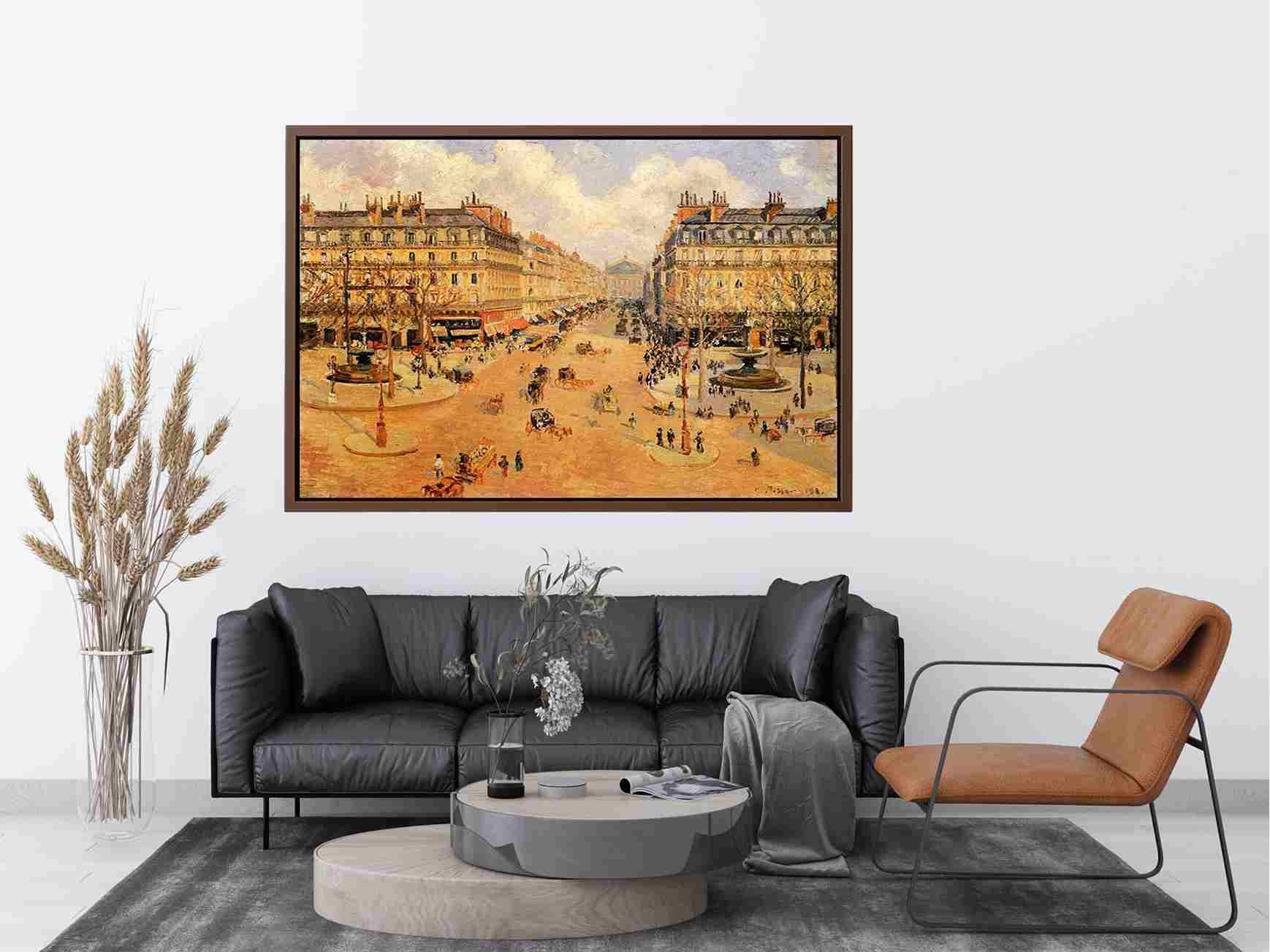
Avenue de l’Opéra, Misty Weather, Morning Sunshine Painting by Camille Pissarro is a quietly commanding vision of modern Paris, where atmosphere, movement, and urban life are fused into a single, luminous experience. Painted during the 1890s, when Pissarro turned his sustained attention toward the city as a living organism, the work captures Paris not as monument or spectacle, but as a breathing environment shaped by light, weather, and human rhythm. Rather than isolating architecture or dramatizing social life, Pissarro offers a measured synthesis in which the city emerges through perception itself.
Camille Pissarro occupies a singular position within Impressionism, not only as its eldest and most intellectually generous figure, but as an artist whose curiosity continually evolved. While many of his contemporaries oscillated between landscape and leisure, Pissarro pursued the modern city with analytical patience and ethical seriousness. Avenue de l’Opéra, Misty Weather, Morning Sunshine belongs to his celebrated series of Parisian boulevards, works that investigate how urban space is shaped less by permanence than by shifting conditions of light, air, and circulation.
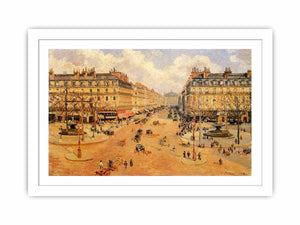
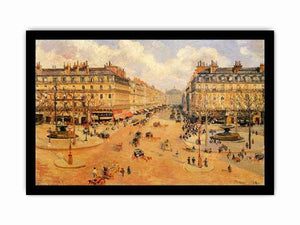
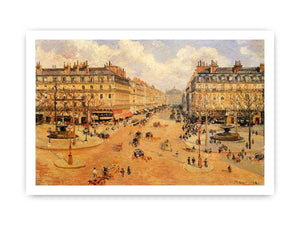
The subject is the Avenue de l’Opéra at morning, enveloped in mist yet gradually animated by sunlight. Pissarro selects neither dramatic weather nor theatrical clarity. Instead, he fixes upon a transitional moment, when fog thins, light strengthens, and the city begins to assert its daily rhythm. Carriages move steadily, figures appear and dissolve within the haze, and architecture stands as a stabilizing framework rather than a dominating presence. The city is not frozen into an image; it is caught mid-becoming.
Compositionally, the painting is structured around recession and flow. The avenue stretches forward, drawing the viewer’s eye into depth while remaining softened by mist. Pissarro avoids rigid symmetry, allowing the street to open organically into space. Buildings line the avenue with architectural regularity, yet their clarity is deliberately moderated. They are not rendered as solid monuments but as forms filtered through atmosphere, reinforcing the painting’s emphasis on perception over precision.
Perspective plays a crucial role in shaping the viewer’s experience. Pissarro adopts an elevated vantage point, often associated with his views from hotel windows, which allows him to observe the city as a system rather than a scene. This perspective distances the viewer from individual narrative while enhancing awareness of collective movement. People and vehicles are reduced to rhythmic elements within a larger pattern, reinforcing the sense of the city as an interconnected whole.
Light is the painting’s central agent of transformation. Morning sunshine does not arrive abruptly; it emerges gradually, dissolving mist and clarifying form. Pissarro captures this process with extraordinary sensitivity. Light filters rather than strikes, revealing the avenue incrementally. This restrained illumination avoids theatrical contrast, favoring subtle tonal shifts that mirror the lived experience of early morning. Light here is temporal, marking the passage from obscurity to clarity.
Color is deployed with disciplined restraint. Pissarro’s palette consists of soft greys, pale blues, muted ochres, and gentle highlights that suggest sunlight without overwhelming the scene. Rather than saturating the canvas, color operates relationally, defining space through modulation rather than outline. The mist acts as a unifying veil, blending tones and softening transitions, while warmer notes hint at the sun’s increasing presence. Color becomes atmosphere rather than decoration.
Brushwork is characteristic of Pissarro’s mature Impressionist technique: broken, responsive, and finely calibrated. Individual strokes remain visible yet never assertive. They accumulate to suggest movement, vibration, and density without dissolving into abstraction. The surface feels alive, but controlled, reflecting Pissarro’s belief that observation required both sensitivity and structure. Nothing is hurried; everything is measured.
Emotionally, Avenue de l’Opéra, Misty Weather, Morning Sunshine conveys calm attentiveness rather than excitement. The city awakens without urgency. There is movement, but no chaos; activity, but no drama. Pissarro resists romanticizing Paris as either glamorous spectacle or oppressive machine. Instead, he presents it as a shared environment shaped by routine, weather, and light. The mood is contemplative, inviting sustained looking rather than immediate reaction.
Psychologically, the painting reflects a modern consciousness attuned to flux. Figures are present but not individualized. Their anonymity is not alienating; it is structural. Pissarro recognizes that modern urban life is defined by collective rhythms rather than personal narratives. By withholding individual focus, he allows the viewer to sense participation without intrusion, belonging without intimacy.
Symbolically, the painting resists overt allegory. Yet its imagery carries quiet resonance. Mist suggests uncertainty and transition; morning light implies renewal and continuity. The avenue itself, newly constructed in the decades before Pissarro painted it, stands as a symbol of modern urban planning and social circulation. Pissarro does not moralize these elements. He observes them, allowing meaning to arise through balance rather than declaration.
Within Pissarro’s broader oeuvre, this work represents a culmination of his engagement with modernity. Having painted rural labor, village streets, and suburban life, Pissarro approached Paris with the same ethical seriousness he applied to the countryside. Avenue de l’Opéra, Misty Weather, Morning Sunshine demonstrates that urban life could be treated with sensitivity and depth, without spectacle or nostalgia. It affirms the city as a legitimate subject of sustained artistic inquiry.
Culturally, the painting occupies an important place in the history of Impressionism’s urban turn. While earlier depictions of Paris often emphasized leisure and display, Pissarro focused on process and atmosphere. His approach influenced later developments in modern painting, where the city would increasingly be understood as a field of perception rather than a collection of landmarks.
In contemporary interiors across the United States, the United Kingdom, Canada, Australia, and Europe, Avenue de l’Opéra, Misty Weather, Morning Sunshine integrates with exceptional refinement. In living rooms, it introduces lightness, openness, and intellectual calm. In studies and offices, it supports focus and reflective clarity. In galleries and luxury residences, it signals connoisseurship and appreciation for Impressionism’s quieter, more analytical achievements.
The painting works seamlessly in modern and minimalist interiors, where its tonal subtlety and spatial openness enhance architectural clarity. It also complements traditional settings, offering continuity through its classical balance and measured composition. In eclectic environments, it functions as a harmonizing presence, uniting diverse elements through shared atmosphere and restraint.
The long-term artistic importance of Avenue de l’Opéra, Misty Weather, Morning Sunshine lies in its demonstration that modern life can be rendered without exaggeration. Pissarro shows that the city’s meaning resides not in events, but in conditions—in light, weather, and movement. The painting endures because it captures a universal experience: the quiet unfolding of a day within a shared space.
Today, the work remains deeply relevant. In an age marked by acceleration and visual excess, its attentiveness to subtle change feels restorative. Through disciplined observation, tonal harmony, and emotional restraint, Camille Pissarro created a painting that continues to offer clarity, balance, and a profound sense of modern presence.
Buy museum qulaity 400- 450 canvas prints, framed prints, and 100% oil paintings of Avenue de l’Opéra, Misty Weather, Morning Sunshine by Camille Pissarro at Alpha Art Gallery, where world-famous masterpieces are recreated with museum-quality detail, refined craftsmanship, and premium materials.
FAQS
What does Avenue de l’Opéra, Misty Weather, Morning Sunshine depict?
It depicts a Parisian boulevard in the early morning, softened by mist and gradually illuminated by sunlight.
Why did Pissarro paint multiple views of Parisian boulevards?
He was interested in how light, weather, and movement transform urban space over time.
Is this painting focused on architecture or people?
It balances both, treating buildings and figures as elements within a larger atmospheric system.
What mood does the painting convey?
It conveys calm, attentiveness, and quiet modern rhythm rather than drama or spectacle.
Where does this artwork work best in interior spaces?
It is ideal for living rooms, studies, offices, galleries, and refined residential interiors.
Is this painting suitable for modern décor?
Yes, its tonal subtlety, openness, and restrained palette integrate beautifully into modern and minimalist settings.
Does the painting have lasting artistic significance?
It is a key example of Impressionist urban painting, valued for its atmospheric intelligence and modern vision.