


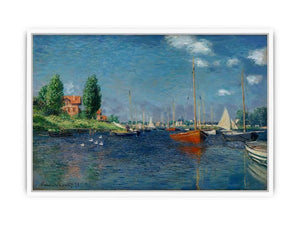

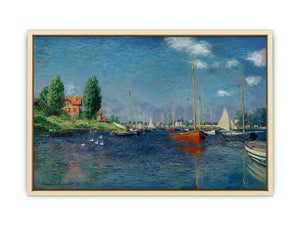


Argenteuil (Red Boats)
Go kalles this summer with this vintage navy and white striped v-neck t-shirt from the Nike. Perfect for pairing with denim and white kicks for a stylish kalles vibe.

Argenteuil (Red Boats)
Argenteuil (Red Boats) Painting by Claude Monet
Argenteuil (Red Boats) stands as one of Claude Monet’s most lucid and confident statements of Impressionist vision, a painting in which modern leisure, colour, and light are fused into a scene of remarkable immediacy and balance. Created during the early 1870s, when Monet was living in the riverside town of Argenteuil, the work reflects a period of renewed stability and artistic clarity in his life. Here, the river is not a timeless pastoral motif, but a contemporary environment shaped by industry, recreation, and modern rhythms, observed with an eye trained to register sensation rather than description.
Argenteuil occupied a crucial place in Monet’s artistic development. Situated along the Seine, it was both a working river and a site of bourgeois leisure, where sailing boats, promenades, and suburban life coexisted with factories and bridges. Monet found in this environment an ideal subject for Impressionism: a landscape defined by movement, reflection, and change. Argenteuil (Red Boats) emerges from this context not as a documentary view, but as a distilled experience of colour and atmosphere, shaped by the artist’s sustained engagement with the same motif under varying conditions.
The composition is structured with deceptive simplicity. The river occupies the foreground, its surface animated by ripples that catch and scatter light. Several small boats are moored near the bank, their vivid red hulls cutting decisively across the cooler tones of water and sky. In the background, the opposite shore rises gently, marked by trees, buildings, and hints of human presence. Monet arranges these elements horizontally, allowing the eye to move laterally across the canvas, mirroring the calm, unhurried flow of the river itself.
Perspective is shallow yet coherent. Monet does not seek dramatic depth or recession. Instead, he allows space to unfold through overlapping bands of colour and reflection. The boats sit firmly on the water’s surface, their reflections extending downward in broken strokes that dissolve form into vibration. Distance is suggested not through precise line, but through tonal modulation and atmospheric softening. This approach reinforces the painting’s emphasis on perception over structure.
Colour is the painting’s most striking and deliberate feature. The red boats are not incidental accents; they are the compositional anchors around which the entire scene is organised. Their saturated hue contrasts sharply with the blues, greens, and silvery greys of the river and sky, creating a dynamic equilibrium between warmth and coolness. Monet’s use of red is confident and unrestrained, yet never decorative for its own sake. The colour functions relationally, intensifying surrounding tones and clarifying spatial relationships through contrast rather than outline.
Light permeates the scene with quiet authority. Sunlight does not blaze or dramatise; it diffuses evenly across water and land, breaking into fragments as it touches the river’s surface. Reflections shimmer and shift, rendered through short, rhythmic brushstrokes that suggest constant motion. Monet treats light as an active presence rather than a static source, allowing it to reorganise colour and form continuously. The river becomes a field of visual activity, alive with subtle change.
Monet’s brushwork is open and declarative. Individual strokes remain visible, their direction and density contributing to the painting’s overall rhythm. Water is described through horizontal touches that ripple and overlap, while the boats are defined with firmer, more concentrated marks. This variation in handling reinforces material differences without resorting to detail. The painting feels immediate because it preserves the gestures of its making, aligning technique with perception.
Symbolically, Argenteuil (Red Boats) resists overt interpretation. Its meaning lies in its affirmation of modern life as worthy of serious attention. The boats, likely associated with leisure and recreation, suggest a society in transition, where time is increasingly divided between labour and pleasure. Yet Monet does not moralise this condition. He observes it, allowing colour and light to carry significance without narrative emphasis. The painting’s calm confidence reflects an artist fully committed to the present moment.
Emotionally, the work conveys clarity and composure. There is no urgency, no dramatic tension. The scene feels settled, yet not static. Viewers often experience a sense of visual refreshment, as though the painting offers space to breathe. This emotional effect arises not from subject matter alone, but from the harmony of colour, light, and movement. Monet achieves vitality without agitation, a balance that would become increasingly rare as his later work pushed toward greater abstraction.
Within Monet’s career, Argenteuil (Red Boats) represents a period of consolidation and assurance. It demonstrates his mastery of Impressionist principles at a moment when they were still contested and evolving. The painting shows an artist confident enough to rely on colour relationships and perceptual truth without recourse to compositional scaffolding inherited from tradition. It is both exploratory and resolved, experimental yet assured.
Culturally, the painting reflects the emergence of a new relationship between people and landscape in the nineteenth century. The river is no longer a remote or symbolic space; it is integrated into daily life, shaped by modern transportation and leisure. Monet’s Argenteuil is not an escape from modernity, but an expression of it, rendered with sensitivity rather than critique. The painting thus occupies an important place in the visual history of modern experience.
In contemporary interiors, Argenteuil (Red Boats) offers exceptional versatility and visual vitality. In living rooms, it introduces colour and movement without overwhelming the space, serving as a focal point that energises while remaining balanced. In studies and offices, it provides clarity and rhythmic calm, encouraging sustained attention rather than distraction. In galleries and luxury residences across the United States, United Kingdom, Canada, Australia, and Europe, the painting integrates seamlessly with modern, minimalist, and eclectic décor. The red accents enliven neutral interiors, while the overall harmony ensures long-term visual ease.
The enduring relevance of Argenteuil (Red Boats) lies in its affirmation of perception as coherence. Monet demonstrates that the modern world, with its everyday scenes and fleeting effects, can be rendered with seriousness and beauty without idealisation. By trusting colour, light, and immediate sensation, he created a painting that remains fresh, balanced, and quietly compelling. The work endures not because it depicts a particular place, but because it recreates the experience of seeing—a moment when colour, water, and light align into lasting visual clarity.
Buy museum qulaity 400- 450 canvas prints, framed prints, and 100% oil paintings of Argenteuil (Red Boats) by Claude Monet at Alpha Art Gallery, where world-famous masterpieces are recreated with museum-quality detail, refined craftsmanship, and premium materials.
FAQS
What does Argenteuil (Red Boats) by Claude Monet depict?
It depicts small red boats moored on the Seine at Argenteuil, focusing on colour, light, and reflection rather than narrative detail.
Why are the red boats so visually dominant?
Their strong colour contrast anchors the composition and intensifies surrounding blues and greens.
Is Argenteuil an important place in Monet’s career?
Yes, it was where Monet developed many key Impressionist ideas while living and working along the Seine.
How does Monet represent water in this painting?
Through broken, horizontal brushstrokes that suggest movement and shifting reflections.
Does the painting depict leisure or work?
It suggests modern leisure, but without explicit narrative, focusing instead on visual experience.
Is Argenteuil (Red Boats) a typical Impressionist work?
Yes, it exemplifies Impressionist priorities of visible brushwork, modern subject matter, and attention to light.
Is this painting suitable for contemporary interiors?
Yes, its balanced composition and vivid accents make it well suited to modern and classic spaces.
Why does Argenteuil (Red Boats) remain relevant today?
Its clarity, colour harmony, and focus on everyday modern life continue to resonate with contemporary viewers.
| 1. Select Type |
Canvas Print, Unframed Paper Print, Hand-Painted Oil Painting, Framed Paper Print |
|---|---|
| 2. Select Finish Option |
Rolled Canvas, Rolled- No Frame, Streched Canvas, Black Floating Frame, White Floating Frame, Brown Floating Frame, Black Frame with Matt, White Frame with Matt, Black Frame No Matt, White Frame No Matt, Streched, Natural Floating Frame, Champagne Floating Frame, Gold Floating Frame |
| 3. Select Size |
60cm X 90cm [24" x 36"], 76cm X 114cm [30" x 45"], 90cm X 120cm [36" x 48"], 100cm X 150cm [40" x 60"], 16.54 x 11.69"(A3), 23.39 x 16.54"(A2), 33.11 x 23.39"(A1), 46.81 x 31.11"(A0), 54" X 36", 50cm X 60cm [16" x 24"], 121cm X 182cm [48" x 72"], 135cm X 200cm [54" x 79"], 165cm x 205cm [65" x 81"], 183cm x 228cm [72" x 90"], 22cm X 30cm [9" x 12"], 30cm x 45Cm [12" x 18"], 45cm x60cm [16" x 24'], 75cm X 100cm [30" x 40"], 121cm x 193cm [48" x 76"], 45cm x 60cm [16" x 24'], 20cm x 25Cm [8" x 10"], 35cm x 50Cm [14" x 20"], 45cm x 60 cm [18" x 24"], 35cm x 53Cm [14" x 21"], 66cm X 101cm[26" x 40"], 76cm x 116cm [30"x 46"], 50cm X 60cm 16" x 24"] |