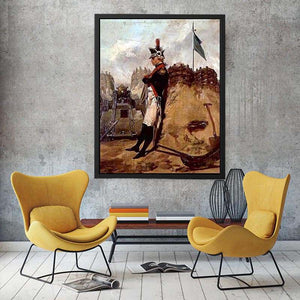
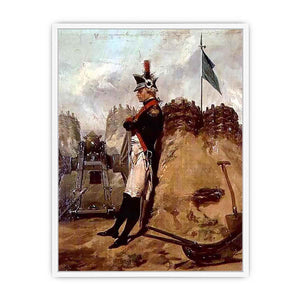
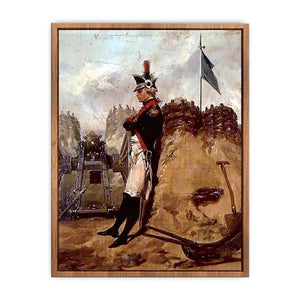
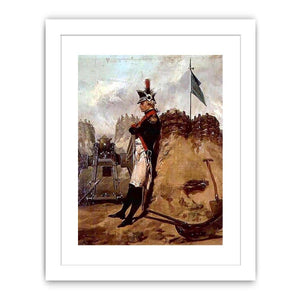
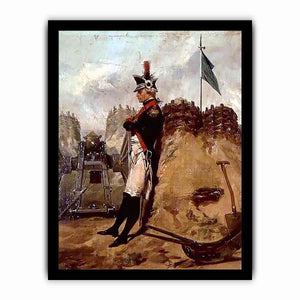
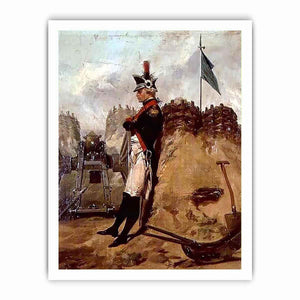
Alexander Hamilton in the Uniform of the New York Artillery Painting by Alonzo Chappel
Alexander Hamilton in the Uniform of the New York Artillery stands as one of the most lucid and psychologically attentive nineteenth-century representations of an American founding figure, a painting in which Alonzo Chappel combines historical fidelity, disciplined realism, and narrative restraint to produce an image of authority grounded in action rather than myth. Created during a period when the young republic was actively shaping its visual memory, the work reflects Chappel’s commitment to portraying history as lived experience—specific, credible, and morally legible—rather than as abstract heroism. The result is a portrait that situates Alexander Hamilton within the material reality of the Revolutionary era while allowing his intellect, resolve, and ambition to register with quiet force.
Alonzo Chappel was among the most influential historical painters in nineteenth-century America, widely recognised for his ability to translate complex political and military histories into accessible visual form. Working in an era eager to codify national identity, Chappel approached his subjects with an illustrator’s clarity and a historian’s care. His portraits of revolutionary leaders are distinguished not by flamboyance, but by compositional order and documentary seriousness. In Alexander Hamilton in the Uniform of the New York Artillery, these qualities are fully realised. Chappel avoids theatrical gesture and grand allegory, opting instead for a measured presentation that emphasises competence, readiness, and civic responsibility.
The composition presents Hamilton in military attire associated with his early service during the American Revolutionary War, before his rise to national political prominence. By choosing this moment, Chappel foregrounds Hamilton’s identity as a soldier and organiser rather than a statesman alone. The uniform is rendered with careful attention to detail, its cut and accoutrements establishing authenticity without overwhelming the figure. Hamilton is shown upright and composed, his posture conveying alertness and discipline. There is no suggestion of performance; the stance feels functional, as though shaped by duty rather than display.
Hamilton’s expression is central to the painting’s psychological impact. Chappel depicts him with focused calm, neither romanticised nor softened. The face suggests intelligence under control, ambition tempered by purpose. The gaze is directed outward yet inwardly concentrated, reinforcing the impression of a man accustomed to responsibility at a young age. Chappel resists the temptation to idealise Hamilton into abstraction. Instead, he presents a recognisable individual shaped by circumstance and conviction.
The spatial treatment is restrained and coherent. Chappel situates the figure within a neutral, unobtrusive setting that supports presence without distraction. There is no elaborate background narrative, no symbolic architecture or battlefield drama. This compositional economy directs attention to the figure itself, allowing uniform, posture, and expression to carry meaning. Space functions as context rather than spectacle, reinforcing the painting’s documentary authority.
Light is applied with moderation and clarity. Chappel employs even illumination that models the figure without dramatic contrast. The absence of theatrical chiaroscuro reinforces realism, allowing details of fabric, flesh, and form to be read with ease. Light here serves comprehension rather than drama. It establishes solidity and immediacy, situating Hamilton firmly within the material world of action and service.
Colour is disciplined and historically grounded. The tones of the uniform, flesh, and surrounding space are harmonised to avoid excess. Chappel favours muted, purposeful colour relationships that support the painting’s sober tone. There is no chromatic flourish intended to elevate mood; instead, colour reinforces credibility and restraint. The overall palette contributes to a sense of seriousness appropriate to a figure whose legacy would be defined by structure, order, and institutional thinking.
Chappel’s handling of texture reflects his broader artistic values. Fabrics are rendered with clarity and differentiation, yet without ostentation. The uniform reads as functional clothing rather than decorative costume. Flesh is modelled with restraint, avoiding idealisation while maintaining dignity. Brushwork remains controlled and unobtrusive, allowing the painting to function as a stable historical image rather than an expressive surface.
Symbolically, Alexander Hamilton in the Uniform of the New York Artillery communicates through implication rather than allegory. The uniform itself serves as the primary symbol, representing service, discipline, and the formative years of a nation in conflict. Chappel does not rely on overt iconography. Instead, meaning arises through the synthesis of posture, attire, and expression. Hamilton is presented as a figure defined by readiness and intellect rather than inherited authority.
Emotionally, the painting conveys composure and resolve. There is no sentimentality, no overt patriotism, no dramatic tension. Chappel’s restraint allows the viewer to engage with Hamilton as a working individual rather than a mythic emblem. The emotional register is one of seriousness and forward orientation, reflecting a personality shaped by ambition and purpose rather than nostalgia.
Within Chappel’s oeuvre, this painting exemplifies his approach to American historical portraiture. He consistently favoured clarity over embellishment, credibility over idealisation. In portraying Hamilton, Chappel contributes to the visual canon of the American founding by emphasising participation and service rather than retrospective grandeur. The painting thus occupies an important place in the nineteenth-century effort to define national identity through recognisable human figures.
The cultural relevance of Alexander Hamilton in the Uniform of the New York Artillery remains pronounced across the United States, the United Kingdom, Canada, Australia, and Europe. Contemporary audiences continue to engage with the image as a representation of leadership grounded in responsibility rather than charisma. In an era increasingly attentive to the origins of political institutions, the painting offers a visual reminder of leadership formed through action and discipline.
In interior settings, the work introduces historical gravitas and intellectual presence. In living rooms, it functions as a statement of civic awareness and cultural depth. In studies and offices, it reinforces themes of leadership, organisation, and public service. In galleries and luxury residences, it signals refined engagement with American historical art and nineteenth-century realism.
The painting integrates seamlessly into traditional, modern, minimalist, and eclectic décor. Traditional interiors resonate with its historical subject and sober palette. Modern spaces benefit from its clarity and compositional restraint. Minimalist environments find strength in its disciplined presence, while eclectic interiors draw coherence from its balance and seriousness.
The enduring importance of Alexander Hamilton in the Uniform of the New York Artillery lies in its refusal to mythologise leadership beyond recognition. Chappel presents Hamilton not as legend, but as participant—young, capable, and defined by responsibility. The painting endures because it recognises that history is shaped not only by ideas, but by individuals willing to assume duty within uncertain circumstances.
To live with Alexander Hamilton in the Uniform of the New York Artillery is to engage daily with a work that honours realism, discipline, and historical consciousness. Through its measured composition, credible detail, and psychological restraint, the painting continues to affirm that national memory gains strength when rooted in clarity rather than exaggeration. It stands as a testament to Alonzo Chappel’s belief that history, when rendered with seriousness and care, retains lasting authority.
Buy museum qulaity 400- 450 canvas prints, framed prints, and 100% oil paintings of Alexander Hamilton in the Uniform of the New York Artillery by Alonzo Chappel at Alpha Art Gallery, where world-famous masterpieces are recreated with museum-quality detail, refined craftsmanship, and premium materials.
FAQS
What moment in Alexander Hamilton’s life does this painting represent?
It represents Hamilton during his early military service in the American Revolutionary War, before his later political prominence.
Why is Alonzo Chappel’s portrayal of Hamilton significant?
Chappel emphasises realism and discipline, presenting Hamilton as a working leader rather than an idealised symbol.
What does the New York Artillery uniform signify?
The uniform signifies service, responsibility, and Hamilton’s formative role in the Revolutionary struggle.
How does the painting differ from more heroic portraits of founders?
It avoids theatrical gesture and allegory, focusing instead on composure, readiness, and credibility.
Is this artwork suitable for contemporary interiors?
Yes. Its restrained palette and serious tone integrate well into both traditional and modern spaces.
What emotional tone does the painting convey?
It conveys focus, discipline, and quiet authority rather than sentimentality or spectacle.
Does this artwork have lasting historical value?
As a nineteenth-century interpretation of a founding figure, it holds enduring cultural and educational significance.
Where is the best place to display this painting?
It is especially well suited to studies, offices, living rooms, and gallery spaces that value history and leadership.