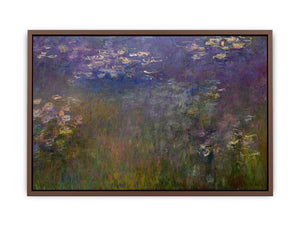
Agapanthus (Center Panel) Painting by Claude Monet
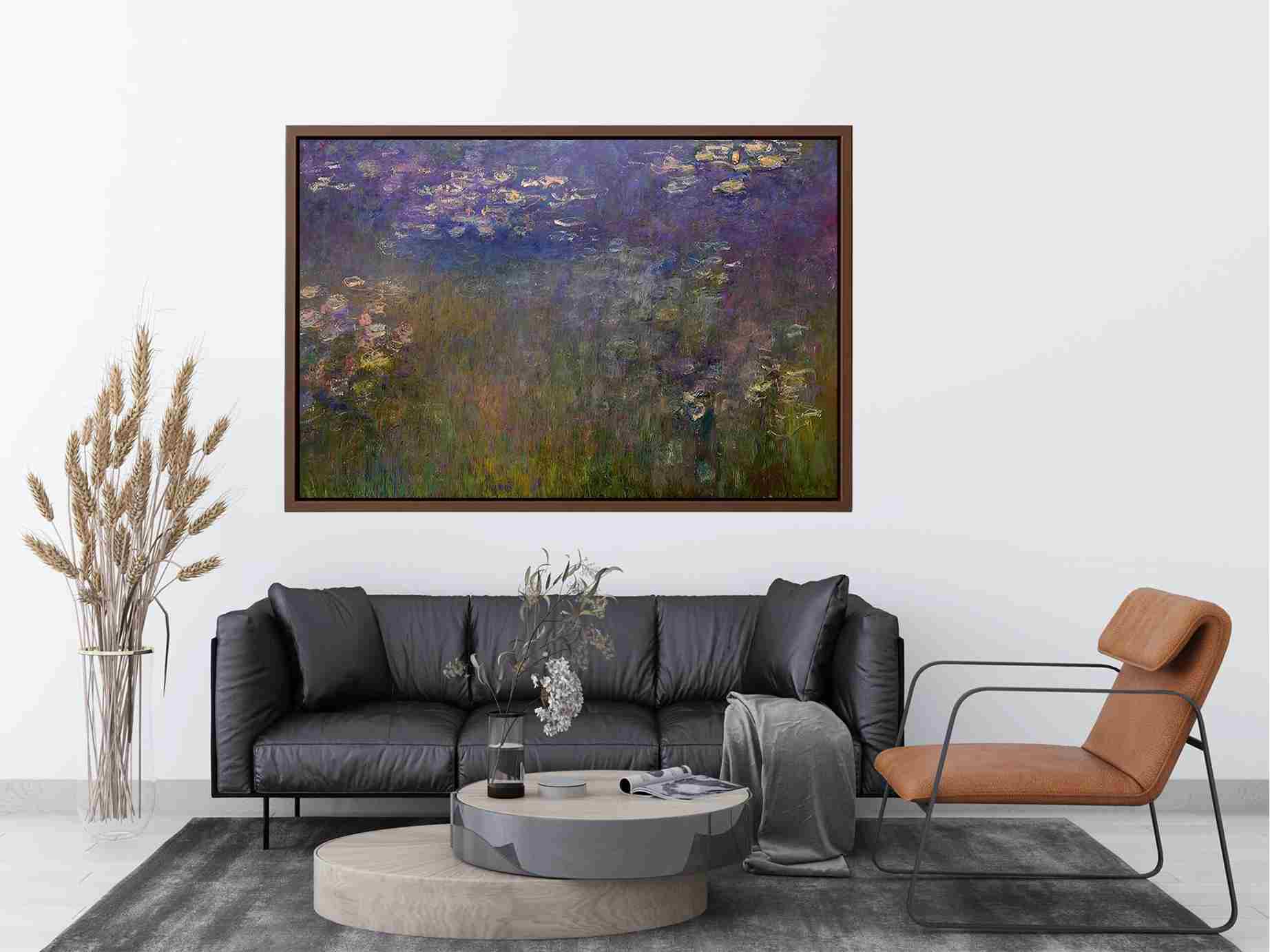
Agapanthus (Center Panel) stands among the most expansive and intellectually resolved expressions of Claude Monet’s late vision, a work in which painting becomes environment and perception becomes duration. Created in the final years of Monet’s life for the great decorative cycle conceived for the Orangerie, the panel belongs to a moment when representation no longer functioned as depiction but as immersion. Here, the subject is not a garden scene observed from a distance, nor a botanical study of flowering plants, but a sustained field of sensation in which colour, rhythm, and scale envelop the viewer. The agapanthus flowers—tall, radiant, and rhythmic—serve as conduits through which Monet translates time, movement, and attention into a continuous visual presence.
By the late 1910s, Monet’s practice had undergone a profound transformation. Having devoted decades to serial observation of haystacks, cathedrals, poplars, and water lilies, he arrived at a conception of painting freed from fixed viewpoint and narrative closure. The Orangerie panels were conceived not as isolated canvases but as an architectural ensemble, intended to surround the viewer and dissolve the boundary between art and space. Agapanthus (Center Panel) occupies a crucial role within this vision, anchoring the ensemble with vertical energy and chromatic lift while maintaining the fluid continuity that defines Monet’s late work.
The composition is organised through rising floral forms that punctuate the pictorial field with measured insistence. Unlike earlier works that rely on horizon or path to orient the eye, this panel establishes order through repetition and rhythm. The agapanthus stems ascend and disperse, their spherical blossoms hovering within a matrix of colour. There is no foreground in the conventional sense, no background to recede toward. Space unfolds laterally and vertically at once, encouraging the viewer’s gaze to circulate rather than advance. Orientation gives way to presence.
Perspective, as traditionally understood, has been fully relinquished. Monet does not construct depth through diminution or linear recession. Instead, he creates spatial sensation through chromatic layering and variation of density. Areas of colour thicken and thin, advance and withdraw, without resolving into fixed planes. The eye navigates the painting by following relationships—between cool and warm tones, between clustered marks and open passages—rather than by locating objects within a measured field. Space is felt, not mapped.
Light in Agapanthus (Center Panel) is not directional; it is ambient and all-pervasive. There are no cast shadows, no source to identify. Light is absorbed into colour and released through it, allowing luminosity to emerge from within the painted surface. Monet’s late palette transforms illumination into a state rather than an event. The painting glows without brightness, radiates without glare. Light is inseparable from colour, and colour becomes the primary bearer of form.
Colour governs every structural decision. Blues, violets, greens, and softened whites interweave across the surface, modulated with extraordinary subtlety. The agapanthus blossoms introduce pale, luminous accents that rise gently from the surrounding field, their cool tones resonating with deeper hues beneath. Monet avoids sharp contrast, preferring gradation and echo. Colour here does not delineate edges; it establishes atmosphere. The painting reads as a continuous chromatic environment rather than a scene composed of discrete elements.
Monet’s brushwork is liberated and expansive. Individual strokes remain visible, yet they no longer correspond directly to specific forms. Marks accumulate, overlap, and disperse, recording not a momentary glance but prolonged engagement. The surface bears the evidence of revision and return, of looking again and again. This temporal depth is essential to the painting’s effect. The agapanthus are not rendered once; they are sustained through time, held in view through repeated acts of attention.
Symbolically, Agapanthus (Center Panel) resists interpretation. The flowers do not function as emblems, nor does the composition propose allegory. Monet had moved beyond symbolism toward an understanding of painting as experiential field. Meaning arises through immersion—through the viewer’s bodily and perceptual response to colour, scale, and continuity. The work does not ask to be decoded; it asks to be entered.
Emotionally, the painting conveys expansion and steadiness. There is no dramatic climax, no focal incident. Instead, the panel offers a sustained, enveloping calm that is neither passive nor static. Viewers often experience a sense of suspension, as though time has been slowed and spread across the surface. The vertical rhythm of the agapanthus introduces quiet uplift, counterbalancing the horizontal flow characteristic of Monet’s water lily panels. The result is equilibrium without stasis.
Within Monet’s artistic evolution, Agapanthus (Center Panel) represents the culmination of his lifelong inquiry into perception. Here, the concerns that animated his early Impressionist works—light, colour, immediacy—are no longer tied to external motifs or fleeting moments. They have been internalised and expanded into a total environment. The painting anticipates later developments in modern art, particularly abstraction and installation, while remaining rooted in observation. It is modern not because it abandons nature, but because it redefines how nature can be experienced through art.
Culturally, the panel occupies a foundational place in the history of twentieth-century painting. Its scale, immersive intent, and emphasis on surface would resonate deeply with later artists seeking to move beyond representation toward experiential art. Yet Monet’s achievement remains singular. Unlike later abstraction, Agapanthus (Center Panel) retains a profound connection to the natural world, translated through sustained attention rather than descriptive detail. It bridges the nineteenth and twentieth centuries not by compromise, but by transformation.
In contemporary interiors, Agapanthus (Center Panel) integrates with exceptional authority and refinement. In large living rooms and open-plan spaces, it functions as an architectural presence, shaping atmosphere rather than decorating walls. In galleries and luxury residences, it communicates cultural depth and intellectual seriousness, inviting prolonged engagement. In offices and contemplative environments, it fosters focus and composure through its steady rhythm and immersive colour. Across interiors in the United States, United Kingdom, Canada, Australia, and Europe, the painting complements modern, minimalist, and refined eclectic décor, softening architectural lines while elevating spatial experience.
The enduring relevance of Agapanthus (Center Panel) lies in its affirmation that art can be a condition rather than an object. Monet demonstrates that when observation is sustained beyond depiction, painting becomes space, colour becomes duration, and viewing becomes inhabitation. The panel endures not because it presents a recognisable scene, but because it offers an experience—one that unfolds slowly, rewards attention, and continues to resonate long after the act of looking has begun. In this work, Monet does not ask us to see flowers; he invites us to dwell within seeing itself.
Buy museum qulaity 400- 450 canvas prints, framed prints, and 100% oil paintings of Agapanthus (Center Panel) by Claude Monet at Alpha Art Gallery, where world-famous masterpieces are recreated with museum-quality detail, refined craftsmanship, and premium materials.
FAQS
What does Agapanthus (Center Panel) by Claude Monet depict?
It depicts agapanthus flowers rendered as an immersive field of colour and rhythm rather than a traditional garden scene.
Why is this painting considered part of Monet’s late work?
It belongs to his final decorative cycle, when he focused on large-scale, immersive compositions.
Is the painting meant to be viewed as a standalone work?
It can be appreciated independently, but it was conceived as part of a larger ensemble intended to surround the viewer.
How does Monet create space without traditional perspective?
Through chromatic layering, density variation, and rhythmic repetition rather than linear recession.
What role does colour play in this panel?
Colour functions as the primary structural and expressive element, creating atmosphere and continuity.
Are the agapanthus flowers symbolic?
No, they serve as visual and rhythmic anchors rather than symbols.
Is Agapanthus (Center Panel) suitable for contemporary interiors?
Yes, its scale and immersive quality make it especially effective in modern and architectural spaces.
Why does Agapanthus (Center Panel) remain relevant today?
Its emphasis on immersion, duration, and perceptual experience aligns closely with contemporary approaches to art and space.