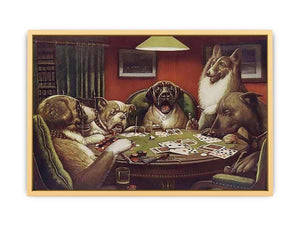
A Waterloo Painting by Cassius Marcellus Coolidge
A Waterloo Painting by Cassius Marcellus Coolidge is a masterful synthesis of humor, social observation, and compositional intelligence, revealing an artist far more deliberate and psychologically astute than his popular reputation often suggests. While Coolidge is best known for his iconic canine poker scenes, this painting demonstrates his broader command of narrative structure and his keen understanding of human—and anthropomorphic—behavior. Beneath its accessible wit lies a carefully constructed meditation on pride, reversal, and the universal experience of defeat rendered with clarity and restraint.
Cassius Marcellus Coolidge occupied a singular position in American visual culture at the turn of the twentieth century. Working outside elite academic circles, he nonetheless developed a visual language instantly legible to a wide audience, grounded in storytelling, gesture, and psychological recognition. Coolidge’s achievement lies not in painterly experimentation, but in narrative economy. In A Waterloo, he demonstrates how a single moment, precisely chosen, can encapsulate an entire dramatic arc.
The title itself is revealing. “A Waterloo” invokes the historical metaphor of total and irreversible defeat, yet Coolidge deploys it within a domestic, almost theatrical context. The scene does not depict armies or battlefields, but a concentrated moment of personal collapse. This transposition of epic language into everyday experience is central to the painting’s effectiveness. Coolidge suggests that defeat, humiliation, and reckoning are not reserved for history’s grand figures; they unfold daily in social spaces governed by pride, competition, and chance.
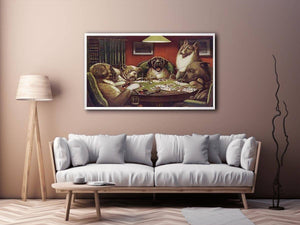
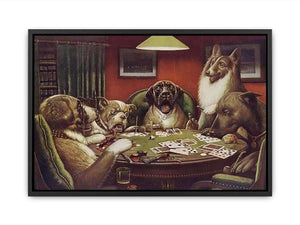
Compositionally, the painting is constructed around a clear narrative pivot. The central figure—the loser—becomes the axis upon which the entire scene turns. Body language communicates the story immediately: posture slumps, gesture betrays disbelief or resignation, and the surrounding figures respond with varying degrees of satisfaction, indifference, or restrained triumph. Coolidge’s arrangement ensures that the viewer understands the outcome before grasping the details, a hallmark of effective narrative painting.
Perspective places the viewer close enough to read expression and gesture, yet outside the emotional stakes of the event. This distance is crucial. The viewer is invited to observe, recognize, and perhaps empathize, but not to intervene. Coolidge constructs the scene like a stage set, where the drama is self-contained and complete. The painting thus operates as both observation and reflection, allowing the viewer to identify familiar social dynamics without becoming entangled in them.
Light is handled with functional clarity. Illumination reveals faces, hands, and the central point of loss without theatrical exaggeration. Coolidge avoids dramatic chiaroscuro, choosing instead an even, readable light that supports legibility. This choice reinforces the painting’s narrative purpose. The scene is meant to be understood, not mystified. Light functions as a spotlight of recognition rather than a tool of emotional manipulation.
Color is restrained and subordinate to storytelling. Coolidge employs a practical palette that distinguishes figures and objects clearly while maintaining unity across the scene. There is no indulgence in decorative color for its own sake. Instead, color supports hierarchy and focus, guiding the eye toward the emotional core of the painting. This restraint underscores Coolidge’s seriousness as a storyteller, even within humorous subject matter.
Gesture is the painting’s primary expressive language. Coolidge demonstrates acute sensitivity to the ways bodies communicate emotion without words. A raised eyebrow, a turned shoulder, a clenched hand—all contribute to the narrative. These gestures are exaggerated just enough to be legible, but not so much as to collapse into caricature. The balance between clarity and believability is central to the painting’s enduring appeal.
Emotionally, A Waterloo operates on dual registers. On one level, it invites amusement. The situation is recognizably ironic, the reversal complete and unavoidable. Yet beneath the humor lies a quieter recognition of vulnerability. Coolidge does not mock cruelty; he observes consequence. The defeated figure is not ridiculed through distortion, but presented with a degree of dignity that tempers laughter with empathy. This emotional balance elevates the painting beyond mere joke.
Symbolically, the painting functions as a commentary on chance, pride, and social performance. Games—whether literal or metaphorical—are arenas where identity is tested and status negotiated. Coolidge captures the moment when illusion collapses and reality asserts itself. The “Waterloo” is not merely loss, but exposure. The painting suggests that defeat is often public, witnessed, and quietly instructive.
Within Coolidge’s broader body of work, A Waterloo reinforces his consistent interest in moments of reversal. Like his better-known scenes, it centers on the precise instant when control slips away. Yet here, Coolidge demonstrates that his insight extends beyond novelty. The painting is tightly composed, psychologically coherent, and narratively complete. It reveals an artist deeply attuned to the mechanics of storytelling and the rhythms of social life.
Culturally, the painting reflects a distinctly American sensibility at the turn of the century—one fascinated by competition, self-making, and the ever-present possibility of failure. Coolidge’s work resonated because it mirrored everyday experience without pretension. A Waterloo captures this ethos succinctly, transforming a private reckoning into a shared visual language of recognition.
In contemporary interiors across the United States, the United Kingdom, Canada, Australia, and Europe, A Waterloo functions with remarkable adaptability. In living rooms, it introduces wit and narrative depth. In studies and offices, it reflects an understanding of human dynamics and humility. In galleries and luxury residences, it signals confidence in displaying art that is intellectually aware, culturally grounded, and unafraid of humor.
The painting integrates naturally into eclectic interiors, where narrative art and character-driven imagery are valued. It also works effectively in traditional settings, where its structured composition aligns with classical storytelling. Even in modern environments, it offers contrast and warmth, reminding viewers that modernity does not preclude narrative intelligence.
The long-term artistic importance of A Waterloo lies in its demonstration that popular art can be precise, thoughtful, and enduring. Coolidge proves that accessibility and depth are not opposites, and that humor, when handled with discipline, can reveal truths as effectively as solemnity.
Today, A Waterloo remains compelling because it captures a universal human moment—the instant when certainty collapses and outcome becomes undeniable. Through compositional clarity, psychological insight, and narrative restraint, Cassius Marcellus Coolidge created a painting that continues to resonate across time and culture. It stands not merely as entertainment, but as a quietly astute observation of pride, chance, and the inescapable drama of loss.
Buy museum qulaity 400- 450 canvas prints, framed prints, and 100% oil paintings of A Waterloo by Cassius Marcellus Coolidge at Alpha Art Gallery, where world-famous masterpieces are recreated with museum-quality detail, refined craftsmanship, and premium materials.
FAQS
What is the subject of A Waterloo by Cassius Marcellus Coolidge?
It depicts a moment of decisive defeat rendered through a socially charged, narrative-driven scene.
Why is the title “A Waterloo” significant?
It uses a historic metaphor for total defeat to frame a personal and social moment of irreversible loss.
Is this painting humorous or serious?
It balances humor with psychological insight, inviting amusement while acknowledging vulnerability.
How does Coolidge convey the story without text?
Through posture, gesture, composition, and spatial relationships that make the outcome immediately legible.
Does this painting relate to Coolidge’s famous dog works?
Yes, it shares his focus on narrative reversal and social behavior, though it stands independently in theme and execution.
Where does this artwork work best in interior spaces?
It is well suited to living rooms, studies, offices, galleries, and eclectic or refined residential interiors.
Does A Waterloo have lasting artistic value?
Its narrative clarity, cultural insight, and balanced humor ensure enduring relevance.