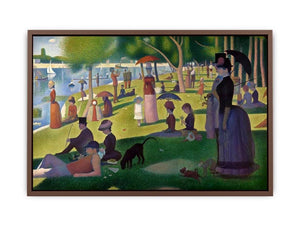
A Sunday Afternoon on the Island of La Grande Jatte Painting by Georges Seurat
A Sunday Afternoon on the Island of La Grande Jatte stands as one of the most intellectually revolutionary paintings of the nineteenth century, a work in which Georges Seurat transformed modern leisure into a rigorously constructed vision of order, perception, and social structure. Painted between 1884 and 1886, the work does not simply depict a Parisian park scene; it redefines what painting could be by uniting scientific theory, classical discipline, and modern subject matter into a single, uncompromising statement. Seurat does not invite the viewer into a spontaneous moment of pleasure. Instead, he presents leisure itself as something measured, structured, and quietly enigmatic.
Georges Seurat emerged at a time when Impressionism had already challenged academic tradition through immediacy, visible brushwork, and fleeting sensation. Seurat admired these painters but found their methods insufficiently disciplined. He sought a more permanent, rational foundation for modern art, one grounded in optical science and compositional logic. A Sunday Afternoon on the Island of La Grande Jatte is the result of this ambition. It marks the birth of Neo-Impressionism and introduces pointillism not as stylistic novelty, but as a system for organising vision.
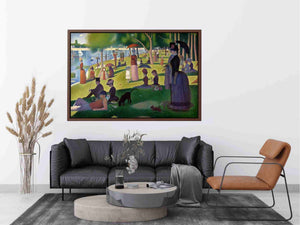
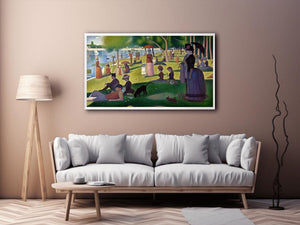
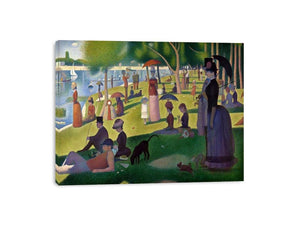
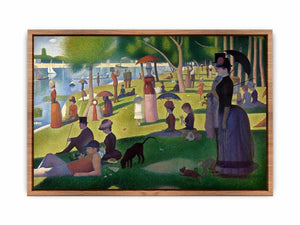
The subject is deceptively simple: Parisians of various classes enjoying leisure on the banks of the Seine at La Grande Jatte, a popular island retreat. Yet Seurat transforms this everyday scene into something monumental. The figures are arranged with deliberate spacing and frontal clarity, recalling the friezes of classical antiquity. Movement is restrained, gestures minimal, expressions neutral. The scene appears suspended in time, as though the act of leisure has been frozen into permanence. This stillness is not accidental; it is conceptual.
Compositionally, the painting is governed by strict order. Vertical figures align rhythmically across the canvas, counterbalanced by horizontal bands of grass, river, and sky. Trees function as architectural elements, anchoring space and dividing zones. Seurat constructs the scene almost mathematically, ensuring balance and symmetry without overt rigidity. Every figure is positioned in relation to the whole, subordinated to an overarching structure that resists spontaneity. The result is a composition that feels calm yet uncanny, familiar yet strangely detached.
Perspective is shallow and controlled. Seurat avoids dramatic recession into depth, keeping figures close to the picture plane. This compression reinforces the painting’s sense of formality and containment. Space is not something to be entered emotionally; it is something to be observed intellectually. The viewer remains outside the scene, aware of its construction rather than absorbed into its atmosphere. This distancing effect is central to the painting’s modernity.
Colour is the painting’s most radical element. Seurat employs pointillism—placing tiny, discrete dots of pure colour side by side—allowing the viewer’s eye to blend them optically. This method rejects traditional mixing on the palette, asserting that colour harmony should occur within perception itself. Greens vibrate against blues, oranges against purples, creating luminosity through contrast rather than blending. The surface shimmers subtly, yet the overall effect remains controlled rather than expressive. Colour becomes system rather than sensation.
Light in A Sunday Afternoon on the Island of La Grande Jatte is even and analytical. There is no dramatic shift in illumination, no moment of emphasis or shadow that signals narrative focus. Light serves clarity and uniformity, reinforcing the painting’s timeless quality. Figures cast shadows, yet these shadows are as calculated as the figures themselves, reinforcing structure rather than atmosphere. Seurat’s light does not fluctuate; it stabilises.
Seurat’s technique is painstaking and methodical. The application of countless individual dots required extraordinary patience and control. This labour-intensive process stands in deliberate contrast to Impressionist spontaneity. The surface, when viewed closely, dissolves into abstraction; when viewed from a distance, it resolves into clarity. This duality reflects Seurat’s belief that modern art should operate simultaneously on sensory and intellectual levels. The painting demands time—both in its making and in its viewing.
Symbolically, A Sunday Afternoon on the Island of La Grande Jatte functions as a study of modern social order. The figures represent a cross-section of Parisian society, yet they do not interact meaningfully. Each appears self-contained, isolated within proximity. Leisure, rather than liberating individuals, seems to standardise them. Seurat presents modern life as structured, regulated, and subtly alienating. The painting does not criticise overtly; it observes with clinical precision.
Emotionally, the work is deliberately restrained. There is no laughter, no visible conversation, no warmth of exchange. The mood is calm, but also static. Viewers often sense a quiet tension beneath the surface—a feeling that pleasure has been formalised into routine. This emotional ambiguity distinguishes the painting from celebratory depictions of leisure. Seurat does not depict joy; he depicts order.
Within Seurat’s artistic development, this painting represents both a pinnacle and a beginning. It established his reputation as a radical innovator and defined Neo-Impressionism as a movement rooted in theory and discipline. Tragically, Seurat’s life was short, but this work alone secured his place as one of the most consequential artists of modernity. It bridged classical composition and modern science, influencing generations of artists who sought structure beyond emotion.
Culturally, A Sunday Afternoon on the Island of La Grande Jatte holds enduring significance as an image of modern urban life under observation. It reflects the late nineteenth century’s fascination with progress, order, and scientific rationality, while subtly exposing their limitations. The painting has become a cornerstone of modern art history because it articulates a shift in how reality is understood—not as spontaneous experience, but as something organised, measured, and perceived through systems.
In contemporary interiors, A Sunday Afternoon on the Island of La Grande Jatte integrates with exceptional authority and intellectual presence. In living rooms, it functions as a commanding focal work that invites sustained engagement. In studies and offices, it communicates cultural literacy, analytical depth, and modern sensibility. In galleries and luxury residences across the United States, United Kingdom, Canada, Australia, and Europe, the painting complements modern, minimalist, and eclectic interiors alike. Its balanced composition and luminous surface allow it to command space without visual excess, making it both visually striking and conceptually anchoring.
The enduring relevance of A Sunday Afternoon on the Island of La Grande Jatte lies in its clarity of vision. Seurat does not romanticise modern life, nor does he reject it. He examines it. The painting endures because it recognises a condition that remains deeply familiar: the organisation of human life into patterns that promise harmony while limiting spontaneity. In this work, Georges Seurat offers not a moment of leisure, but a structure of seeing—one that continues to shape how art, society, and perception intersect in the modern world.
Buy museum qulaity 400- 450 canvas prints, framed prints, and 100% oil paintings of A Sunday Afternoon on the Island of La Grande Jatte by Georges Seurat at Alpha Art Gallery, where world-famous masterpieces are recreated with museum-quality detail, refined craftsmanship, and premium materials.
FAQS
What does A Sunday Afternoon on the Island of La Grande Jatte by Georges Seurat depict?
It depicts Parisians spending leisure time along the Seine, arranged in a highly structured and formal composition.
Why is this painting considered revolutionary?
Because Seurat introduced pointillism and applied scientific colour theory to create a new visual system.
What is pointillism?
It is a technique using small dots of pure colour that blend optically in the viewer’s eye.
Why do the figures appear rigid and still?
Seurat intentionally reduced movement to emphasise structure, order, and social formality.
Is the painting celebrating leisure?
It observes leisure rather than celebrates it, presenting it as organised and emotionally restrained.
What artistic movement does this work belong to?
It is the foundational work of Neo-Impressionism.
Is A Sunday Afternoon on the Island of La Grande Jatte suitable for contemporary interiors?
Yes, its balanced composition and intellectual depth suit modern and minimalist spaces.
Why does this painting remain relevant today?
Its exploration of modern life, perception, and social structure continues to resonate in contemporary society.